
Our oceans and seas are awash with queerness. I’ve always been interested in the sea, from my early childhood playing at the beach to running a charter sailing business.
Nowadays I’m more interested in what goes on beneath the waves. Specifically, how ocean inhabitants have valuable lessons for LGBTQIA+ people like me dealing with those who tell us that queer identities ‘aren’t natural’ and defy ‘common sense’.
Even a cursory dive into the world beneath the waves reveals a wealth of natural gender and sexual variance, including everyone’s Disney Pixar favourite Nemo.
As the largest male Clownfish in their anemone and therefore the mate of the only female resident, in reality Nemo's dad would have actually reacted to the disappearance of his partner by taking over her role as matriarch of the group. She would in fact have become Nemo’s second mum.
This ability of Clownfish is probably the best known example of sequential hermaphroditism, a scientific term that means simply that they can change sex over time. In Clownfish this is triggered by a specific set of social cues and serves to increase the group’s chance of survival.
Clownfish are not the only examples of fish that do this. The Kobudai, otherwise known as the Asian Sheepshead Wrasse, performs a similar trick, albeit the other way around. Starting life as female, they will change to being male when they reach a certain size.
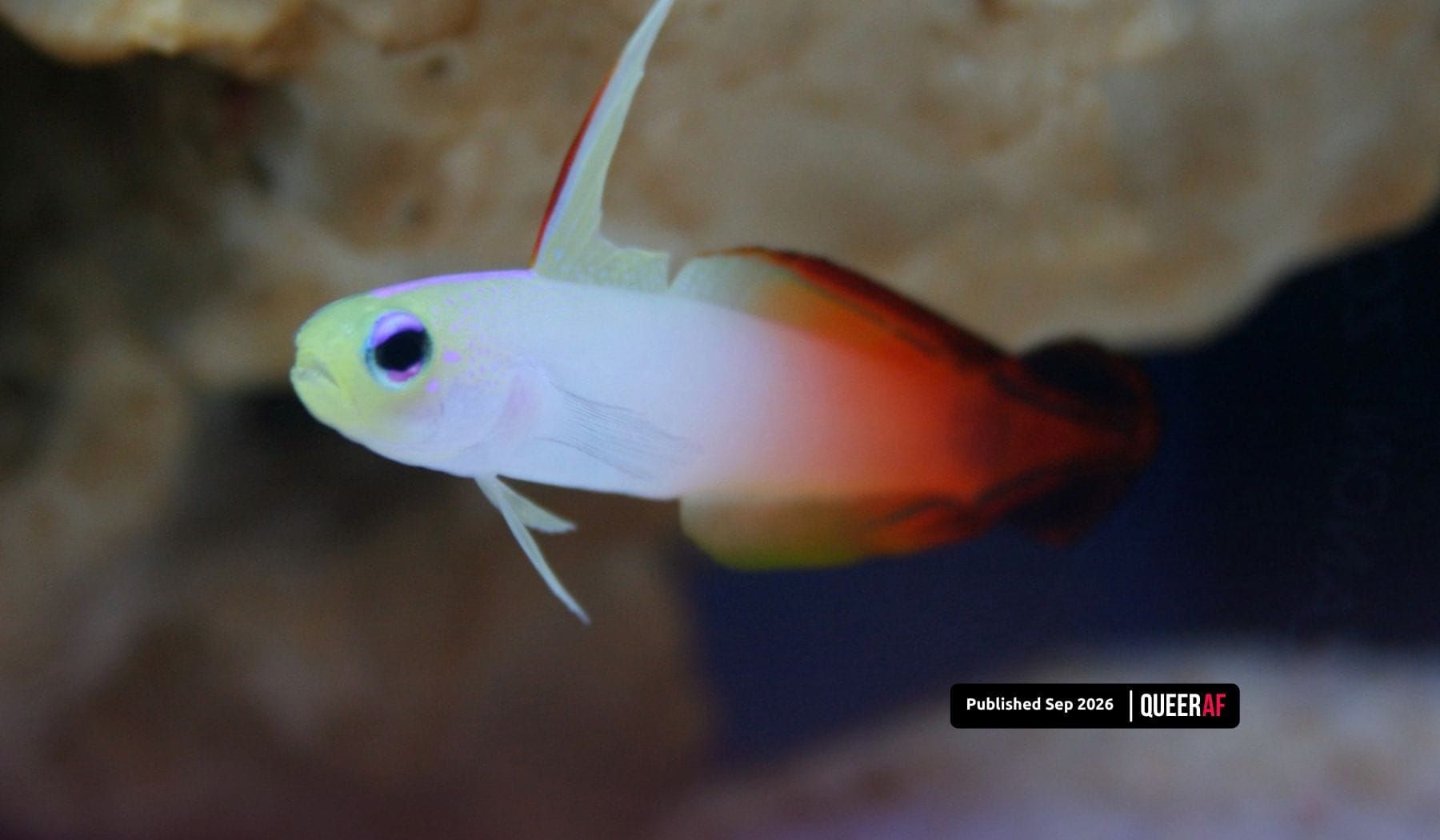
Both Clownfish and Wrasse perform this feat only once in their lives, but this is not a uniform rule for hermaphrodite fish. Certain species of Gobies can switch back and forth depending upon prevailing circumstances, and the Mangrove Killifish is fully hermaphrodite, possessing the ability to self-fertilise throughout their entire lives.
This is not even a rarity beneath the surface of our seas. Over 500 species of fish display some kind of hermaphroditism – a 2009 study estimated that as being around 2% of all fish.
The main reason that we see this so often in fish species seems to come down to natural diversity. Fish have been around for more than 500 million years, leading to estimations of anywhere between 25,000 and 35,000 described living species. Mammals like us, on the other hand, have only been on Earth for 200 million years, with less than 6000 species identified so far.
Queerness of all kinds is not even limited to aquatic life. The oldest known land-based living creature, a tortoise called Jonathan, has for the last 30 years had a male partner. Same sex relationships have been observed in creatures as diverse as lions, giraffes, dolphins and 1.2% of described bird species.
The plant kingdom too exhibits queerness aplenty. Oak trees are amongst the 10% of all seed plant species that are monoecious, possessing both male and female cones or flowers, and the Schizophyllum Commune Fungi have over 23,000 mating type specificities or sexes.
These widespread phenomena show that gender fluidity and queerness are powerful tools in nature’s arsenal. In an unpredictable world, this flexibility can mean the difference between extinction and survival. Fluidity and adaptability are strengths, not weaknesses.
Science indicates that what is natural and common sense is actually to embrace difference and see value in queerness. There’s a learning here for us all: when it comes to survival, diversity is demonstrably the best policy.
Get the Queer Gaze in your inbox each week with our free weekly newsletter or pitch to write an edition for us now.
We deserve good news too.
When there is so much hate out there, it's easy to get swept up in the doom.
QueerAF doesn't do that. We sprinkle in the joy that is the lifeblood of why being LGBTQIA+ is so simply wonderful.
And in the newsletter where this was first published, there was actually a bunch of positive news to celebrate. It shows me that despite the headlines knocking us down, we're getting right back up again and using our anger to fuel our fight.
While the rest of the media cashes in on hate about us, we can focus on queer joy - because you drive us. The community. QueerAF readers - not advertisers.
Our members directly fund our content. When you sign up, you get to have your say on how your funds are used. On what content we should commission.
But we turn down advertising and sponsorships in this newsletter so we can focus on delivering on content for you, not just clicks. That's why we need you to sign up to become a QueerAF member.
You'll join hundreds of awesome queer as f**k members who ensure we can keep our unique approach to queer content happen. If you want to see the media cover more stories about the joy in our lives - please, consider a membership. We can't run our outlet without you.