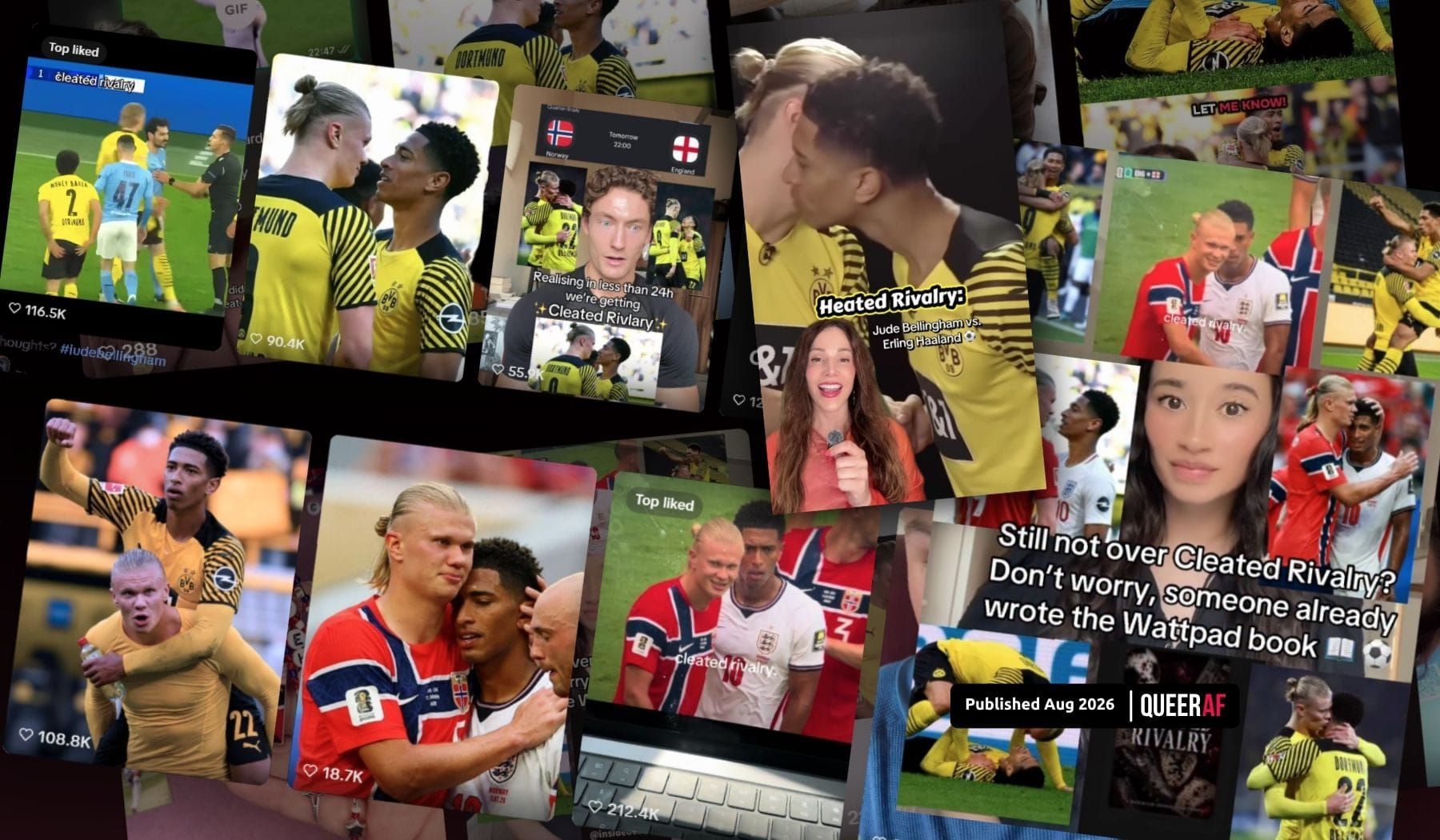


At the peak of the World Cup, my TikTok feed was full of edits tagged #CleatedRivalry, imagining a fictional romantic relationship between England’s Jude Bellingham and Norway’s Erling Haaland. Online, one of the world’s straightest cultural arenas transformed into a queer romantic drama.
The edits have now mostly faded from my feed. But they’ve left me with questions.
The imagined pairing between Bellingham and Haaland was dubbed "Cleated Rivalry", a play on Heated Rivalry, Rachel Reid’s popular gay hockey novel and TV drama.
While Heated Rivalry did attract LGBTQIA+ fans, women made up a significant part of the audience. The show sits in the broader genre of "Boys' Love", which is centred on male-male romance and is mostly created and consumed by women.
As scholar James Welker notes, Boys’ Love’s appeal to women comes from its ability to offer a space to explore romance and desire outside the constraints of traditional patriarchy. It is no surprise, then, that fans brought this fantasy into the ultra-masculine spectacle of the MAGA World Cup.
However, it gets more complicated when fans start creating these stories with real people. Heartstopper actor Kit Connor was forced to come out as bisexual after relentless media and fan speculation about his sexuality. It seems few believe that Bellingham or Haaland are actually gay. But the internet is picking up on actions that don’t fit its stereotypical image of the footballer. Affection between footballers can seem so unusual within the macho culture of elite football that it becomes evidence of queerness, rather than of a friendship existing outside conservative views of how ‘men’ should behave.
No openly gay player has ever played in the men's World Cup. This isn’t because gay professional footballers don’t exist, but because the elite culture of football is hostile to visible queerness. Jake Daniels, one of the few openly gay professional players, noted that football is still viewed as a "masculine sport" where being gay can often be seen as being "weak."
An uncomfortable contradiction lies at the heart of Cleated Rivalry. By turning Bellingham and Haaland’s closeness into a queer fantasy, fans are challenging the idea that footballers have to project a particular kind of masculinity. But if we read affection or vulnerability as “gay”, are we really challenging those expectations? Bellingham himself has spoken about the pressure he previously felt to project a “macho athlete image.”
By labelling certain behaviours as “gay”, do we risk making footballers less comfortable stepping outside that macho image? And for players who may still be in the closet, could constant speculation leave them fearing that the “wrong move” might lead to them being outed?
I’m still uncomfortable with the idea that Bellingham and Haaland’s closeness was read as queer. But maybe that discomfort is what makes Cleated Rivalry so revealing. The internet turned two footballers’ friendship into a queer story in a sport that gives us so few other places to find one. Maybe the bigger problem is that football has made queerness so unusual that fans had to invent it themselves.
Get the Queer Gaze in your inbox each week with our free weekly newsletter or pitch to write an edition for us now.
We deserve good news too.
When there is so much hate out there, it's easy to get swept up in the doom.
QueerAF doesn't do that. We sprinkle in the joy that is the lifeblood of why being LGBTQIA+ is so simply wonderful.
And in the newsletter where this was first published, there was actually a bunch of positive news to celebrate. It shows me that despite the headlines knocking us down, we're getting right back up again and using our anger to fuel our fight.
While the rest of the media cashes in on hate about us, we can focus on queer joy - because you drive us. The community. QueerAF readers - not advertisers.
Our members directly fund our content. When you sign up, you get to have your say on how your funds are used. On what content we should commission.
But we turn down advertising and sponsorships in this newsletter so we can focus on delivering on content for you, not just clicks. That's why we need you to sign up to become a QueerAF member.
You'll join hundreds of awesome queer as f**k members who ensure we can keep our unique approach to queer content happen. If you want to see the media cover more stories about the joy in our lives - please, consider a membership. We can't run our outlet without you.