
Section 28, the set of laws prohibiting local authorities from “promoting homosexuality”, was one of the most harmful iterations of legalised homophobia in British political history.
Its repeal was a hugely significant event that took years of fighting, yet few newspapers reported on it. When the laws were abolished in 2003, fifteen years after Margaret Thatcher introduced them (twelve for Scotland), it was neither celebrated nor denounced by the press.
After years of announcing its fervent support for the legislation, the hypocrisy of the mainstream media was striking. Even more infuriating, perhaps, was the lack of recognition for the activist groups that made the end of Section 28 possible – particularly two networks, Stonewall and Outrage!.
In my research on the subject, I encountered many examples of our culture’s cruelty toward queer people: exclusion, censorship, moral panics – all the same tactics used against Trans+ people by our current media and political institutions.
The events that led to the repeal of Section 28 offer a critical lesson for the LGBTQIA+ community today, threatened by a new set of laws designed to prevent the dissemination of ‘gender ideology’ in schools. The possibility of history repeating itself stresses the importance of such retrospection, of learning about how activists have already fought similar kinds of discrimination.
Stonewall and Outrage! did not always agree with each other, but without their mobilisation, it is likely we would still be living under the same homophobic laws.
Before Section 28 was established in 1988, there were already political, social and moral divisions within the queer community between lobbyists and protestors – those who advocated for the inclusion of gay people within a respectable society, and those who used confrontational forms of protest to challenge, and eventually transform, our social and political institutions. An extremely sanitised and whitewashed version looked at the tensions between these changemaking approaches in the plot of the 2015 film, Stonewall. Section 28 emphasised that distinction. It also highlighted how difference – perhaps even tension – can be an urgent part of political struggle.
How two very different groups tussled to change history
Stonewall was formed in 1989 and had fourteen founders, including Michael Cashman, Ian McKellen and Simon Fanshawe. Its opposition to Section 28 was based on the framework of equality, ensuring that this agenda was always part of the discourse among politicians and subsequently the British population.
Fanshawe described how part of the organisation’s mission was to build “a mainstream campaign”; while Cashman stated his role within Stonewall consisted of “arguing with politicians … on radio shows and in the media for justice”. Critics argued the organisation was assimilationist, claiming the ordinary gay person couldn’t feel “reflected in its campaign”.
Despite this criticism, its founders stood firm on the idea that working with the government, not against it, was the most effective way to realise the end of anti-LGBTQIA+ laws.
The organisation started meeting with Members of Parliament to influence their policies. They were viewed as polite, sensible, and conservative enough to gain their attention. As McKellen recalled: “[Politicians] saw Stonewall, who turned up in meetings in ties and jackets and had all been to university, [and thought] – ‘[that’s] our sort of person’”.
Disillusioned by the reemergence of respectability politics within LGBTQIA+ activism, others were considering alternative methodologies in which emotion, particularly rage, could be utilised as political tools.
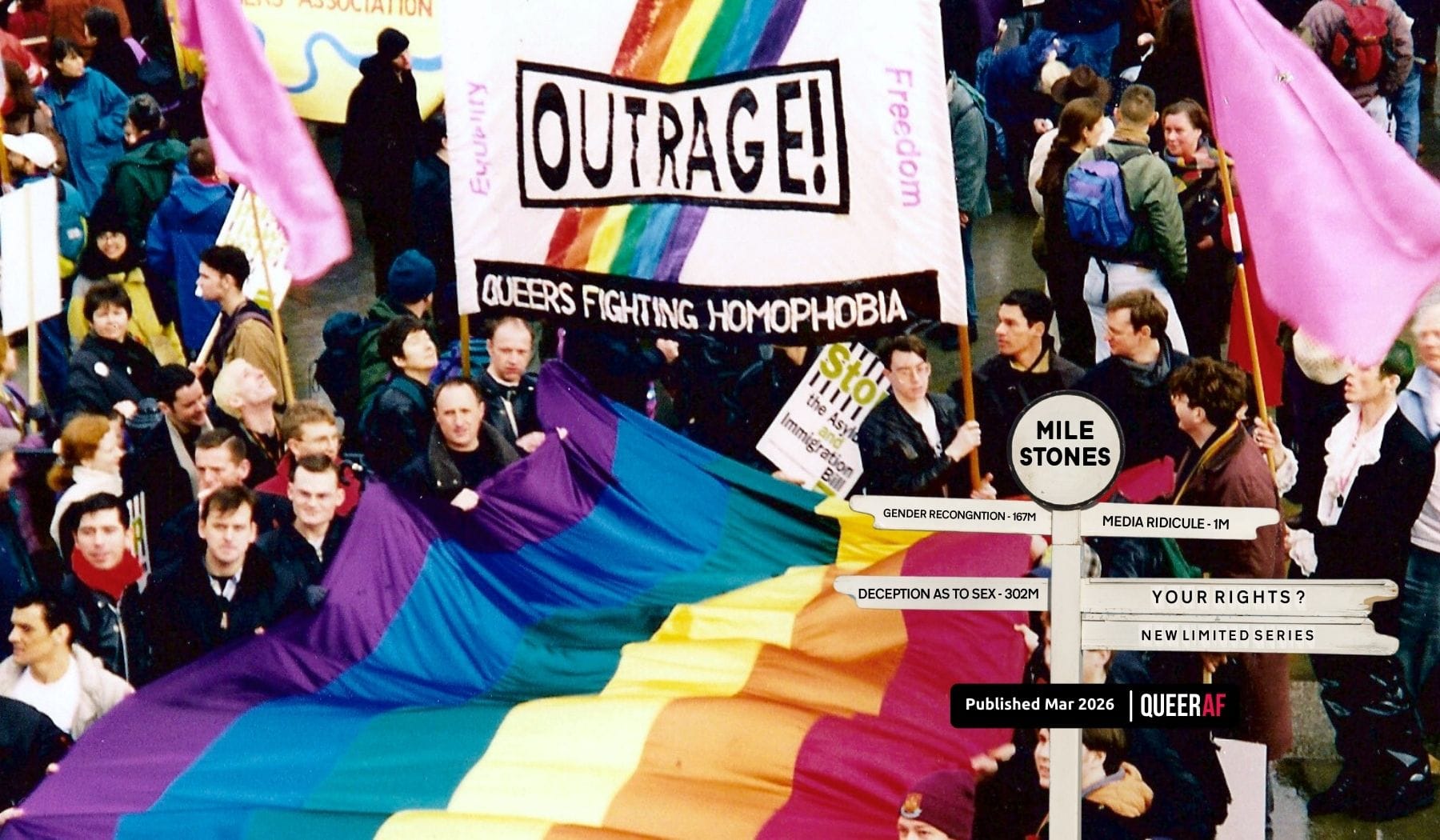
In April 1990, a 48-year-old gay man called Michael Boothe was beaten to death. This event kick-started a new group into action: Outrage! The network identified as a “group of queers committed to radical, non-violent direct action and civil disobedience”.
Their actions were frequently criticised by the media, and their campaign was immediately placed in moral contrast to Stonewall. As McKellen described it later, “[Stonewall] would tend to play things safe, not be radical enough in word or deed like Peter Tatchell”.

Outrage! was organised as a non-hierarchical structure, unlike Stonewall. Still, Tatchell was often described by the press as the network’s leader, often as a result of his confrontational activism and outspokenness in the press.
In 1997, he outlined the Group’s transformative ethos: “Equal rights within a straight-dominated society inevitably means equality on heterosexual terms … [We] articulate a post-equality agenda”. For many of the network’s members, opposing Section 28 was only part of the story: they wanted to challenge, provoke, and dismantle the culture that had produced the law in the first place.
The network’s protests were examples of a particular genre of politics: protest as performance. They drew on traditions of camp and satire in guerrilla art to stage their dissent. This included kiss-ins in public spaces like Piccadilly Circus and interrupting public lectures by religious figures with heckling and signs that read ‘Stop crucifying queers’.
To directly target Section 28, Outrage! developed a subgroup, which went under the acronym SISSY (Sex Information for School Students and Youth). SISSY demonstrated outside of schools, handing out leaflets containing messages along the lines of “Don’t knock it till you’ve tried it!”
But the most controversial faction within Outrage! was perhaps FROCS (Faggots Rooting Out Closet Sexuality), the group that engaged in outing – the act of exposing public figures who were secretly gay but publicly homophobic. The aim was to draw attention to the hypocrisy of straight society. In 1994, the group named ten Church of England bishops, urging them to “Tell the Truth”.
Members of Outrage! including Tatchell organised a demonstration outside the cathedral in which a closeted man, Michael Turnball, was enthroned; they wielded placards stating ‘He Had Gay Sex But He Won't Allow Gay Clergy’ and ‘From Glory Hole to Glory Be’. The effect of this disclosure was striking: one of the named bishops stepped down, another came out, and other bishops expressed an interest in being in dialogue with the gay community.
Still, the action was shocking to many gay and lesbian people, including even some members of Outrage!, who argued that forceful disclosure only appeased the homophobic demands of straight society. In a 1995 article published by The Independent, Andrew Brown wrote that the “more sober” Stonewall distrusted outing as “immoral in the short term and imprudent in the long term”, citing a radio debate in which Tatchell argued against a representative of Stonewall, as well as a conservative journalist who wanted more gay people’s sexualities to be a matter of public record.
Did their work undermine each other - or was it part of a perfect mix?
It’s not possible to credit either organisation as the sole reason why Section 28 was repealed – a change of this scale occurs as a result of complex, multifaceted social forces.
In June 2000, the 99 Scottish MPs voted to repeal (17 were against and 2 abstained). Scotland now appeared as a more modern parliament, and prompted New Labour – a government whose keywords included ‘renewal’ and ‘reform’ – to revisit the set of laws.
Because Stonewall’s lobbyist approach appealed to Labour’s progressive centrism, they were able to introduce the idea of including gay equality within the government’s aspiration for modernisation. Labour were willing to place trust in an organisation that understood the careful balance between promoting social liberalism and keeping the establishment onside.
Even after Section 28 was defeated, Cashman continued to work with Tony Blair on the Civil Partnership Act, since the repeal of the laws marked a degree of trust between the government and Stonewall as an organisation.
Outrage!, on the other hand, was essential for galvanising public discomfort with Section 28, and this was crucial because Section 28 was not solely a legal issue. The laws were a form of social – as well as political – violence. Historians such as Matt Cook have argued that the clause was “virtually unworkable”, as there were no prosecutions under it for teachers in schools. Rather, the legislation was powerful because it “cultivated an atmosphere of fear and shame”.
Without Outrage!, it is difficult to imagine how different the cultural landscape might be for young queer people in Britain, particularly those who do not fit the suit-and-tie-wearing impression of a non-threatening gay individual that Stonewall appealed to.
Outrage!’s focus on the structural roots of prejudice within and outside of the state helped raise the public’s awareness of how homophobia is entrenched in society, extending beyond and beneath its overt expression in law.
As such, it is perhaps no surprise that Stonewall, considering its history of favouring the respectable queer individual, finds itself today in a fraught and polarised position on Trans+ rights.
Transgender people are rarely privileged enough to be respectable (meaning middle-class, educated, and cis-passing). In recent years, there has been a welcome rise in new advocacy groups across the UK that use lobbying as an approach, including TransActual and Trans Solidarity Alliance.
My mother – god bless her – is a campaigner for the advocacy group TransLucent and member of the women’s collective NION. I have accompanied her during meetings with MPs, experiencing firsthand the social currency of my passability and well-spokenness.
It is in moments such as these, when I find myself trading my appearance for greater social acceptance, that I feel torn about the legacy of Stonewall. But I remain clear in my admiration of radical networks such as Trans Kids Deserve Better, whose refusal of respectability lies at the heart of their audacious demonstrations.
Still, I cannot help but feel fortunate to at least have a seat at the table: I just hope that one day, when the opposition is defeated, we will all be recognised for the different parts we played in our shared struggle.
Understand how we got here, so you can fight back
Milestones is a limited six-part newsletter that will unpack, explore and deliver you a critical understanding of how Trans+ rights in the UK have been shaped.
From the creation of NHS gender identity clinics, to the pivotal court cases that set precedents for rights that exist - but are under attack today.
This article is just a preview of what's to come in the series.
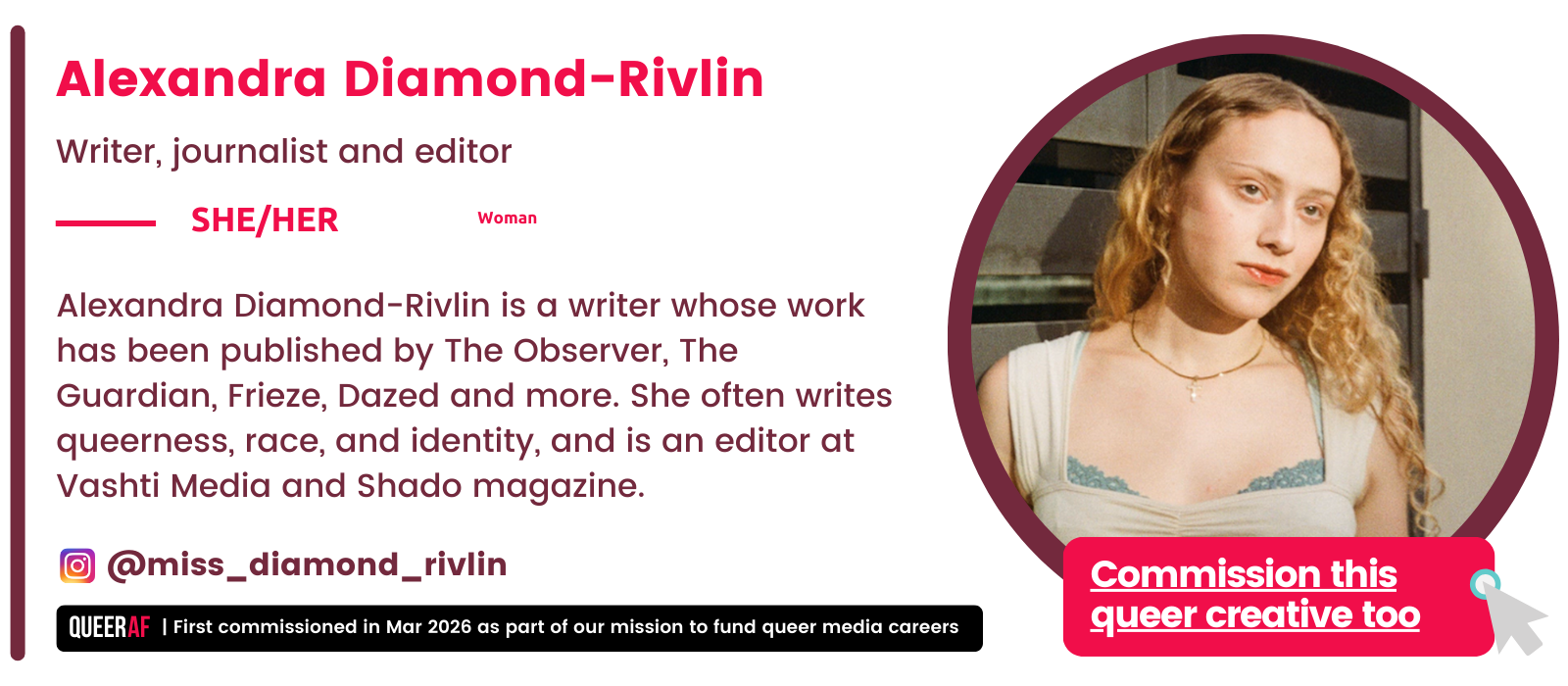
This special newsletter series has been written by some of the UK's most respected Trans+ journalists, Ludovic Parsons, Jess O'Thomson, Sasha Baker and Alexandra Diamond-Rivlin - with hours of research poured in.
Expect accessible, but comprehensive long reads on six themes:
- What court cases have shaped the rights of Trans+ people at work
- The history of the UK's Trans+ healthcare system
- How the media has shaped public understanding of Trans+ rights
- Legal gender recognition
- The way the criminal justice system is treating Trans+ people
- Different ways Trans+ communities have fought for rights