


CW: Sexual assault
Chiara Watkin, a 21-year-old trans woman, was convicted of sexual assault in 2025 and sentenced to 21 months in prison. Her case sparked outrage online, with many Trans+ people viewing it as the result of new guidance on ‘sexual assault by deception’ the Crown Prosecution Service (CPS) adopted last year.
The guidance, almost half of which is devoted to “deception as to sex”, ignited fears among Trans+ people that they may one day be forced to weigh up the immediate threat to their safety from revealing their gender history to a sexual partner with the risk of prosecution if they keep it hidden.
Watkin’s case has intensified this worry, and to many represents a new frontier of criminalising Trans+ people in UK legal systems, which are widely and increasingly mistrusted by the trans population. Polling from YouGov, commissioned by the Good Law Project, showed that the percentage of trans people who trust judges dropped from 46% in 2022 to just 31% now.
Watkin is not the first person – or the first transgender person – to be prosecuted for “deception as to sex”, one of a very limited set of deceptions that can legally constitute sexual assault or rape.
However, since the trend of bringing these prosecutions first emerged in 2012 – until last year – all the people convicted under this provision were assigned female at birth. Roughly half were trans men, though several of the others, despite presenting as cis queer women at the time of their trials, had diagnoses of gender dysphoria.
Watkin is the first trans woman to be convicted of this offence, and her case is the first successful conviction of this nature with a male complainant. She is also the first person to be prosecuted for sex or gender deception since the CPS published controversial updated guidance in 2024, though it is hard to say how much impact this had on the decision to prosecute her, especially as the events in question happened four years before her trial.
However, the length of her sentence – three years in prison – may speak to the shift in perceptions of the nature of the deception at play in these cases. When trans men have been prosecuted in the past for this form of deception, it was always for assault by penetration – using a prosthetic in place of a penis – and the fact that they were living as men at the time of the offences and at trial was a mitigation that usually led to them receiving little to no prison time.
The deception for which Watkin was convicted involved no penetration – and would therefore typically carry a lighter sentence. That she faces substantial prison time suggests her longstanding female identity and presentation did not mitigate her sentence. This could point to a move towards a more rigid “sex-based” construction of deception, where previously both sex and gender were seen to have some relevance.
The case may represent a new frontier of transphobia in the legal system, but many of the details that make Watkin’s conviction appear arbitrary and unfair are present in convictions dating back more than a decade.
How did deception as to sex guidelines get to this?
The trend began with the case of Justine McNally, who was convicted in 2012. It set a legal precedent that deceiving a sexual partner about your gender can be sexual assault.
At 13, McNally created an online profile for a boy named Scott and entered into an online relationship with a 12-year-old girl. After a years-long online relationship, McNally, then 17 – who lived in Scotland – travelled to meet the girl at her home in London, still claiming to be Scott.
Though the details are somewhat disputed, the two were physically intimate. Their in-person relationship continued for several months and ended when a family friend of the girl found a strap-on in McNally’s bag.
Though one of McNally’s exes had already informed the girl that Scott was a persona, the girl said she believed McNally was a cisgender boy, and was “literally sickened” to learn she’d been in a relationship with a woman.
She confided in her headteacher, who then contacted the police. McNally, for her part, told the girl she wished to transition to continue the relationship, though she still identified as a woman in 2016 – the last time she spoke publicly.
Having initially pleaded guilty to six counts of sexual assault, McNally appealed her case. Her sentence was reduced from three years in prison to a nine month suspended sentence, but the effect of the appeal was to establish in law the idea that deceiving a victim about your gender has the ability to vitiate – i.e. render invalid – consent during an otherwise consensual sexual encounter.
There is undeniably some instinctive logic to this – but questions about fairness quickly arise. The forms of deception that invalidate consent in Britain's legal systems are otherwise extremely narrow. “Steathing” – the act of deliberately removing a condom during sex – is one such example of this. Another is impersonating a real person known to the victim, such as their husband or wife.
However, lying about fertility does not make an otherwise consensual sexual encounter an assault. Not disclosing your HIV status doesn’t either – though recklessly or deliberately transmitting HIV can give rise to other charges.
Here, the law appears to acknowledge that prejudice against HIV-positive people – at least those on medication that makes the virus undetectable, and therefore untransmittable – is a factor. The law doesn’t force HIV-positive people to sacrifice their own privacy to have sex without the risk of prosecution.
Lies or omissions relating to sexuality or ethnicity are treated similarly. A straight cisgender woman who learns her boyfriend is bisexual and has slept with men is free to end the relationship, but the discovery of this information – however much it horrifies or disgusts her – does not render their previous sexual encounters nonconsensual.
The discovery that someone is transgender, however, apparently can have this effect. This comparison alone speaks to the way the legal system casts doubt on the reality of Trans+ people, treating them as less entitled to privacy than other marginalised groups that experience sexual stigma.

‘Spycops’ who used false identities have not been prosecuted
Notably, the CPS has declined to bring rape charges against any of the spycops who adopted false identities to infiltrate activist groups, sometimes initiating sexual relationships with often younger, usually female members. Some even fathered children with their targets. Many of the women undercover police officers tricked into sexual relationships regard the officers as rapists, but under UK law, lying about your job seemingly cannot invalidate consent, even in these extreme circumstances.
The standard for whether deception can vitiate consent is based on direct relevance to the sexual act – the basis under which the extensive and violating deception by the spycops is excluded.
But, as trans legal scholar Alex Sharpe points out, it is not clear that McNally should have been convicted under this test. Sharpe, who has studied sex deception cases extensively, says that the McNally ruling appears to hinge on the “common sense” idea that someone has the right to know the “true” gender of their sexual partners.
Sharpe argues that the court, by effectively creating this right, adopted a cissexist perspective – that it is reasonable to assume someone is cisgender unless told otherwise. In doing so, she says the court failed to take into account Trans+ and other queer people’s lived realities.
The appeals court judgment takes it as read that McNally was a cis girl pretending to be a boy. Sharpe argues a more expansive perspective is needed, not limited to whether someone is a man or a woman, but taking into account how gender exploration can be an authentic component of queer sexual expression.
The McNally case set a dangerous precedent that would see several more convictions in the following years – both of cis queer women (usually, like McNally, with complex gender histories) and of trans men.
Several features recur in these cases: questionable prosecution narratives accepted as fact; the complainant expressing disgust upon learning about the defendant’s gender history; a police report made by a relative or family friend; guilty pleas. The overall effect is to raise serious questions about Trans+ people’s access to a fair trial.
Sharpe notes that the prosecution narratives in many of the cases with cis female-presenting defendants require the judge and/or jury to believe implausible stories.
The same year as McNally’s appeal, Gemma Barker, 19 at the time of the offence, was prosecuted for creating several different male personas to date two of her female friends, then aged 15 and 16. Barker’s is the only conviction of this nature I have read about where there is no suggestion of a Trans+ identity.
However, as Sharpe notes, a successful conviction of sexual assault by deception should require proof that the defendant did not reasonably believe that the complainant knew her true identity. In this case, the prosecution asks us to believe that Barker carried on a friendship with the two girls as herself, while successfully disguising herself as three different men – two of whom dated the same girl at different times – and neither girl realised these four people were in fact all Barker.
As Sharpe notes, it strains credulity, and yet judges and juries have a tendency to buy into far-fetched prosecution narratives in these cases – possibly due to pervasive transphobic bias.
Where do trans men show up in the timeline?
With actual trans men convicted under the provision, the narratives tend to be less far-fetched, though the justification for prosecution related to deception is also weaker.
Chris Wilson, who had lived as a boy since childhood, was convicted of “obtaining sexual intimacy by fraud” in 2013, after he, aged 20–22, posed as a 17-year-old boy to initiate relationships with two girls, then 15 and 16.
The judge considered that Wilson was not pretending to be a man but was authentically living as one, and treated this as a mitigating factor, ordering probation and a community order instead of jail time.
However, why a trans man’s gender should be considered fraudulent at all is unclear. Headlines from the time illustrate a clear lack of literacy on the part of journalists covering the cases, who often failed to draw distinctions between the two: “Sex fraud woman put on probation,” reads the BBC’s, even though the article explains Wilson’s gender history.
As The Equality Network, a Scottish LGBT+ rights charity, pointed out at the time, the fact that Wilson initiated a relationship with an underage girl should have been the issue that was prosecuted, rather than his gender, which he did not lie about.
“The message it sends to trans people is you will be criminalised if you don’t share your gender history with sexual partners,” Tim Hopkins, then the group’s director, told the BBC.
In the succeeding decade, several cases appear to have proven Hopkins right.
In 2015 came the conviction of Kyran Lee – possibly the least justifiable conviction until Watkin’s. Lee, 25, began a relationship with a woman, Carol, 27, online, using a fake photo.
When they met in person, Carol realised Lee didn’t look like his picture, but forgave him. They dated for a few weeks, with Carol becoming impatient over Lee’s reluctance to sleep with her. When she threatened to leave him he agreed to sex, secretly using a prosthetic.
Carol – atypically for sex deception cases – reported him to the police herself after a colleague of Lee’s outed him to her. Lee was shocked to be charged with assault by penetration, according to a sympathetic feature written about him in Buzzfeed News.
He pleaded guilty and was handed a suspended sentence, earning headlines like “Fake penis assault woman given suspended jail term”.
As the 2010s wore on, tougher sentences started to be handed out, and the use of prosthetics in lieu of a penis became a greater focus of prosecutions, though the press at least stopped calling trans men women in headlines.
Carlos Delacruz was sentenced to three years prison time in 2018 after using a prosthetic penis with two unwitting female partners, though he was freed after just two months. This was another case in which the complainants went to the police themselves.
The fact that both endured pain during sex and thrush afterwards were aggravating factors in the case, as was the fact that one of the women blamed herself for being unable to become pregnant by Delacruz. All of these things, however upsetting, could result from sex with a real penis, which would have been highly unlikely to lead to prosecution.
As Sharpe notes, the courts consider convictions like these necessary to protect the complainants’ self-perception as heterosexual women. She argues that courts should acknowledge that sexuality is fluid and grant people – however they identify – the autonomy of acknowledging they may sometimes experience attraction not easily bound by the labels they use for themselves.
The only reason courts do not treat Trans+ people this way – she argues – is because there is an ingrained assumption that Trans+ people’s true nature is that of their sex assigned at birth. Cis people’s self-perception of their own heterosexuality is essentially protected in law.
Gayle Newland's case
Gayle Newland was controversially sentenced to eight years in prison in 2017, having been initially convicted of assault by penetration in 2015. The prosecution narrative said Newland tricked her best friend into a two-year relationship, posing as a man named Kye, while simultaneously continuing their friendship as Gayle. By the time of her second trial, Newland had a diagnosis of gender dysphoria, though she continued to live as a woman.
Newland’s case aroused a lot of sympathy, with many arguing she should not have been convicted, or that her sentence was unfair. Lengthy features were written about her in The Observer, asking big questions about identity in the digital age, and what justice means when the facts are so implausible on both sides. Her class background likely contributed to the more considered hearing she got in the press, and likely the fact that she got a retrial, but ultimately the jury bought the prosecution’s incredible story.
Not every person unfairly prosecuted under this law is so sympathetic. In 2022, Tarjit Singh, a trans man, was convicted of assault by deception, after using a prosthetic during sex with two women and a 16-year-old girl. He was also convicted of violently assaulting and threatening to kill one of the women.
All in all, he was sentenced to ten years in prison. His crimes, which involved almost setting one of his victims on fire and leaving her with a broken nose, are undoubtedly horrible, but it is inescapable that – despite acknowledging that Singh is a man – a considerable part of his sentence was for “tricking” the women into sexual relationships. Had a cis man been similarly violent to his partners, he would not have been imprisoned for nearly so long.
While I do not doubt that Singh’s victims were traumatised by his treatment of them, including the discovery that he had been using a prosthetic during sex and did not in fact have a penis, whether that should carry legal weight is far from clear.
Blade Silvano, who carried on a two-year relationship with a woman using the name Blade Mendez, received an even longer sentence of ten and a half years in 2023. The woman went to the police when she found a Facebook account, which revealed that Silvano had given her a fake surname and confirmed her suspicions that Silvano had also been faking cancer. The judge said Silvano did not have gender dysphoria, and all reporting uses she/her pronouns, but the fact that Silvano didn’t use a fake first name despite telling many other lies raises serious questions about this.
With the exception of Lee, all the trans men prosecuted appear to have harmed their victims beyond the fact of failing to reveal their gender history. But it is rendering that last part of their conduct a crime that enables cis people to lend legal weight to their transphobic beliefs, and wield the law as a tool to degender Trans+ people.
Pretending to have cancer or carelessly giving a sexual partner thrush makes you a bad partner – but when cis people do these things, they’re not treated as rape.
How did these cases impact the prosecution of Chiara Watkin?
This brings us to the case of Watkin, who never used a prosthetic and was clear about her gender identity, which matches her presentation. This raises serious questions about how broadly the CPS is interpreting “deception”.
Sharpe argues that Trans+ men often see a prosthetic penis as an extension of themselves, and therefore, it may be justifiable to avoid prosecution in these instances. Nonetheless, she acknowledges how the use of a prosthetic in place of a penis does represent a gap between the sex act consented to and the sex act that occurred.
In Watkin’s case, the CPS lacks even this justification, as there was no gap.
The case hinged on the idea of active deception. The key instance of this in the case is Watkin saying she was on her period. This was portrayed in court as a lie to get the complainant into bed, but the lie was to prevent the complainant from touching her below the waist
A cis teenage girl lying about being on her period to avoid a sex act she’s uncomfortable with would arouse sympathy. When a trans girl does the same, it’s treated as a serious crime.
Sharpe has previously criticised the CPS’s approach to lies told for the sake of sparing a trans person’s privacy, which have often been interpreted as deception intended to convince the victim into a sexual encounter. When a trans man puts a condom on a dildo, is that further evidence of deception? According to the CPS, yes it is.
The fact that Watkin is a trans woman brings to the fore several elements that were not present in previous cases: notably the very real threat to her had she revealed her gender history to the complainant, and the violence she is likely to suffer in a men’s prison.
Analysis: “Deception as to sex” has the same impact as a Trans+ Panic clause – and it ingrains transphobia into the law
Watkin’s case is not – as it may first appear – an aberration. It is part of a long history where Trans+ people’s right to privacy has been trampled on to flatter cis people’s self-perception.
The complainant’s assertion that he does not “swing that way” as he said in court, is one of the starkest examples of the legal system being wielded against a trans person to guard cis straight people’s sexualities.
There are other similarities with previous cases too: the complainant reported Watkin to the police after she texted him to inform him she was trans at her mother’s urging. But the boy – both he and Watkin were 17 at the time – had already been mocked by his friends who identified Watkin’s gender history upon meeting her.
The CPS guidance makes clear that a Trans+ person not disclosing their gender to a sexual partner will not always be a crime, but the limits of this are unclear.
An extreme case, where three boys and a girl were sentenced to significant prison time after beating and stabbing a trans girl, sparked backlash from the gender critical movement. Some gender critical activists said the girl, who had performed a sex act on one of the boys, should also be prosecuted for sexual assault. This was, mercifully, a bridge too far for the CPS.
All we can really conclude from the available data is that if someone stabs you, the CPS is unlikely to prosecute you for being trans – but if you lie about your gender history to a sexual partner, even to protect your privacy, you could be facing jail.
Watkin is appealing her conviction. If she wins, the judgment could throw up questions about the legality of the CPS guidance and their judgment in charging decisions.
But when it comes to the British legal system, it is hard for trans people to expect much in the way of justice.
“This narrative, that merely existing as a trans person is a form of deception, puts our community in immense danger,” Trans+ legal researcher Jess O’Thomson wrote for QueerAF. “It legitimises these kinds of attacks as a form of “revenge” for the wrongs wrought by trans people’s mere presence in public life.”
“This undergirds trans “panic” defences, where violence against us is legitimised by the violence we are perceived to cause by unwittingly inflicting our existence on others.”
 QueerAF
Understand how we got here, so you can fight back
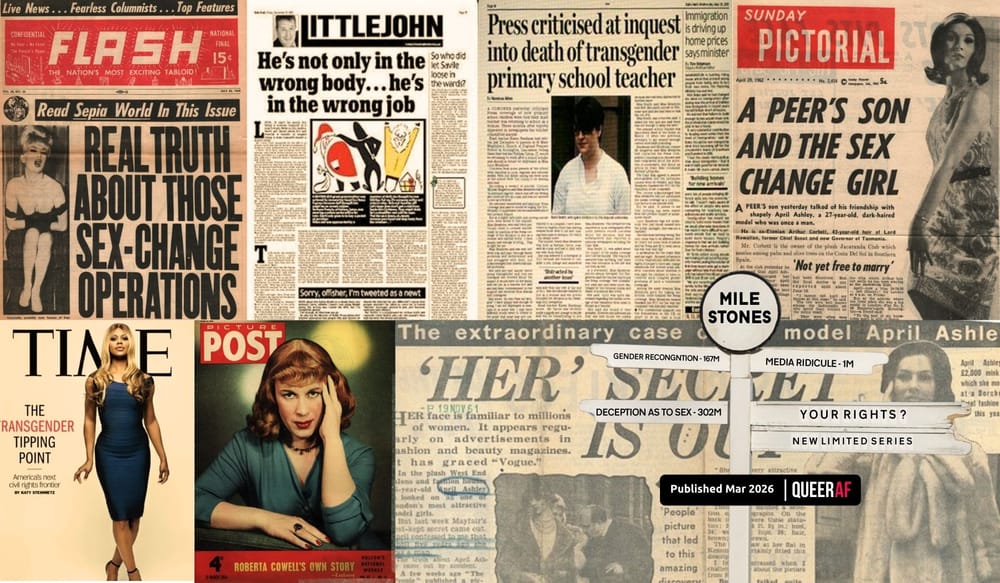
Milestones is a limited six-part newsletter that will unpack, explore and deliver you a critical understanding of how Trans+ rights in the UK have been shaped.
From the creation of NHS gender identity clinics, to the pivotal court cases that set precedents for rights that exist - but are under attack today.
This article is just a preview of what's to come in the series.
This special newsletter series has been written by some of the UK's most respected Trans+ journalists, Ludovic Parsons, Jess O'Thomson, Sasha Baker and Alexandra Diamond-Rivlin - with hours of research poured in.
Expect accessible, but comprehensive long reads on six themes:
- What court cases have shaped the rights of Trans+ people at work
- The history of the UK's Trans+ healthcare system
- How the media has shaped public understanding of Trans+ rights
- Legal gender recognition
- The way the criminal justice system is treating Trans+ people
- Different ways Trans+ communities have fought for rights