
TL;DR: Advice issued by the UK's equalities watchdog after the For Women Scotland ruling was lawful, the High Court has ruled, dismissing fears that forcing Trans+ employees to use gender-neutral or accessible bathrooms will out them by saying "being the subject of comment by others is a burden that anyone can expect to bear".
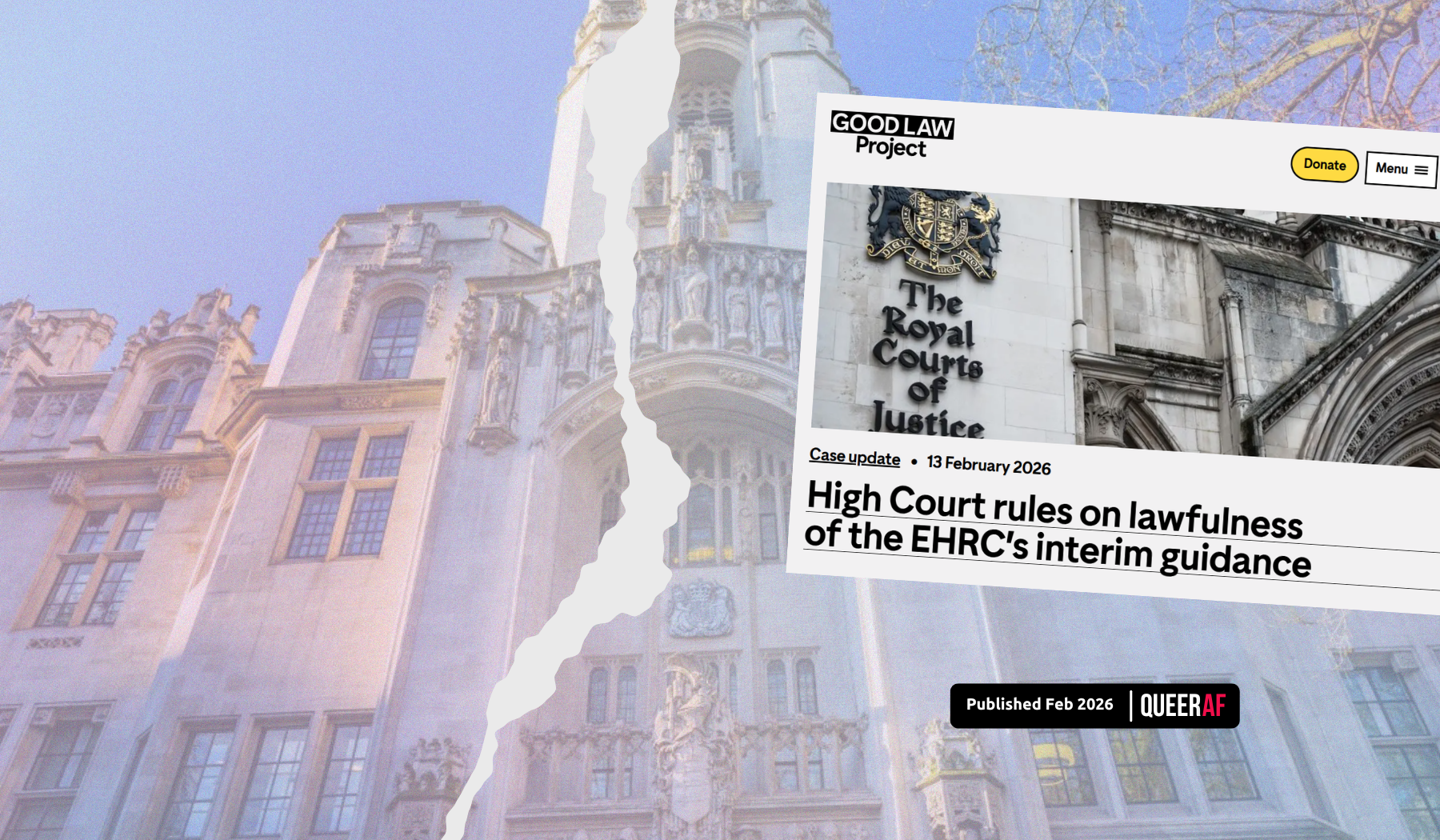
The Good Law Project (GLP) has lost its legal challenge against interim guidance from the equalities watchdog that amounted to a ban on Trans+ people using the toilets and changing rooms of their lived gender.
The interim guidance, published by the Equality and Human Rights Commission (EHRC) in April 2025 soon after the Supreme Court ruling in For Women Scotland, was withdrawn in October - QueerAF
The GLP challenged the interim guidance at the High Court in December, arguing it was legally flawed, that publishing it was unlawful, and that the guidance was incompatible with Trans+ people's human rights.
In a 32-page ruling, High Court judge Mr Jonathan Swift, a former government lawyer, rejected all three arguments. Refusing the GLP's judicial review, the judgment says that the organisation "does not have standing to bring the challenge" because it "is not personally or directly affected by the decision challenged".
The ruling said that the EHRC interim guidance does not force Trans+ people to use single-sex facilities in line with their birth sex, nor does it make it unlawful for service providers to provide trans-inclusive facilities like men's and women's changing rooms. However, many businesses have read the interim guidance as a blanket ban on trans inclusivity in single-sex spaces, bringing in new workplace policies to comply with the EHRC's advice.
It also said that allowing a Trans+ woman to use women's toilets does not discriminate against cis men, as some gender-critical campaigners have argued.
It creates a "workers' rights crisis" for the Trans+ community
However, because workplaces must comply with workplace regulations that don't cover public services, the situation is different for Trans+ people at work. Employers are required to provide single-sex toilets that are used by employees according to their birth sex, according to the EHRC interim guidance.
“The legal situation for trans people, employers and service providers is now completely incoherent," a Trans+ Solidarity Alliance spokesperson said. "We are pleased the court has confirmed that the Equality Act does not function as a bathroom ban, but outdated workplace regulations have failed to keep up with modern times and last year’s Supreme Court judgment has made them entirely unworkable."
They added: “This risks outing trans people at work, who may have been using gendered facilities without issue for years - and it is unclear how trans people without access to gender neutral facilities will be able to do their jobs. This is a worker's rights crisis for the trans community."
High Court suggests outing of Trans+ people is merely 'gossip at work'
Three anonymous claimants, two trans and one intersex, were granted their judicial review of the interim guidance. All three argued that their employers had followed the EHRC's interim guidance and asked them to use accessible or disabled toilets at work, with one claimant saying she was worried that if she did this, "other employees would think she was acting unusually and that would cause speculation about the reasons for her change of practice".
The ruling responded to these arguments, saying that it would be "rare" for it to amount to less favourable treatment in the eyes of the law for a Trans+ person to be asked to use the disabled toilets instead of the gendered toilets of their choice.
"A propensity for gossip is a feature of every workplace," the ruling says. "So far as concerns gossip at work, no employee can expect not to be the subject of gossip about something on some occasion… being the subject of comment by others is a burden that anyone can expect to bear from time to time, and ought not to be a foundation for legal redress."
The judge also suggested that while labelling some toilets "accessible" or "disabled" is "current common practice [...] it is not a practice that is invariable or need continue. There is no reason why, if only as a matter of sensible accommodation, the labelling could not change".
Jolyon Maugham, GLP director and founder, said this "wave away as ‘workplace gossip’ of evidence of what it means to be outed in an increasingly transphobic and violent society" is "deeply troubling".
"They remind me of how the pain of women was once dismissed as hysteria," Maugham said. "I urge the judiciary to listen harder to what trans people say about what their lives have become."
The ruling was welcomed by new EHRC chair Dr Mary-Ann Stephenson, who said: “It’s our job to champion everyone’s rights under the Equality Act, including those with the protected characteristics of sex, sexual orientation and gender reassignment. A shared and correct understanding of the law is essential to that endeavour." - EHRC
The GLP, which crowdfunded £487,874 to bring the legal challenge, will now have to pay EHRC's costs of around £300,000. QueerAF understands that the GLP plans to appeal the High Court's ruling.
Analysis: This makes the situation less clear
Whether taken alone or along with other recent legal judgments regarding Trans+ rights, the High Court's ruling does not exactly bring the clarity that it purports to be promoting.
The judgment leaves plenty of grey area, going into increasingly obscure law – which leaves room once again for "both sides" to claim a positive interpretation of the verdict. While the ruling, which is littered with double negatives, backs the right for gendered public spaces to be inclusive of Trans+ people, gender-critical groups can also claim that Trans+ people have no right to use single-sex spaces of their lived gender.
The ruling also reveals outdated judicial views about disabled people's right to accessible bathrooms at work and the implications of outing Trans+ people as being mere office gossip. Gossip itself is a strange thing to see considered in a judgment, considering it has no legal meaning – and in this case, seems to be being confused with harassment.

This week's news has really put into perspective for us how much a better resourced news team would help us, help you.
Ludovic Parsons, our lead investigative journalist, jumped into action yesterday - despite not planning to be working for us this week - in order to respond to one of the biggest news stories of the year.
Our coverage of one of the most significant judgements in Trans+ rights since the Supreme Court is much stronger for it.
It's always been our shtick to get those with lived experience to write on the subjects that only they can truly understand the nuances of. But that remains something that the rest of the media consistently fails on.
In the wake of last year’s Supreme Court ruling, we were the only publisher in the UK - including those in the gay media - to hire a Trans+ journalist to respond to the moment.
Jess O'Thomson, who went on to be part of the legal team involved in this week's judgement, turned around a piece in just six hours, that would go on to get thousands of views, win awards for the article, and become the go-to-source in the queer charity sector to understand the ruling.
That’s why we’re crowdfunding: to protect access to journalism that fights back. And even better, to increase how much we can do while investing in talent to build careers, so they can change the media.
But we can’t do this alone. Please support our crowdfunder now.