

Faith is a difficult thing for many Trans+ people. Many parts of religious practice are deeply gendered, and gender roles can be so deeply ingrained into what it means to be in that religious community. But this tension is something that Trans+ people have learnt to work with and through, and can even deepen a person’s connection to their faith.
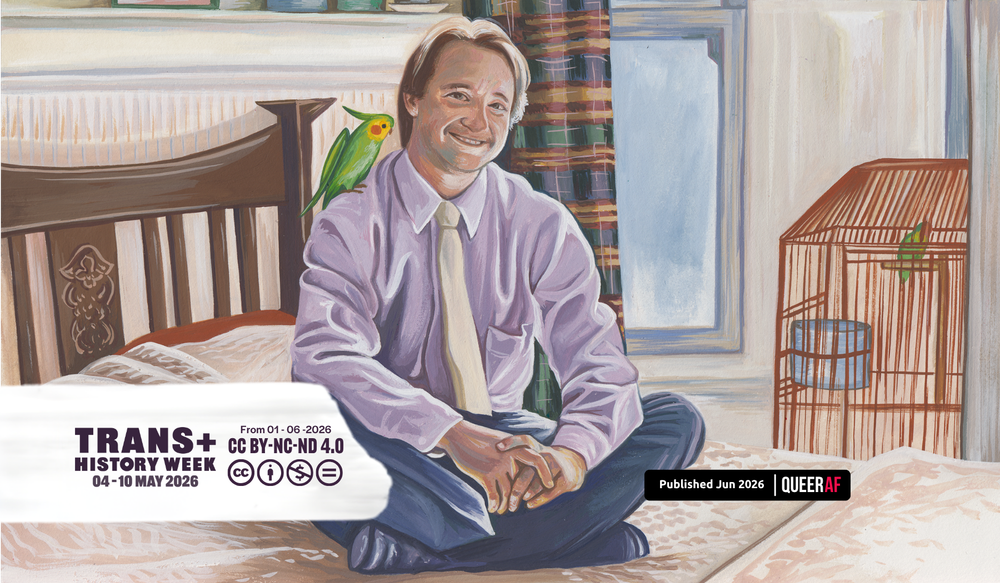
In 1999, Micah Bazant self-published TimTum: A Trans Jew Zine. Across 64 pages the zine explores Micah’s perspectives on the intersections of trans and Jewish identities. It is a deeply personal zine, talking about their own transition milestones, but it also has a historical flair, diving into the histories of gender-diverse Jews such as Claude Cahun.
TimTum isn’t the only Jewish trans zine. There are many others from the same era and other times, such as Miriam Saperstein’s My Body is a Prophet and Rena Yehuda Newman’s House of Jacob // People Israel.
Zines are a self-published medium, written for the author’s community, typically with limited circulation. They’ve long been popular in the queer community, and initiatives such as the Queer Zine Archive Project have allowed these independent publications to achieve wider reach. So much of Trans+ history is not written by us, and that’s why this zine is such an important part of our history.
TimTum is a Yiddish term, adapted from the Hebrew term tumtum. Whilst Micah uses it, in their own words, to mean a “sexy, smart, creative, productive Jewish genderqueer”, the term has a complicated history.
More recently, tumtum has been used as a pejorative for effeminate men, particularly in Yiddish – but it originated within scripture as a term for those whose sex is hidden.
The way tumtum are treated within Jewish scripture is varied, but there is never an obligation for them to reveal their ‘true’ sex. The in-betweenness of these individuals was dealt with and worked around for the purposes of ritual practice.
Micah’s zine is both unwaveringly Trans+ and Jewish – you can’t separate the two. It describes the tension that this causes in their own life. Recognising this tension is important, as it allows us to better understand our connected histories of oppression – as exemplified in the story of Toni Ebel and Charlotte Charlaque, the Jewish trans couple who had to flee the Nazis.
But, equally as importantly, Micah also talks about the joy that comes from holding both identities so close together.
In a section about getting top surgery, Micah says that they “love love love” their new chest:
“Now I catch myself in the mirror, or feel the pull of my t-shirt across my bare chest, and it finally looks and feels right. It’s an instant and unmediated Rightness. And now my gender is materialised in some ways.”
They continue by talking about how spiritual and ritualistic the process of surgery was, comparing it to other Jewish rituals such as mikveh, a ritual immersion into water, or wearing tefillin leather boxes with straps wrapped around the arms, often adorned during morning prayers.
This is something that has stuck with me, particularly through my own experience of getting top surgery last winter. Micah laments that something as “radical and deliberate” as the “reshaping” of one’s chest should be “intensely spiritual”, and yet the pre-surgery process is so “pathologised and depersonalised”.
Micah tells of conversations with a Rabbi about undergoing mikveh before surgery. Although they didn’t go through with it, it has been common for many trans Jews to perform mikveh as a way to mark various transition milestones. The organisation Mayyim Hayyim (translated as Living Waters) offers immersion ceremonies for those wanting to mark their transition, as well as ceremonies for those who have recently come out.
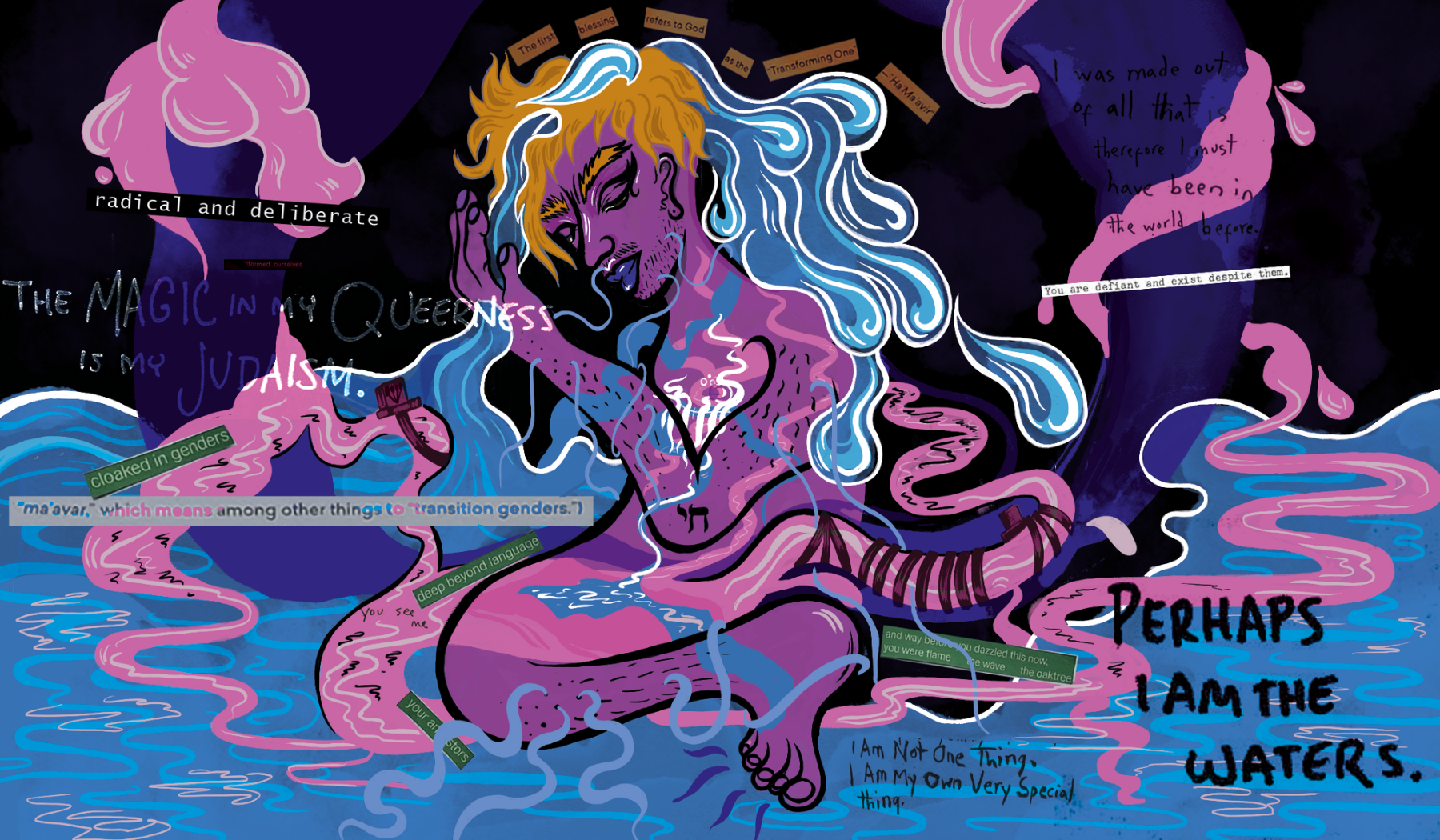
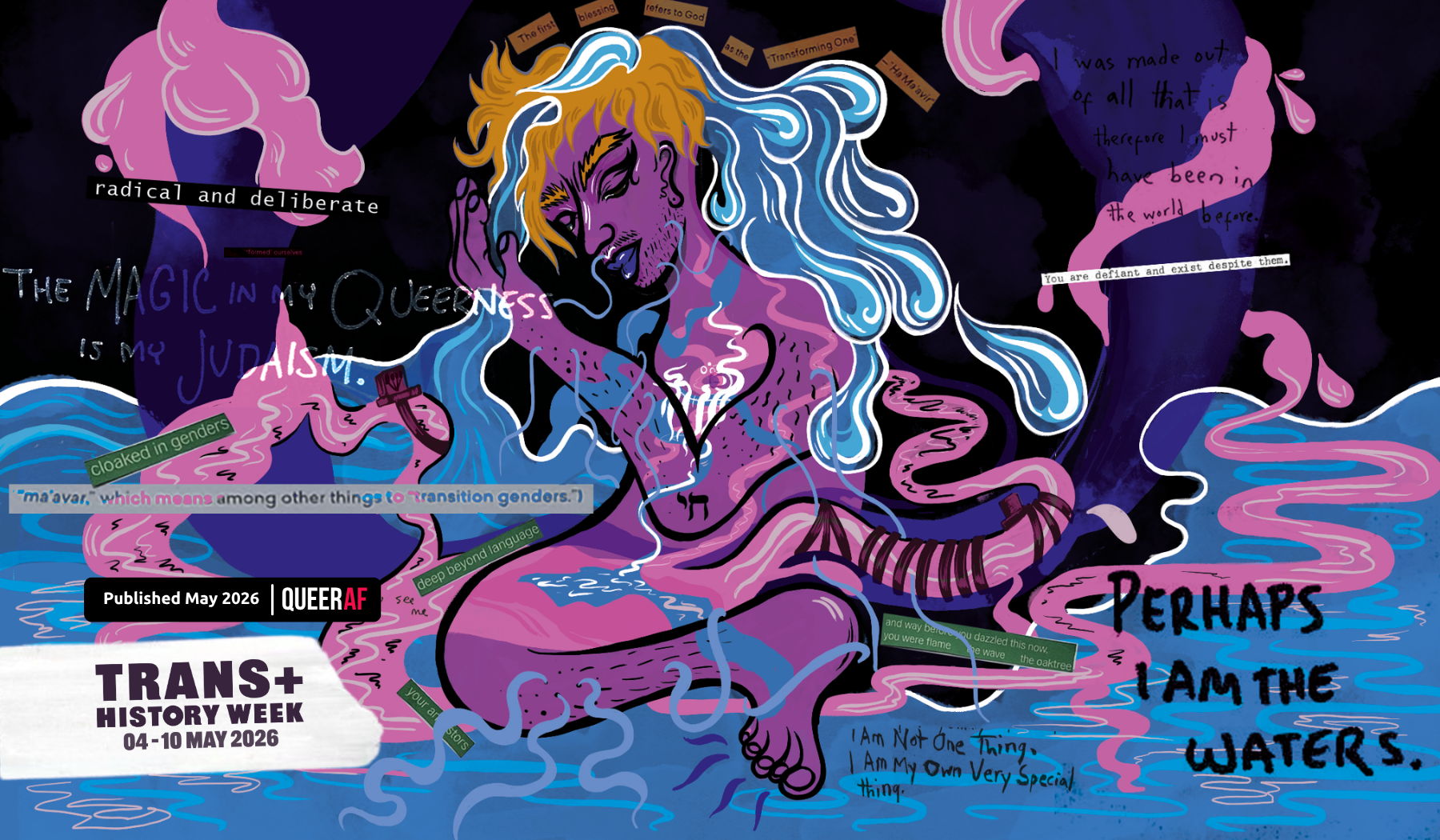
🎨 Artwork description, by Aaran Sian
This illustration draws on the many visual references, zines and writing which has inspired Jamie’s article, exploring the evolving rituals of Trans Jewish identity through the act of Mikveh. At its centre, the illustration shows a trans-masculine, gender-fluid body immersed in water, where the boundaries between body and ritual dissolve. The water flows through and becomes part of them, speaking to the fluidity of gender across lineage and the in-betweenness of Timtum identities. Inspired by inclusive practices of Mikveh, including those from Mayyim Hayyim, the piece explores Mikveh as a site of honouring and self-creation, where transition is sacred. Water emerges from the body, forming hair, shaping and becoming top surgery scars, and cascading across the chest. As a way to honour trans-masculine identity without reduction to a single visual marker. Layered throughout are fragments from zines and texts, including works by Miriam Saperstein, Rena Yehuda Newman, the TimTum zine, and Rabbi Elliot Rose Kukla, woven into the water. Within the figure, rivers, routes and landscapes reference the idea of Jewish people as ‘always transitioning’, honouring movement, diaspora and transformation together. The work reflects the power of rituals as a space of reclamation, connection and self-definition.
Rituals are to be found everywhere. They’re not only a part of someone’s spiritual or religious identity, but can be foundational to someone’s trans identity too. Many trans men record videos to commemorate certain milestones as the effects of T start to kick in – in my eyes, that’s a trans ritual practice.
Within the section on top surgery, Micah talks about not realising that Jewish practice had changed “constantly and radically over the millenia”. We often see ritual as steeped in an unchanging tradition, assuming that disrupting it could break something meant to remain unbroken. But this is not accurate to history.
Across the centuries, there are examples of Jewish ritual practice being changed, adapted, modified, and innovated, as seen in Nathan Macdonald’s work looking at innovation in the Hebrew Bible and early Judaism. Mayyim Hayyim’s work is a perfect example of this.
When we, as Trans+ people, change a ritual or push for a change to common practice, it can often feel as though we’re making an unnecessary disruption. If a practice has stood still for so many years, why change it now? Why make that disruption?
Not only do you make the disruption because it’s right, but you make it because disruption has always been part of the story. We haven’t been the first to push for change, and we won’t be the last.
What can we learn from this history?
It’s important to remember the power of creating your own practice. Part of what makes TimTum such a powerful testament to Trans+ Jewish identity is its focus on self-creation.
Putting this into action is especially important in a time of increasing censorship of queer content and knowledge. In January 2026, we saw a fantastic community response to this, with Berkeley students making hundreds of thousands of edits to Wikipedia in an effort to preserve queer history against Donald Trump.
Zines are self-published. They rely on the community they serve to get seen. In a world of hostile institutions – media, healthcare, education and others – they understand the power that can come from going down a different route, and creating the resources for your own community.
Trying to limit our knowledge isn’t a new tactic either. One of the most significant Nazi book burnings targeted Magnus Hirschfeld’s trans health clinic. TimTum reminds us that – in an era where erasure is increasingly persistent – it’s up to us to capture our lives, and ensure we’re saving our stories.
The UK has seen a tumultuous year for Trans+ rights. In fact, they're in a mess because of the Supreme Court ruling which has brought anything but clarity.
In our Milestones series, we examined how the media shapes what society thinks and feels about Trans+ lives. The history of TimTum, and the work we do here at QueerAF, is a reminder of how we can fight back even when they seek to censor us.
By creating, telling our stories, and ensuring our community has the information it needs to fight back.
The landscape ahead means a continued raft of new legal challenges, political fights, and propaganda that needs to be challenged.
We can only win this fight if we all get the information we need to cut through the noise. We need to use nuanced, detailed analysis as the base for our activism.
That's what QueerAF does best. That's why thousands of you read our main newsletter every week. That's why we need you to upgrade today.
Our small but mighty newsletter punches above our weight, but we need you to upgrade to become a paying member so we can accelerate the work we do - and get it in front of as many eyeballs as possible.
The UK is at a critical juncture, and we need your support - so we can help the LGBTQIA+ community navigate through it.
All we're asking for is the price of a coffee a month. If you value the work we do, please take action, and help us fight back against the hate.
We are Queer As Fuck. And so are you.
Thank you,
Jamie Wareham
Founder, QueerAF
Upgrade now, with our Always Been Here sale, to grab a sweet discount on our most popular membership - or check out all the options here.
15% off Monthly - £5.95 / 15% off Annual - £50.15
Sale ends Sunday, 10th May at midnight.