
Geocities: a cautionary tale of how Trans+ history can be deleted with one click
In 1993, David Bohnett's partner of several decades died of AIDS-related complications. Bohnett used the insurance payout to buy a $5,000 computer, hosted websites from his home, and founded GeoCities, a new digital frontier that became an online queer community.
Seeking to build a wider web of queer community where everyone could connect online the company gave anyone who wished to sign up their own small 2MB of space on the web. Users took that 2MB and created homemade websites with visitor counters, barely legible flashing text, ticking tape banners, annoying auto-playing audio files and lots and lots of Comic Sans. By 1998 Geocities was the third most visited site on the internet, with people all over the world stuffing Bohnett’s home servers with over 38 million pages.
Geocities democratised the technological tools that enabled everyone to make their own web pages. It was the precursor to MySpace, Tumblr and Facebook. It was a space where queer freedoms thrived. It was also, critically, a place where queer and Trans+ people built themselves online for the very first time.
However GeoCities didn't survive its own success. Yahoo! purchased it during the dotcom boom for $3.5 billion. By 2009, the homepage simply read: "GeoCities is closing."
“Are you sure you want to permanently delete these files?” The pop-up on the desktop screen presents a deceptively simple fork in the road. We make decisions like this every day. At the time they make a lot of sense – we need space on our harddrives, room for another podcast for the train, space to take some cute new pics. But when we click delete, what are we losing?
Tens of millions of pages, including vast archives of early queer and trans community life, are now long gone. What survives today is scattered across the Internet Archive, old USB drives at the back of desk drawers, and partially saved copies maintained by volunteers. The limited archive of what is left of the historic Geocities ruins are a romantic reminder of yesterday's web. And its story has a lesson to teach.
History repeated itself when Tumblr's 2018 ban on adult content, driven by payment processors, advertisers, and Apple's App Store policies, wiped out another generation of queer websites. These user guidelines changed hands several times, once in another Yahoo! acquisition, for $1 billion in 2013, and then again in 2017 when ‘Yahoo! was in turn acquired by the even bigger behemoth, telecoms company Verizon.
Fan communities, trans coming-out archives, and a decade of LGBTQIA+ creative culture disappeared almost overnight. The same pattern repeated itself: a platform, an acquisition, a policy change, and then silence.
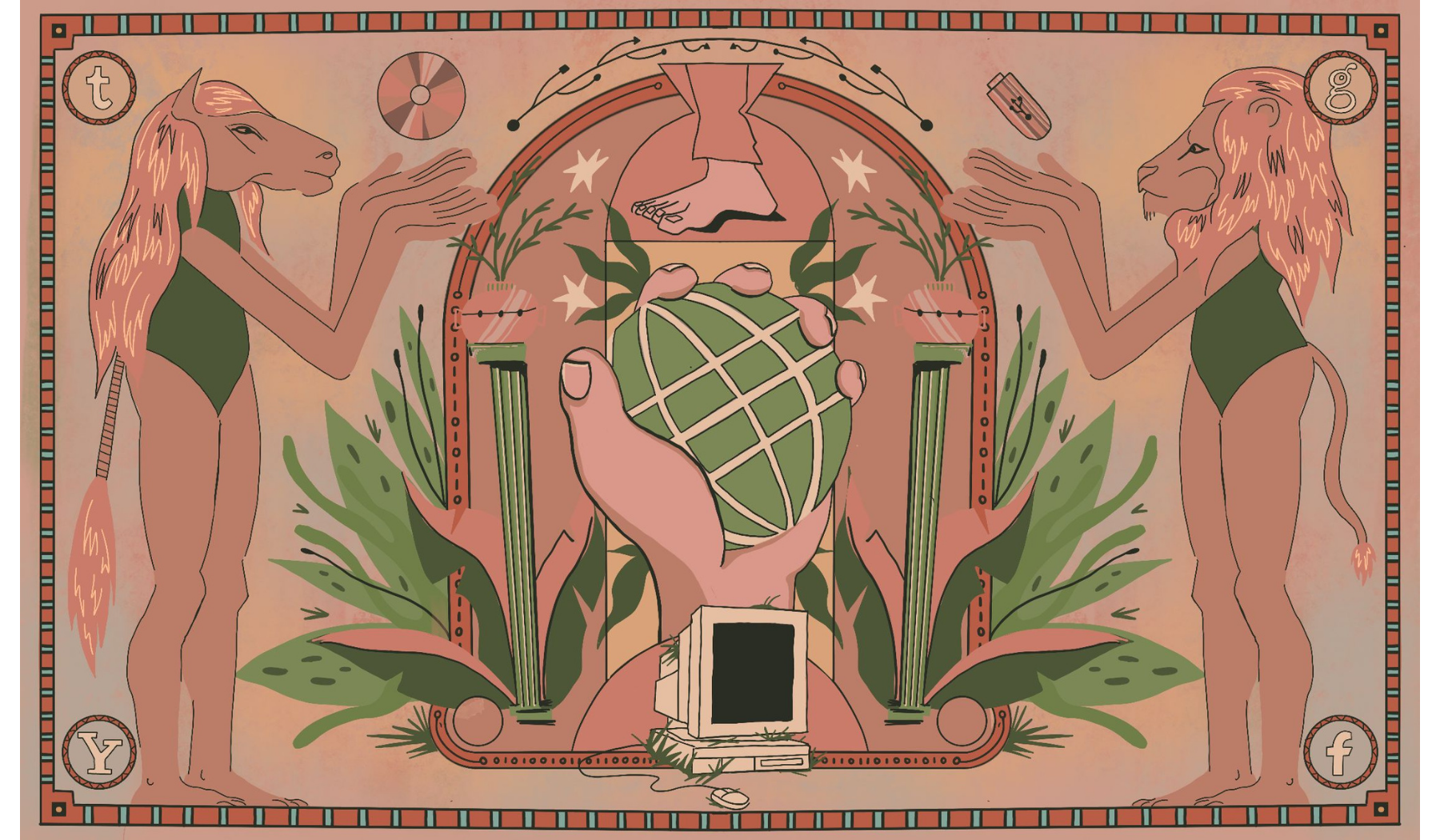
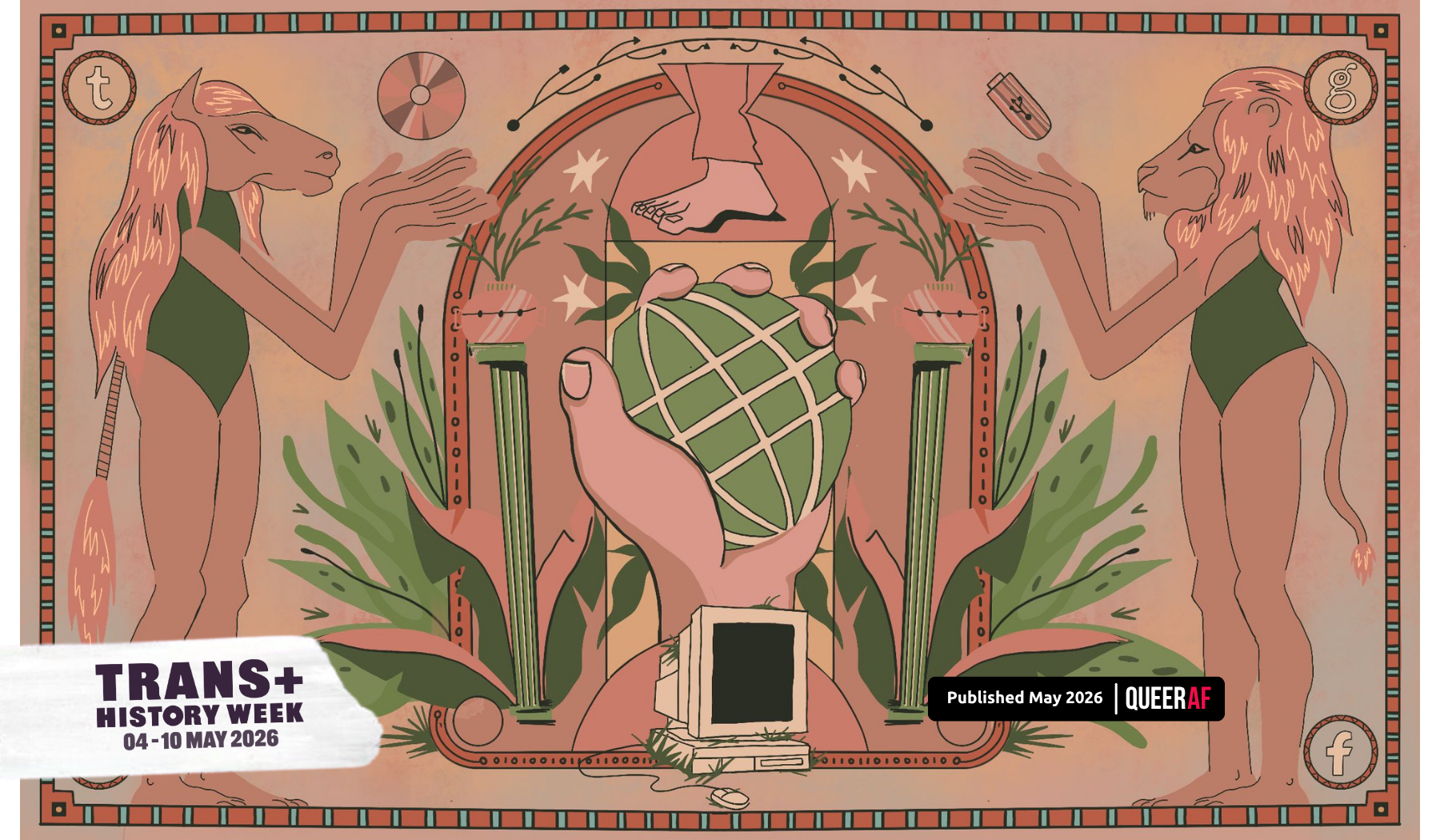
🎨 Artwork description, by Elly Makem
This illustration is an homage to the artefacts of queer internet culture - the objects of the Wild Wild West of the WWW. From Tumblr to USB sticks, LANs to Geocities, the art is a depiction of the reality of speed of how much the internet has changed in the last thirty years, and what queer culture lifelines have been lost as a result of big tech. The illustration features two figures in a tomb-painting style homage to the gay-connecting ways of old.
In The Two Revolutions: A History of the Transgender Internet, Avery Dame-Griff documents how Trans+ people were among the earliest and most inventive users of the handmade web. They "made space for themselves through obfuscation and elision, manipulating existing infrastructures to meet their needs, using techniques they'd already perfected over a long history of silencing and oppression."
That history stretches back to Tim Berners-Lee's original vision for the World Wide Web in 1991: open source, free to all, owned by no one. He dreamt of an open online utopia, making the source code of the World Wide Web (WWW) available for all. His HyperText Markup Language (HTML) gave anyone the tools to publish and link their own stories.
Even earlier, Ted Nelson's concept of "hypertext", developed from 1965, imagined a radical, non-linear repository of documents that could fork, branch, annotate and contradict each other in real time. His almost science-fictional vision for a hypertext environment, called Xanadu, imagined an international radical repository where each democratic document could link to each other, and where writing was never finished.
Trans+ and queer people understood what that freedom meant. When you have spent your life having your identity defined by others, the ability to write yourself into existence, in your own words, on your own terms, has a powerful allure. Working in free and fluid text, Trans+ people were some of the most inventive users of these hand-made affordances on forums like BBnet, Geocities and “made space for themselves through obfuscation and elision, manipulating existing infrastructures to meet their needs, using techniques they’d already perfected over a long history of silencing and oppression.” - The Two Revolutions
The open web that Berners-Lee and Bohnett imagined looks very different today. Our data is separated and harvested by social media platforms owned by tech giants all too willing to censor us and bend to authoritarian leaders.
Dame-Griff is clear about what this shift means. He describes how on “these platforms, trans users are guided to fit their understanding of transness within the platform’s defined affordances and infrastructure…in making their self-identity platform ready, their understanding of said identity reflects the modular logic of the database–the identity as classifiable data, able to be easily defined, linked, and recalled.”
In other words: platforms don't just host Trans+ identities, they shape them and offer templates for them. But when the terms they use to define our lives change, they also erase them. Today's interfaces clean up, build walls around, and moderate content, progressively narrowing the range of expression and quietly determining whose histories remain legible.
Meanwhile, government regulation is finally catching up with the exponential growth of social media and the internet. In the UK, the Online Safety Act requires age verification, including uploading government ID, to access dating sites and adult content. However in doing so we can perhaps best look to the ‘Free Will’ meme - a social media trend where you’re presented with two, less than ideal options - as the best metaphor for the age we live in under the implementation of laws like it.
The under-18s the lawmakers were purportedly trying to protect already know how to download a VPN. Meanwhile, the communities most dependent on these spaces, including LGBTQIA+ young people and particularly those in rural areas, face new barriers to the very platforms that connect them.
The ruins of GeoCities are still partially visible on the Internet Archive. Volunteers have spent years salvaging what they can. It is, as it stands, an incomplete record of a community that built itself online when it had nowhere else to go.
If we are serious about protecting LGBTQIA+ people, not just online safety in the narrow sense, but the survival of Trans+ and queer history, then we need policy that understands what is actually being lost when platforms shut down, update their guidelines, or simply close.
The delete confirmation box always makes it sound simple. Permanent deletion, it turns out, rarely is.
Learning lessons from history, so we can march forward
The UK has seen a tumultuous year for Trans+ rights. In fact, they're in a mess because of the Supreme Court ruling which has brought anything but clarity.
In our Milestones series, we examined how the media shapes what society thinks and feels about Trans+ lives. Geocities is a cautionary tale of what happens when a tool, afforded to everyone to challenge and skip the mainstream - is bought up, and ultimately deleted, by those powers.
The landscape ahead means a continued raft of new legal challenges, political fights, and propaganda that needs to be challenged.
We can only win this fight if we all get the information we need to cut through the noise. We need to use nuanced, detailed analysis as the base for our activism.
That's what QueerAF does best. That's why thousands of you read our main newsletter every week. That's why we need you to upgrade today.
Our small but mighty newsletter punches above our weight, but we need you to upgrade to become a paying member so we can accelerate the work we do - and get it in front of as many eyeballs as possible.
The UK is at a critical juncture, and we need your support - so we can help the LGBTQIA+ community navigate through it.
All we're asking for is the price of a coffee a month. If you value the work we do, please take action, and help us fight back against the hate.