
"Don't, Jo; it's so boyish!" "That's why I do it." (page 7, Little Women, Penguin English Library 2018 edition)
Louisa May Alcott, known to his family as Lou, was the author of the classic novel Little Women. Reading Lou’s personal writings suggests that, as well as being a suffragette and a pioneer of women’s fiction in the US, this famous author may have been gender diverse.
Research into Lou’s letters, diaries and archives shows that the author identified with masculinity and explored gender diversity in great detail. We cannot sit down with L. M. Alcott and ask for his thoughts about gendered language – but in this article we’ve used he/him pronouns to bring his masculinity to light. After all, people are not absolutes. We are capable of change, of fluidity, and of moulding ourselves into new shapes. But, is it possible for someone else to mould you into something you are not? And if so, how do you counter that?
Alcott’s story raises these questions, and in his writings we can begin to find answers. But to do so, we also need to wade through a lot of historical obfuscation.
The idea that we cannot possibly assign queer intent to historic figures is nothing new. From purposefully mistranslating Sappho’s poetry to imply she had a male lover, to arguing that Shakespeare’s sonnets about his male lover were purely fictional and just ‘another dramatic characterisation’ by the author - page 180, William Shakespeare A Compact Documentary Life by S. Schoenbaum, 1927.
There are many cases where people will purposefully misconstrue any mention of historical queerness to be something that it is not. But it hurts especially badly when someone is willing to bring to light queer figures in history, give us every piece of evidence in existence, only to turn around and say that we shouldn’t call them queer at all; that they ‘do more’ for history if we remember them as something they were not.
I came across multiple instances of this in my research into Alcott’s life. As a transmasculine writer, I am no stranger to the act of misgendering, and its equally cruel cousin, degendering – an anti-transgender bias that describes a tendency to not refer to an individual’s transness.
I read through countless articles that posited Alcott as possibly nonbinary, possibly lesbian, but only masculine in childhood fantasies. His possible manhood was deemed undeserving of our interest.
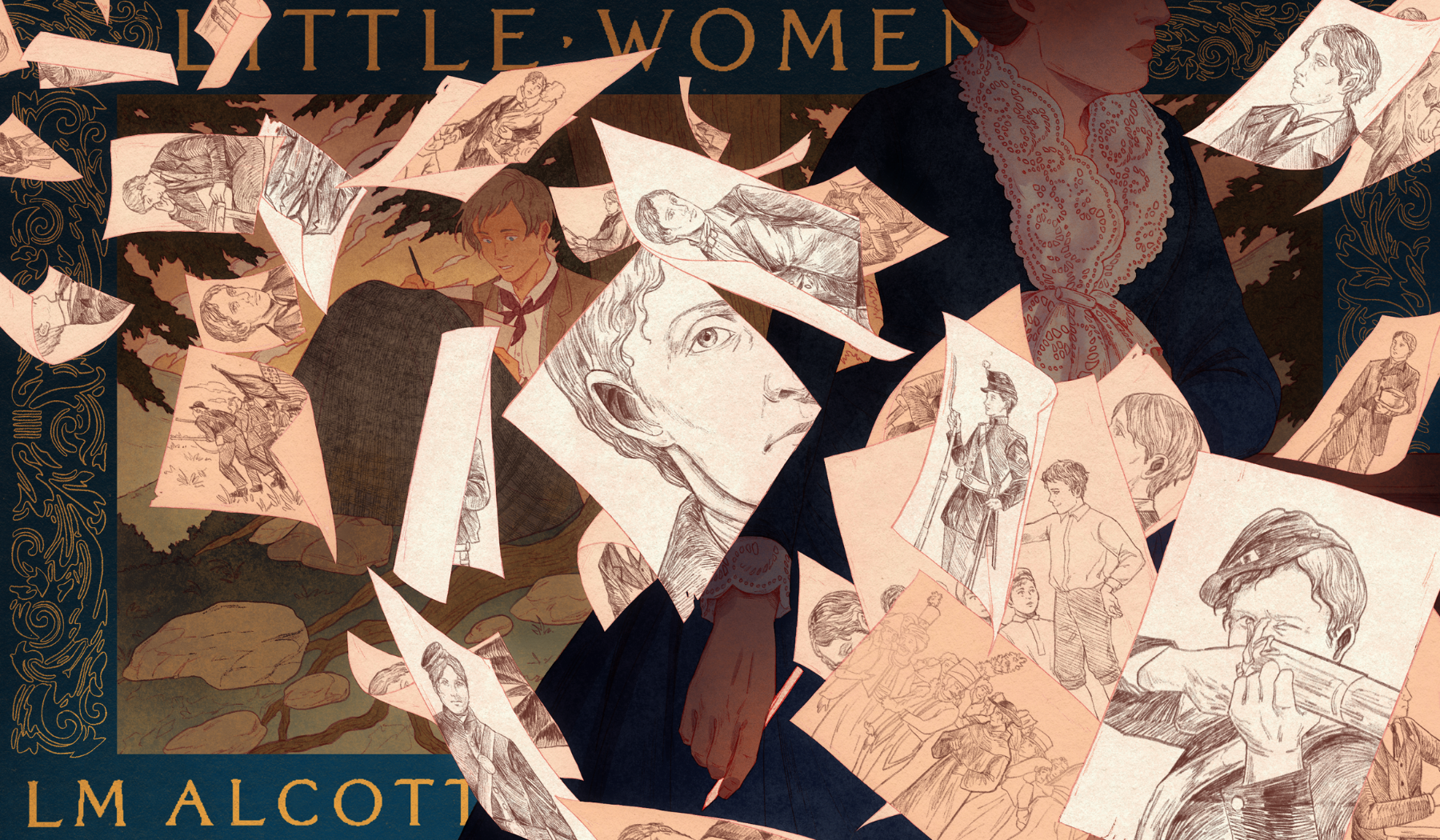
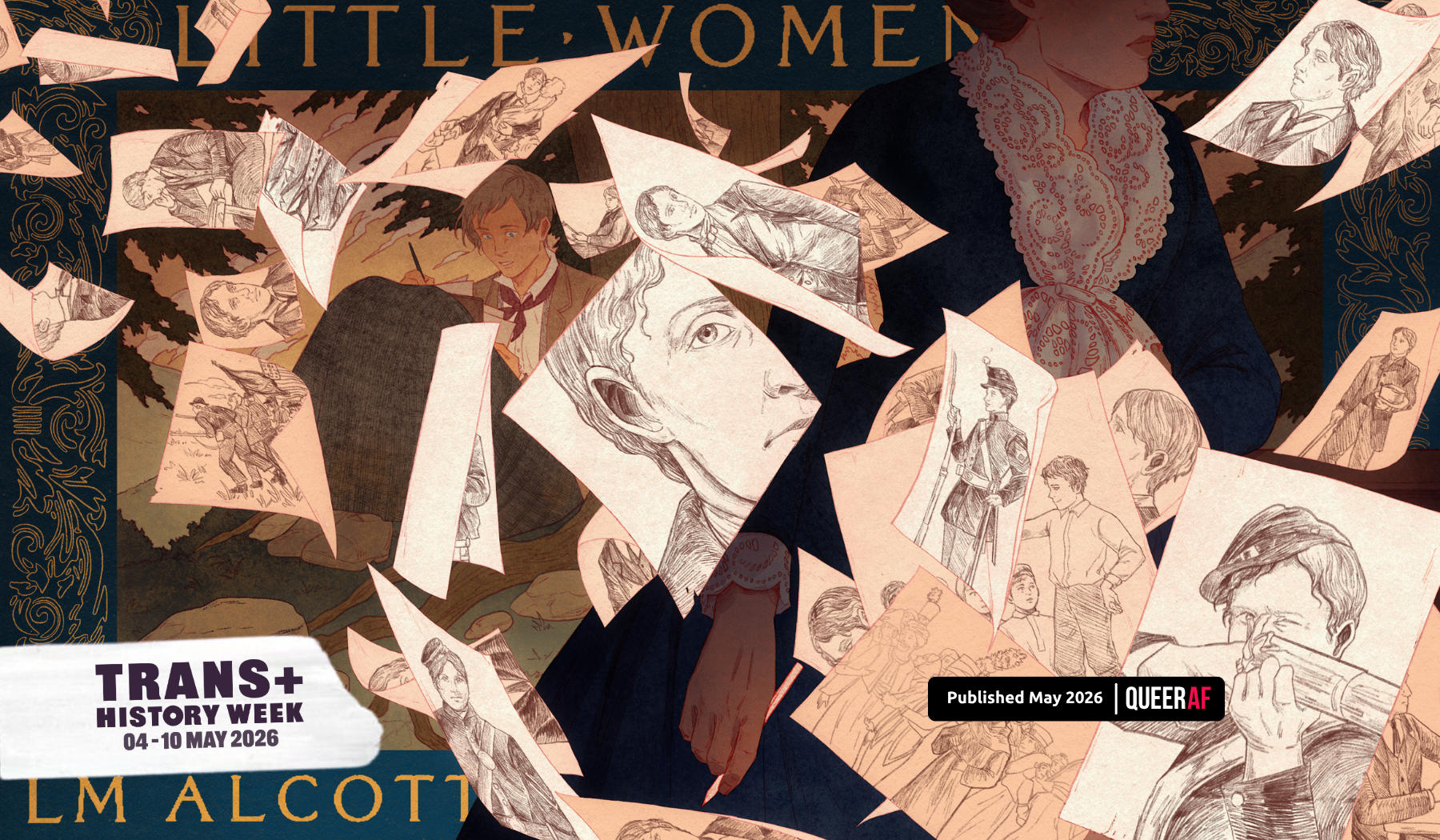
🎨 Artwork description, by 'Riotbones'
A digital illustration about LM Alcott's relationship with masculinity, both through the character of Jo March from Little Women and his other writings. The portrait of LM Alcott is shrouded in darkness, as a representation of how that image of him doesn't provide a full picture of the complexities of his identity. Instead, the focus is on Jo, and more so on the sheets of paper flying around, which represents Alcott's imaginings of himself, such as “enjoyed the attention he received when he dressed as a Monk at a costume party (page 73, The selected letters of Louisa May Alcott, 1987), and wished to fight in the Civil War as a man”. Thus, the illustration seeks to capture not only his experiences with gender, but also the transformative power of imagination in reshaping all of our lives.
It is no secret that Alcott referred to himself with masculine terms. He claimed he had been “born with a boy’s nature”, and when the sons of his older sister Anna became orphans, he made the remark that he was “writing and thinking of the little lads, to whom I must be a father now’ - page 51, The selected letters of Louisa May Alcott, 1987, page 177, The journals of Louisa May Alcott, 1989.
Yet introductions to the two books, edited and compiled by Madeleine B. Stern, do not bring any attention to these, or any other instance in the books where Alcott would refer to himself in a masculine manner. The introductions of both books, written by Stern, talk of the journals and letters as a “web spun by a storyteller who tells [his] own extraordinary story” and as a “varied history’ - page 3, The journals of Louisa May Alcott, 1989, page xvii, The selected letters of Louisa May Alcott, 1987.
And yet a mention of Alcott’s genderbending nature.
Instead, the books collecting Alcott’s correspondence focus on him as a pioneer of woman’s fiction. They speak of his importance through the lens of the ‘female’ sex, implying he did more for feminism as a woman than he could have done if we took his own masculine presentations seriously.
But stripping Alcott of his masculine aspects, ignoring his own words about his gender, is a form of degendering. This degendering takes away Lou’s ability to represent himself across time – and is worsened by the fact that he is being written about post-mortem by people who read letters he wished to be destroyed after his death - page 301-302, Louisa May Alcott: The Woman Behind Little Women, 2009.
Alcott’s story, both modern and historical, rings true today in the way that trans people are degendered.
Stripped of being allowed to be our true selves, and thrust into roles we might have never wanted to be a part of. We are, as it suits our detractors, simultaneously weak and powerless women, and also brutish, powerful men – an approach that Umberto Eco describes as a tenet of fascism. In today’s world, we are what fits best for the people talking about us. We are not allowed to speak for ourselves. In his time, L. M. Alcott did not experience much acceptance. He never truly lived the life of a man in the way men like Dr James Barry or Dr Alan Hart did.
Yet Alcott never let go of his fantasies of being a man. He described himself as a “gentleman at large”, enjoyed the attention he received when he dressed as a monk at a costume party, and wished to fight in the Civil War as a man - page 46, page 73, The selected letters of Louisa May Alcott, 1987, page 105, The journals of Louisa May Alcott, 1989.
In Little Women, the character Jo similarly represents herself as masculine, as a “brother to all [the] girls’. The character bears many similarities to Lou himself – like him, Jo was the second oldest of their siblings, was a writer, and went by a masculine name - page 8, Little Women, Penguin English Library 2018 edition.
In some ways, Alcott accepted himself in his own life, not just through his characters. He was happy and content with himself as a man’s soul in a woman’s body - page 49, Our Famous Women by Elizabeth Stuart Phelps, 1884.
What can we learn from this history?
Psychology tells us that high levels of self-acceptance are linked to positive emotions, satisfying social relationships, achievements, and ability to adjust to negative life events - Williams & Lynn, 2010 as cited in Bernard 2013.
The necessity of self-acceptance in LGBTQIA+ people has only recently been researched extensively. The discrepancy is slowly shrinking, but we still have a ways to go before we as a community are as cared for by psychology as the general population. However, the fear of difference is another tactic of fascism, so why shouldn’t we embrace our differences?
Our detractors fear us, so to fight us they strip us of what makes us powerful. Alcott teaches us that to accept yourself is to fight someone else’s attempt at changing you, your narrative, and your history.
To accept yourself as your true gender is an act more powerful than the burying of our history as trans people. Our stories are finally coming to light. And if loving yourself when others cannot is how we fight transphobia and bigotry – well, as Jo says, “that’s why I do it.”
Capturing Trans+ history, and making it accessible as possible - so it can be a tool for liberation in the fight ahead: is what we're all about.
Booker couldn't be clearer either. When Trans+ stories are told, without Trans+ lived experience holding the pen, gender diversity is dismissed, discredited or simply lost.
We can't be erased. Especially not if we unite to ensure our history is told, and to as many people as possible.
That's what we need your help with. QueerAF might be a small non-profit publisher, but we're mighty.
To help us continue to punch above our weight and fight back, we need you to upgrade to become a paying member so we can accelerate the work we do - and get it in front of as many eyeballs as possible.
To celebrate Trans+ History Week, we're running the Always Been Here sale to entice you even more. You can get 15% off both the monthly and annual '100% QueerAF' subscription:
15% off Monthly - £5.95 / 15% off Annual - £50.15
All memberships come with a number of perks like early access, a greater say on content, plus discounts on events and merch.