

On July 21st 1969, an estimated 650 million people watched Neil Armstrong walk on the moon. It was the culmination of decades of international research, limitless governmental support, and several billion dollars of investment.
Four days later, in the conference room of a London hotel, a number of doctors, surgeons, academics, and social workers assembled to discuss humanity’s next step. If they could achieve it, it would be equally monumental: a ‘Gender Identity Clinic’.
This was the First International Symposium on Gender Identity, subtitled, ‘Aims, Functions, and Clinical Problems of a Gender Identity Clinic’, held between July 25th and July 27th 1969 in London’s plush Piccadilly Hotel. It was not the most attention-grabbing moment in Trans+ history. In a month which also included riots in Northern Ireland that sparked ‘The Troubles’ and the release of Abbey Road by The Beatles alongside the moon landing, a medical conference was hardly going to make headlines.
I discovered the records of the Symposium while researching the origins of the current NHS Gender Identity Clinic (GIC) system. The first UK-based GIC had in fact been formed three years earlier, but the Symposium was foundational in establishing the GIC as a framework. The Symposium wasn’t, at its core, concerned with creating one standalone clinic, but rather a simplified, standardised system, reproducible across the country.
But by the time I discovered the records, in 2024, I was four years into waiting for a first appointment at a GIC myself, and starting to wonder if something had gone systemically wrong. And the more I researched, the more it became apparent that the First International Symposium was actually incredibly important in understanding how we got to this point.
Crucially, thanks to digital archives, the Symposium’s discussions have been preserved. This isn’t a mythical origin story, lost to time – we can listen to what was discussed by the cisgender doctors for ourselves.
Their words make it abundantly clear that this isn’t simply another system rendered dysfunctional by lack of maintenance, funding, and care. In fact, the records of the First International Symposium demonstrate that the GIC system was unfit for purpose from the very beginning.
To put it bluntly, it was never going to work.
"An extremely frustrated lot"
Taken purely as an archive of Trans+ life of the era, the Symposium offers some really remarkable glimpses. Most of these come from Margaret Branch, a psychiatric social worker at Guy’s Hospital in London. She was one of very few contributors at the Symposium who made a point to share details about the lives of the Trans+ people, not just their appointments and diagnoses.
From Margaret, we hear about a Transfeminine PhD student who is applying to be a lecturer. A Trans man working as a mechanic in a police garage. A Trans woman working as an executive officer in the Civil Service.
But these glimpses of the diversity and individuality of Trans+ lives at the time were not what was actually discussed for the majority of the Symposium. Instead, we were described in generalisations, as “sensitive”, “submissive”, even “psychopathic”.
“I find,” comments one speaker, “that they are an extremely frustrated lot of people.”
Despite the vast differences between Trans+ peoples’ individual experiences, lives, and needs – differences which we can hear being expressed explicitly at the time by speakers like Margaret – the Symposium nonetheless considers us a monolith. There was no possibility that the realities of our individualised experiences were ever going to be appropriately considered in the Gender Clinics which emerged from these discussions.
And it’s worth considering that these are generalisations based on the few transgender individuals who are able to access care at this time. So their conclusions are even further limited by the fact that the Trans+ people they are encountering are predominantly middle class, predominantly white, and presenting, at least to these healthcare professionals, as binary.
This gives some indication as to why the current system remains so inflexibly rigid in its protocols, so limited in its understanding, and still so remarkably ill-equipped. Those limited discussions have led to a system where, to this day, many non-binary people feel pressured by GIC services to change their presentation in order to access care.
This is symptomatic of the fact that the Symposium’s vision of a GIC system was never one which affirms, cares and provides.
It was one which segregates, restricts and controls.
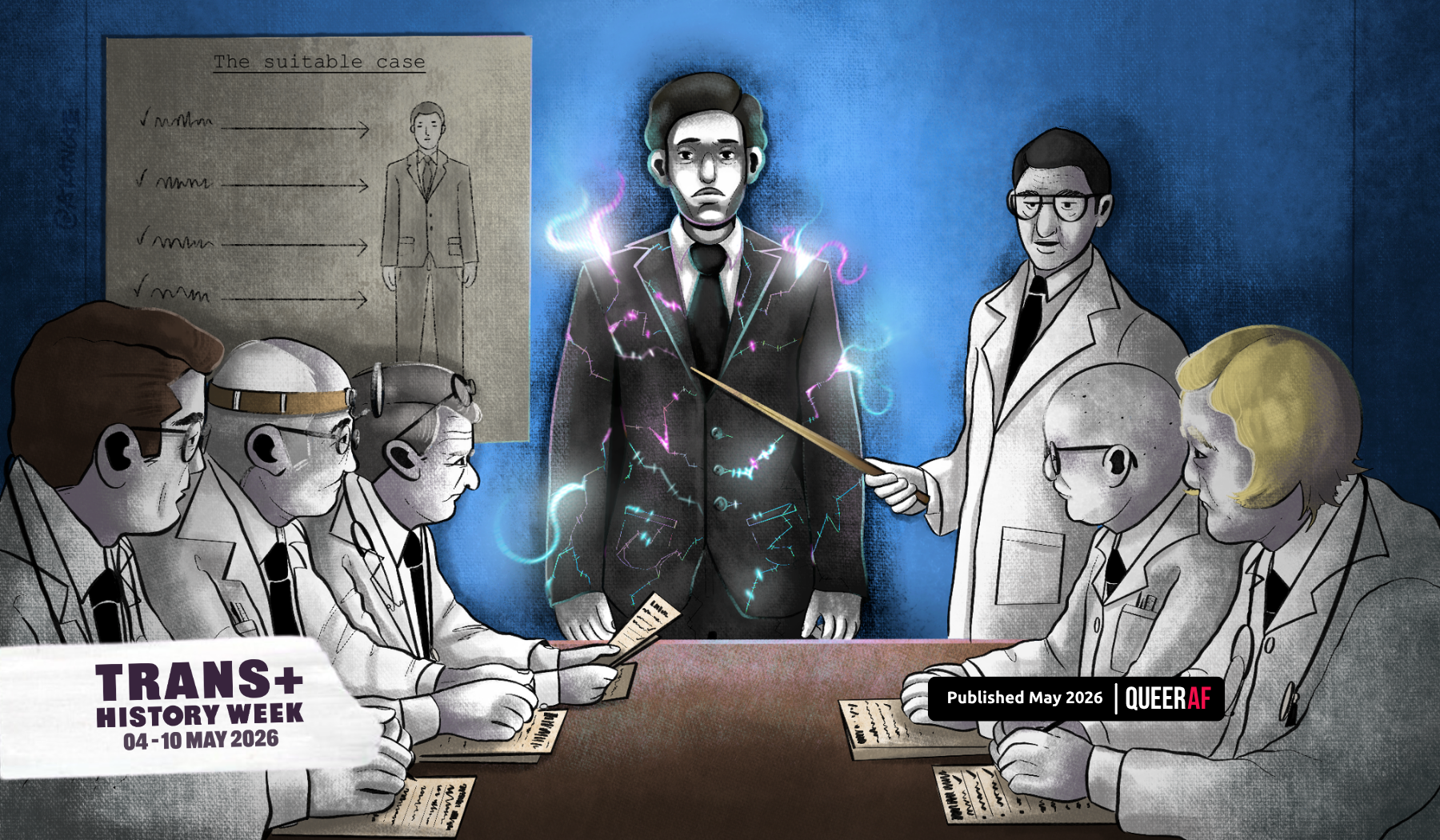
As Margaret Branch puts it, “one [doctor] sticks with them, and after a bit, they turn up in a neat dark suit.”
🎨 Artwork description by Caelan Okyere
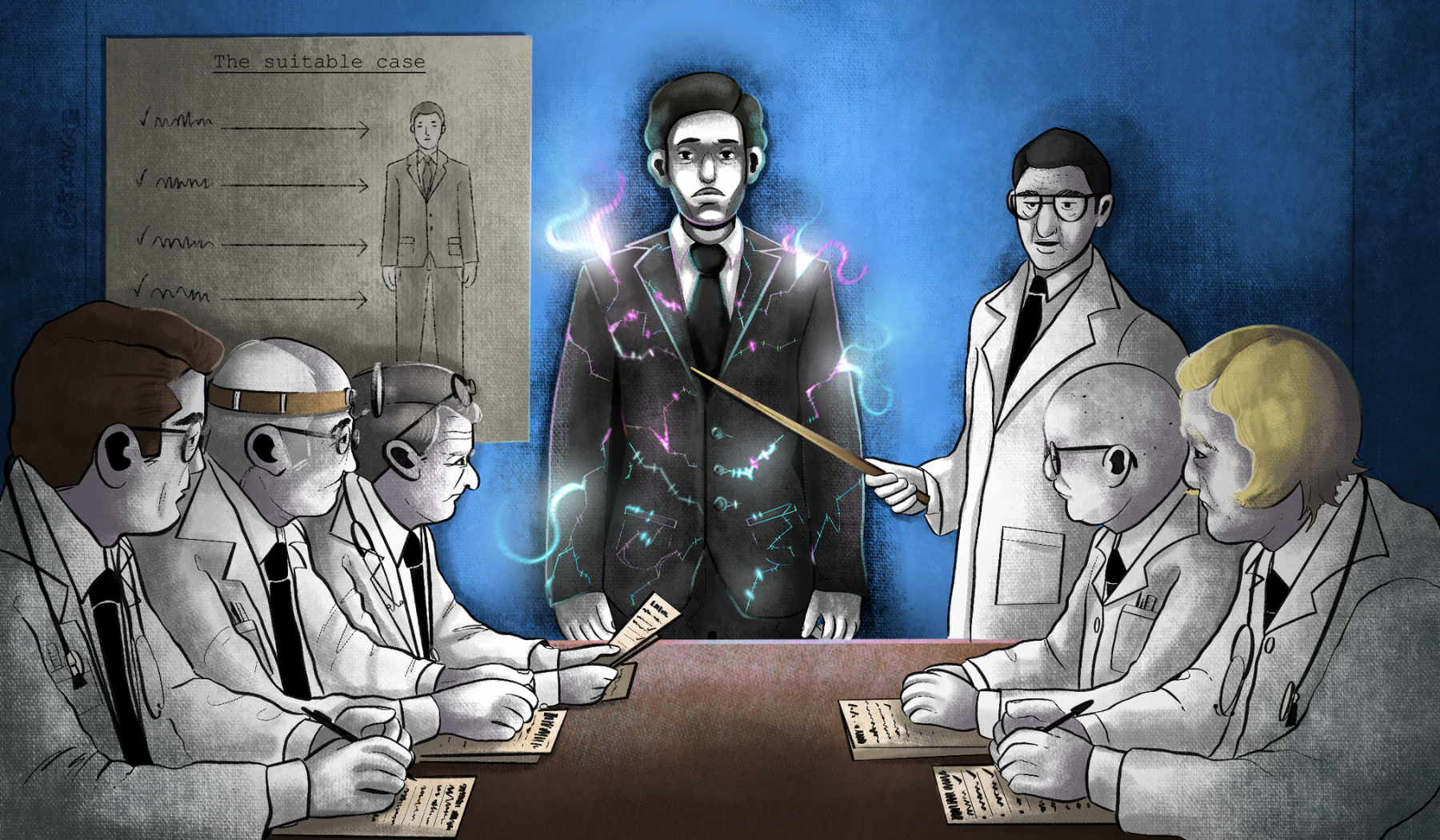
This illustration responds to the 1969 Gender Identity Symposium, where Trans+ people were discussed as case studies, with their voices absent from the conversation. The central figure, dressed in “neat dark suit”, reflects the narrow image of “acceptable” transness that medical institutions were willing to recognise. The figure is positioned at the head of the table and surrounded by the doctors, they are observed, analysed, and spoken about, rather than heard. Cracks within the suit reveal light rays in trans pride colours beneath, portraying a more complex and expansive identity that exists beyond the constraints. These rays symbolise the tension between visibility and survival, while at the same time expressing resilience and the persistence of trans identity beyond institutional control.
Putting us in neat dark suits
In light of this, we could jump to an obvious conclusion: that the Symposium failed to understand Trans+ health because everyone involved was cisgender.
But the truth is more complicated. There were at least two Trans+ people present.
One of them was Virginia Prince, the divisive publisher of Transvestia magazine, who was known to speak out against gender affirming surgery.
The other was eccentric philanthropist Reed Erickson, who was the founder of the Erickson Educational Foundation (EEF), one of the core supporters of the Symposium.
That plush hotel? It had been paid for with Erickson’s money.
I’ve struggled to understand Erickson’s role in all of this. I’ve wrestled with his involvement in the creation of this system. I’ve asked myself why he, of everyone involved, didn’t seem to see what was being formed here. Why he didn’t speak out.
And then, during the process of writing this article, I was offered that first appointment I had been waiting for. This was now six years since I had been referred.
And it finally dawned on me that when you are finally getting what you want, what you need, what you have begged, campaigned, and fought for – it feels like you’ve won.
No matter how broken the system is. Despite all its failings. It has finally worked, just about well enough, for you.
But that does not mean it works for everyone.
What can we learn from this history?
In December 2025, the UK Space Agency announced at an expo in Glasgow that it will be pouring £17 million into UK based space projects.
Two months earlier, a QueerAF investigation found that Glasgow’s Sandyford Clinic has an approximate wait time of 224 years for gender affirming care.
That isn’t to say this is a hopeless situation. It isn’t. There are ways to fix our gender care system, both temporarily, and on a broader, more permanent scale. And that long-term solution may well mean moving away from Gender Clinics altogether, and integrating Trans+ care into the general system.
In fact, some Trans+ people have been asking for this from the very beginning. One of Margaret Branch’s patients, the PhD student, asks her to tell the Symposium that: “the gap in the health service, the gap in her particular treatment, was the fact that none of us really were liaising with anybody else.”
But in order to achieve a solution, we need to start talking about the problem. And in order to do that, those in power need to acknowledge that there is a problem in the first place.
Despite its many issues, the First International Symposium on Gender Identity was undoubtedly one significant small step towards addressing barriers to accessing Gender Affirming Care.
Now, fifty-six years later, Trans+ healthcare is in need of a giant leap.
Trans+ History Week will play a part in the fight back against anti-trans narratives - but it's not for them.
It's for us, to celebrate our history. It's for the over 20 Trans+ creative talent who have been paid, mentored and provided with equipment. It's for you, to take power from our history of enduring resilience.
We've run this initiative as an investment in the community and its beautiful creative talent - so we can help Trans+ journalists build media careers.
So much of what we think and feel comes from the media, and its a huge part of the reason anti-trans rhetoric has become normalised. That's why if you can change the newsroom, you can change the country.
As a not-for-profit, we reinvest everything into this mission - and mentoring schemes like we do with Trans+ History Week. That's why we need your help.
QueerAF's biggest source of revenue is from readers like you and our newsletters are ad-free. It helps us focus on our work, instead of chasing clicks for advertisers.
So please join as a QueerAF member now. Help us invest in Trans+ creatives to give our community the history lessons it needs - to win the fight back.