TL;DR: An investigation by QueerAF and Good law Project has verified 50 suicides of trans people in the UK over the past 10 years, and this is only the tip of the iceberg. Using open-source research, FOIs, interviews with bereaved parents, data from new project Trans Lives which collects data on trans deaths, and a whistleblower who has spoken publicly for the first time, we have found that despite warning signs that trans people are dying of suicide more than the general UK population, official data remains inadequate – while rights and healthcare rollbacks continue.
Suicide is preventable; help is available and more resources are listed at the end of the article.
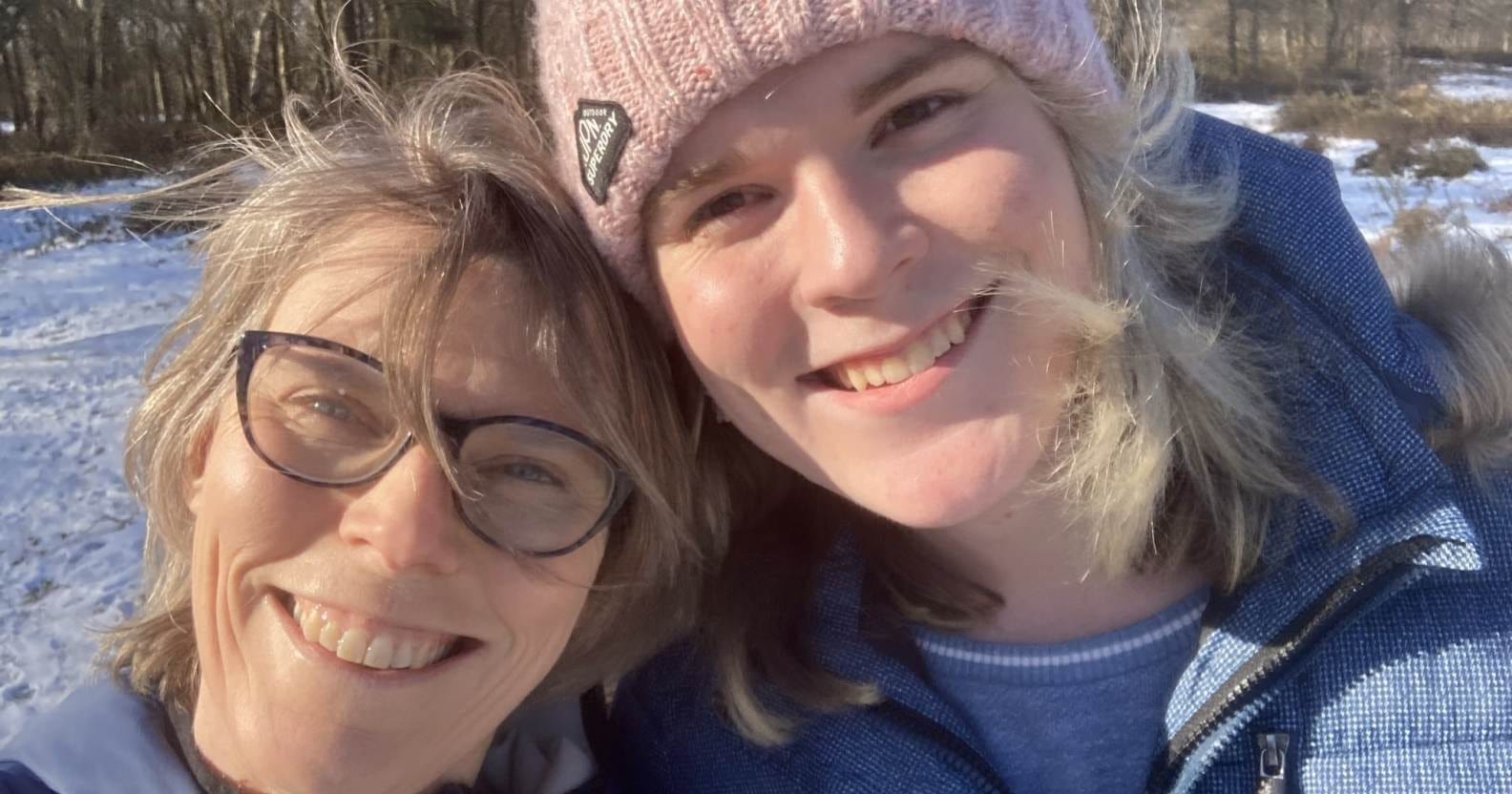
“Greetings freakish lifeforms!” That's how Zach Klement, a young trans man from near London, would often start his YouTube videos.
Zach’s videos were both funny and sad, full of surreal, tongue-in-cheek humour and Dr Who references. His pieces to camera, chats with friends and documentaries spanned complex topics such as autism, gender dysphoria, psychiatric hospitals and how schools treat students with health issues. In the middle of a mental-health crisis? Put a wig on a piece of gym equipment in the park and talk to it about your feelings, suggests Zach. Need weights for some exercise? Stick two tubs of ice cream to either end of a stick – then eat the ice cream afterwards.
In October 2020, he posted his last video, Angry Baking with Zach. In it, he says he hasn’t been able to make a video for eight months, talks about mental-health stigma and bakes brownies. The following February, at age 21, he took his own life.
“When you talk about someone who has ended their lives in that way, you think of someone who is just so low, and that’s partially true,” says Zach’s mum, talking about his years long battle with mental health. “But when he wasn't suicidal, he was funny – like, incredibly funny – very bright, and always trying to do good things. Trying to raise money to help other people, volunteering."
Zach is one of 50 trans and nonbinary people, verified by Good Law Project and QueerAF through multiple sources, who have died by suicide or self-inflicted death over the last 10 years. Over the same period, we have also verified six more trans and nonbinary people who died of preventable or premature deaths other than suicide.
This investigation pieces together information about trans deaths from coroners’ reports, interviews with bereaved families, freedom of information requests, media reports and publicly available datasets. Our analysis of these cases and official figures of trans deaths over a decade shows that trans people are dying of suicide more than the general UK population.
While there is never one reason why someone takes their own life, some experts are concerned that this is happening amid trans rights and healthcare rollbacks. A former NHS clinical psychologist whistleblower has told us that these deaths were “not only predictable, but predicted.” But many trans deaths are left uncounted or unpublished. Zach’s was one of them.
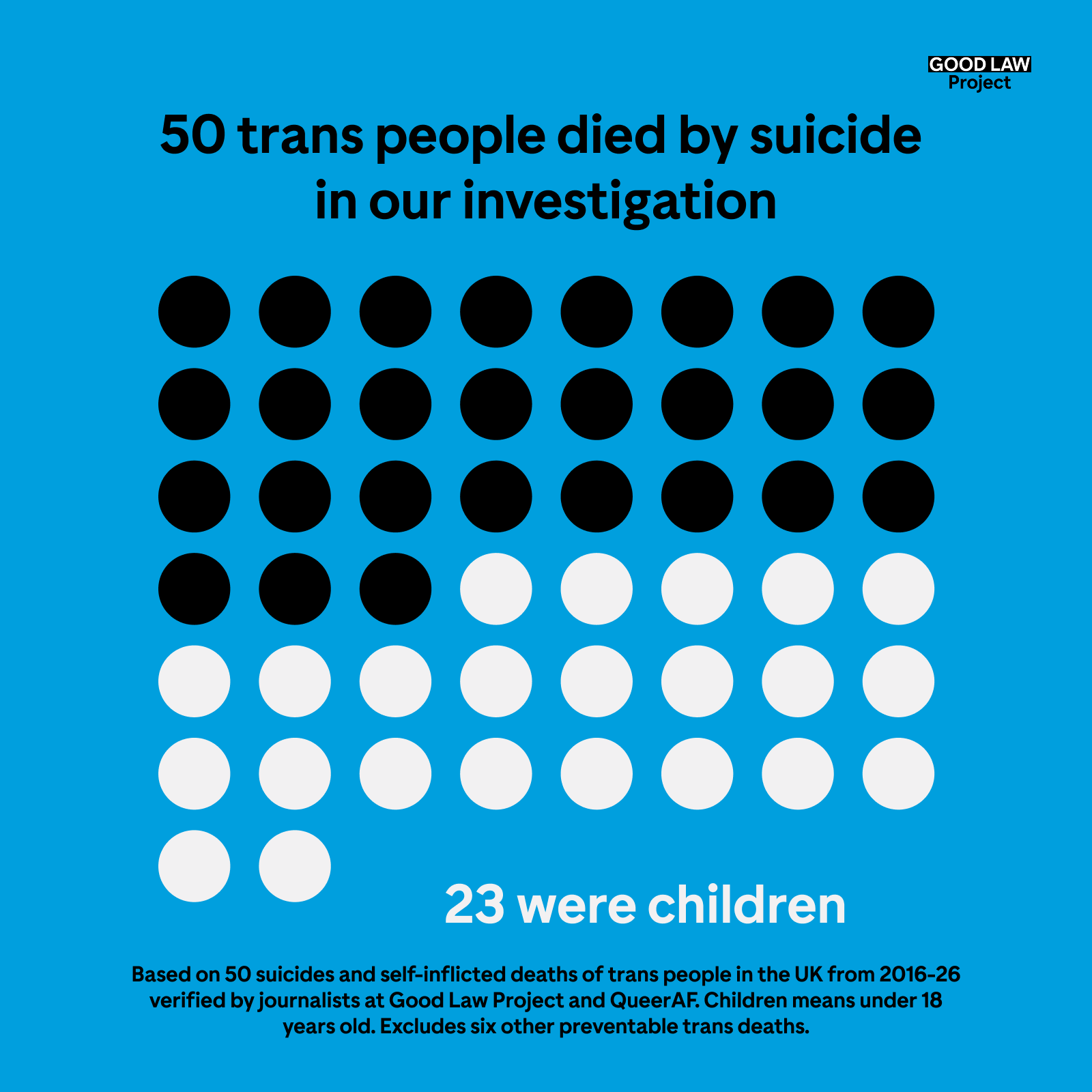
50 trans suicides – the tip of the iceberg
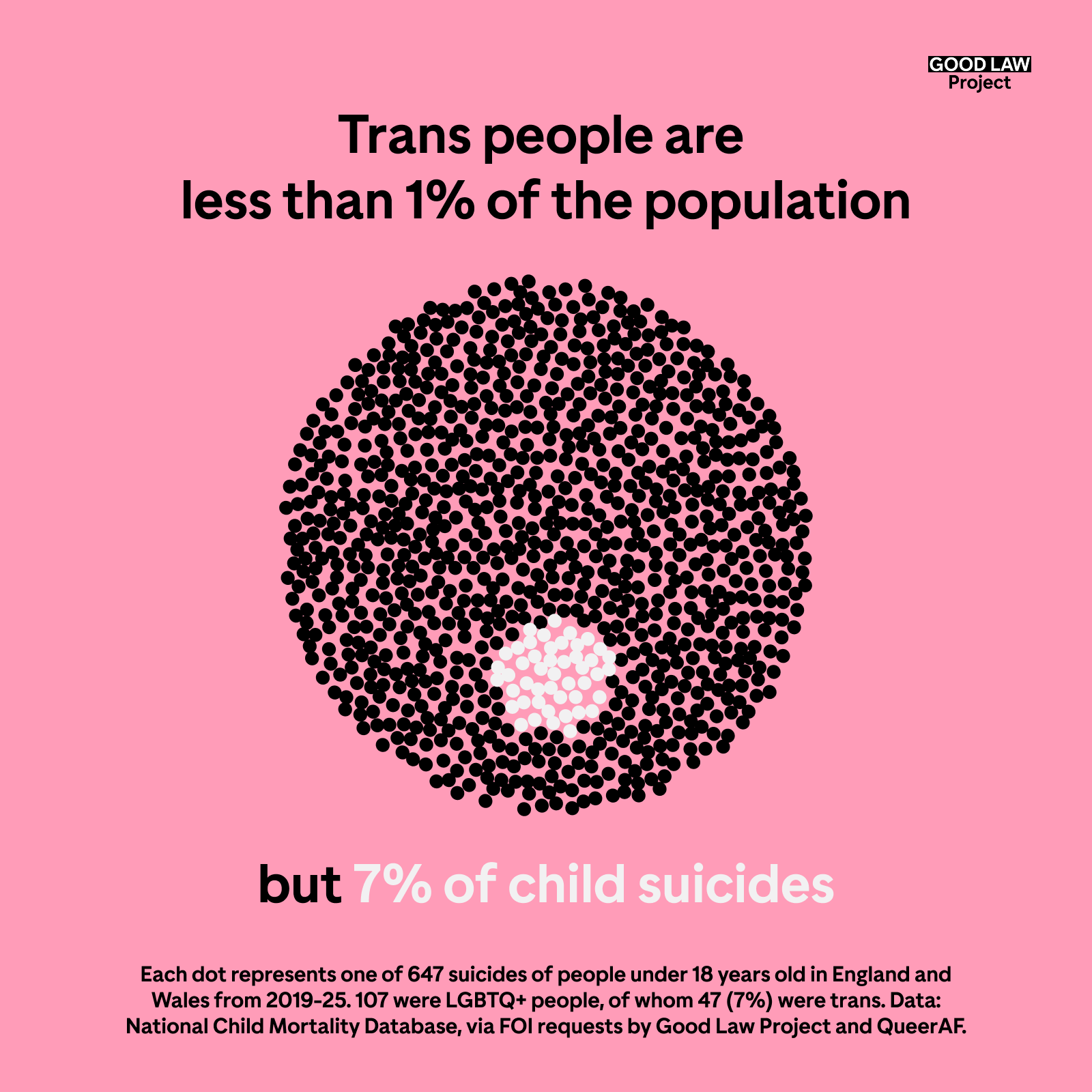
Of the 56 trans people whose deaths were verified in our investigation, many of them were young, with under-18s making up nearly half of them. Trans people make up less than one percent of the population – but from 2019 to 2025, trans under 18s made up seven per cent of all child suicides.
Deaths were verified using open-source research, official documents, interviews with bereaved families and anonymised casework data. We also located 22 prevention of future death reports (PFDs) written about trans people, issued by coroners who found systemic failures which require changes to save future lives. These reports are rare, made for just two percent of inquests – which only happen in about 20% of cases.
Five of the reports specifically cite delays and waiting lists for gender care. Eight were ruled as suicides. They are difficult reads, documenting how these young people were left in distress waiting for gender care appointments they would never get the chance to attend, without adequate mental health support from services while they waited on “very long” lists.
One trans woman had been on a waiting list at an NHS gender clinic for more than two and a half years when she died, aged 24. She had suffered bullying and abuse causing her “a great deal of distress”, and told professionals that she was “keen to be accepted by and receive treatment from the Gender Identity Clinic.” The coroner's report ruled that it was not a suicide, as there wasn’t sufficient evidence about intent, but that she had taken an action that led to her death. In the months leading up to her death, she was in contact with the police, courts and mental health professionals. She had sourced hormone treatment for herself, but at the time of her death, she was still waiting for an appointment at the gender clinic.
In the report, the coroner wrote that there was a "lack of clarity" about who was "responsible" for her wellbeing.
In recent years, trans healthcare in the UK has become more and more restricted. Between 2016 and 2025, the average wait time for a first appointment at an NHS gender clinic increased from around nine months to 25 years – an increase of more than 3,200%. Meanwhile, the number of people waiting for an appointment at a gender clinic has also increased, from around 2,300 people at the start of 2016 to more than 48,000 people in 2025.
While the waiting times for healthcare have increased, the government has removed gender-affirming care for under-18s, including banning puberty blockers and pausing hormone therapy pending a review.
“Inquests into the deaths of young trans people have consistently exposed years‑long waits for gender‑affirming healthcare, and chronic under-resourcing of mental health and social services that leaves trans people without access to support they need,” says Deborah Coles, director at Inquest, a charity that campaigns on state-related deaths. “It is clear that too often, the deaths of trans people are preventable. We are at crisis point.”
These systemic failures must be addressed urgently, Coles adds. “Access to gender-affirming care should not be a battle. Everyone deserves to live with dignity and to receive the care they need to live and thrive.”
NHS England declined to comment on the five prevention of future death reports that specifically mention the delays and waiting lists in the provision of NHS gender care.
Graphics: Miriam Quick
Trans deaths in official data
Some official suicide datasets do collect information about gender identity – and trans people are disproportionately represented.
Data obtained by freedom of information request from the National Child Mortality Database (NCMD) shows that between 2019 and 2025, there were 647 child suicides in England and Wales. Of these, 107 children were LGBTQ+ and 47 of those were trans – meaning that trans children make up 43 per cent of LGBTQ+ suicides of under 18s, and seven per cent of all child suicides over this time period.
Trans people are estimated to constitute less than one per cent of the general population according to official statistics in development.
The NCMD was forced to release its figures on trans suicides with a freedom of information request after repeated requests by campaigners and journalists. But recent data it did make public shows an increase in the number of LGBTQ+ children dying. This information about children who died comes from child death reviews, and between March 2024 and April 2025 there were 34 where sexuality or gender identity was a contributing factor. This is a two and a half fold increase from the previous year, when there were 13.
“These figures are devastating, but they are not surprising,” said Alex Matheson, director of inclusion at the LGBT Foundation. “They reflect what we see every day – trans and LGBTQ+ young people are being pushed into crisis by isolation, stigma, and the steady erosion of their rights. When government policy, medical systems, and public debate all tell trans children that who they are is not valid, the harm is profound. These deaths were preventable. The solutions are already known: affirmation, access, and dignity.”
Matheson added that data from the Foundation’s own services shows “consistently elevated” levels of crisis and distress among LGBTQ+ people compared with the general population, with nine in ten trans people who ask them for support reporting experience of suicidal thoughts.
Another dataset that includes some trans deaths is the National Confidential Inquiry into Suicide and Safety in Mental Health (NCISH), which records suicides by both children and adults in contact with mental health services in the year before they die. This report, by the government's suicide advisor Professor Louis Appleby, found that from 2016 to 2020, seven trans people took their lives each year.
According to this report, which is published annually, in 2021,16 trans people took their lives. In 2022, 34 trans people took their lives. And in 2023, 20 trans people took their lives. These figures are between two and four times the previous baseline number of trans suicides that persisted in the four years prior.
In total, the National Confidential Inquiry into Suicide and Mental Health shows that 104 trans people died by suicide over a seven-year time period. But this data only includes trans people who are in contact with mental health services when they die, so it is far from being a complete picture of trans deaths.
All put together, these official data sources offer overlapping windows into the disproportionate number of trans suicides, but none of them gives the full picture.
“There is little reliable, routinely collected or linked data on suicide among transgender people, especially adults. In its absence, the Good Law Project and QueerAF have relied on FOI requests and coroner’s reports to piece together estimates. The resulting picture is concerning, but fundamentally incomplete, making meaningful comparison or quantification of risk impossible,” said Ann John, a professor of public health and psychiatry at Swansea University Medical School who reviewed our findings.
“Existing evidence and what we know about the complex interplay of factors that lead to suicide suggest transgender people may face higher suicide risk – through isolation, discrimination, stigma and barriers to healthcare. But without robust national data, the true scale remains unknown—undermining suicide prevention efforts, need assessment, service planning and effective policy development.”
Falling through the cracks
Despite all these warning signs, the official data reported on trans deaths remains inadequate. After the Tavistock gender clinic closed in 2024, the government commissioned Appleby to look into the suicides of young trans people under the clinic’s care.
He found that 12 of these young people took their own lives between 2018 and 2024, six of whom were under 18. Appleby acknowledged that his report had limitations, because of the “quality of the data provided and its comprehensiveness”. But we have found that this study did not include the deaths of at least two young people who were referred to the service when they were under 18, due to a technicality.
Caroline Litman is a former NHS psychiatrist who has been on a long journey to understand Appleby’s report. Her daughter Alice took her own life in May 2023 after waiting for gender care for nearly three years, which the coroner said “contributed to a decline in her mental health”. Since Alice’s death, Caroline has become a trans rights campaigner and written a book about her daughter’s story.
She fought hard with the Tavistock gender clinic to find out if Alice’s data was included in the report, and was shocked when she found out it was not. Appleby’s remit was to count the deaths of current or former patients of the under-18s gender service, so Alice should have been counted. But she appeared to have fallen through the cracks because she was on the waiting list for the children’s service only briefly, having been referred at age 17 and a half.
“This combination of obfuscation and gaslighting only adds to the traumas being heaped upon trans people by the cis people charged with their care,” Caroline says. “It’s enraging and it has to stop.”
When Zach’s mum made a similar request to Caroline, she got the same answer. Zach's death was not counted in Appleby's review of “young patients” because he was put straight on the adult waiting list aged 17. This is common for trans 17-year-olds: the long waiting times mean they won't be seen by a youth service before turning 18, so they are referred straight to an adult gender clinic. But this means that Appleby’s report may have missed more cases like Alice's and Zach's.
"It's no surprise to me that Alice wasn't the only young trans person left out of Appleby's data,” said Caroline. “Now I ask the government to acknowledge that they don't know how many others were not included in this influential report, because they presented to services at the cusp of adulthood, or for other reasons they have failed to identify or consider.”
In one video, Zach says “gender dysphoria is a daily struggle.” He recalls telling his mum when he was 10 that he didn’t want to grow up because he didn’t want to become a woman. Things got worse when puberty started. “My body was changing in ways I did not like… at the time I didn’t know how to express myself. I started self-harming and having suicidal thoughts. Since I came out, I've been able to see the light at the end of the tunnel. I can't wait until I fully transition.”
When we contacted the health department, they said that the "death of any young person is a tragedy", adding that "all young people questioning their gender deserve care, dignity and understanding and ensuring their safety and wellbeing is paramount".
But the department didn't respond to our questions about why some cases were not included and whether what we have found suggets that the report may have failed to account for other suicides of young trans people, insisting that Appleby's review "was clear the data does not support the claims of a rise in suicides made by some campaigners".

Appleby's 2024 report is not the only one to have gaps when it comes to trans deaths. A recent Office for National Statistics (ONS) report about leading causes of deaths focused on LGB+ deaths, using data from the 2021 UK census. ONS said it did not produce a similar report about gender because the gender identity answers are “in development, reflecting their innovative nature, evolving understanding of measuring gender identity and the uncertainty associated with them”. It also stated that it is developing its standards for collecting data on gender identity that will “support the effective comparison of data for future statistics".
The amount of information on trans health in the National Confidential Inquiry on Suicide and Mental Health is minimal and has dwindled over the years, from three paragraphs in 2020 to a mention of just one number in the following three reports.
Identifying trans deaths is intrinsically challenging. It is not always possible to identify if a person was trans, be it because the person was not out, because they were misgendered in death by next of kin or official records, or because they were non-binary – which is not currently an option on death certificates. But as our freedom of information requests have revealed, not all available data is published.
"This increase in deaths… was not only predictable, it was predicted," says clinical psychologist Heather Wood, who used to work at the Tavistock gender clinic. In emails seen by Good Law Project and QueerAF, Wood raises the alarm in 2020 that NHS restrictions on puberty blockers could “lead to an increase in self-harm and suicidal ideation” by her young patients.
NHS England declined to comment on Heather's claims.
Wood felt compelled to speak publicly for the first time after recent FOI requests by Good Law Project and QueerAF revealed that from April 2019 to March 2025, the NCMD recorded 46 suicides of trans children. In 2021-2022 specifically, suicides of trans children in England increased to 22, up from just five and four the previous two years. While this time period coincides with the pandemic, according to official data there was no notable increase in suicides generally, as noted by an ONS statistian at the time.Of the 46 deaths in England, 44 were within the time frame analysed for the government report by Appleby on suicides and gender dysphoria at the Tavistock clinic. Appleby accounted for just 12 suicides in England and Wales in his report, because his scope was specific to Tavistock data.
For Wood, the yearly figures reported by Good Law Project better aligned with her understanding of deaths of young people at that time. Prior to the Bell vs Tavistock ruling, which triggered these healthcare rollbacks, Wood says she was aware of one suicide of a young trans person within the service over a seven-year period. But in the years following the restrictions, the numbers staff were presented in meetings rose, first to 11 deaths and then 16.
The rise in deaths related to the service is mentioned in an open letter endorsed by 50 out of 85 Tavistock staff in early 2023. “It warrants a public inquiry,” said Wood, adding, “We told them this would happen…This was clinically irresponsible. And they ignored that warning."
When Wood saw the numbers revealed by Good Law Project and QueerAF, she says she “felt a sense of anger that the trans community has been denied access to those numbers. Because ultimately, that data doesn't belong to the government, it doesn't belong to NHS England, it belongs to the trans community."
A former senior clinician at the Tavistock we spoke to corroborated Heather’s claims, stating that in 2022 “the medical director at the time carried out an audit and shared with the senior team that there were 16 suicides”.
When the Supreme Court ruled on the definition of sex under the Equality Act, Zach was constantly in his mum's thoughts – but she also saw him not having to live through the rollback of trans rights as a “silver lining".
"It would have upset him so much," she said, referencing JK Rowling’s donation to For Women Scotland, who brought the case. Zach was a huge Harry Potter fan, and even made a compassionate video called Dear JK Rowling in 2019 when the author first started making anti-trans comments on Twitter. “I know there’s this thing about free speech, but why would you use your free speech to tell people that they don’t exist, especially when you have a lot of followers?” asks Zach. “You could be really upsetting some people or making it OK for other people to say hurtful things.”
Still, Zach’s mum has hope. Partly, she finds it on Friday nights, which she spends volunteering at a local LGBTQ+ youth group. “I always feel like there's room for progress,” she says. “In all situations where you're trying to make change for the better there's always that one step backwards – you make progress and then there's a rebound, there's a reaction. But you have to keep fighting.”
Analysis: We need better data – Trans Lives is on a mission to fix that
It's clear that there is an issue when it comes to counting the number of trans people dying by suicide in the UK. There isn't comprehensive, high quality data. As this investigation has shown, the best we can do is to piece together different datasets, which themselves all have slightly different criteria for which deaths they are counting.
What we do know is that the existing evidence shows that suicide deaths are higher in trans people than in the general population. But we need more information.
That's where the Trans Lives project comes in. Founded by Lucy Brisbane McKay, a community organiser and journalist with almost 10 years experience working with bereaved families, Trans Lives aims to use its research to build understanding of what is needed to prevent future deaths of trans people.
“Our community knows that too many trans people are falling through the gaps and being actively harmed by UK healthcare and society," says Brisbane McKay. "Yet nobody is counting exactly how many people are dying preventable and premature deaths or working to understand why. Trans Lives seeks to change that by collectively building a community evidence base, to remember and resist.”
“If we understand the information better, we're in a better place to support those who need it, and show people that these deaths are preventable – and critically, prevent them.”

Suicide is preventable; without better data suicide prevention is being undermined
The government responded to our reporting of increasing preventable deaths and suicides in Trans+ people, by saying that our reporting – not the systemic issues that government is responsible for – was creating risk of more deaths.
We were steadfast then, and even more so now. Spurred on by a report used by Wes Streeting as evidence of the safety of Puberty Blocker bans, our latest investigation begs big questions.
It took the painstaking work of three journalists to trawl through preventable death reports for months to come up with the figures we presented today. And what is most clear to us is how this is just the tip of the iceberg.
The multiple data experts we sense checked our story with were clear: what we've found is concerning, and it's far from the full picture.
We took the extraordinary step of delaying the release of this story to give organisations like NHS England and the NCMD more time to respond, at their request. They've since failed to answer any of our follow-ups.
This accountability journalism is critical to bring to light the information that should be guiding the fight ahead. It's been a huge investment, and one we have no intention of backing away from.
If you value the journalism we're doing, alongside our investment in a new generation of LGBTQIA+ creatives, please upgrade today.