

One year ago today, the Supreme Court of the United Kingdom declared that, in its legal opinion, the definition of a woman under the Equality Act 2010 is restricted exclusively to what it calls ‘biological women’.
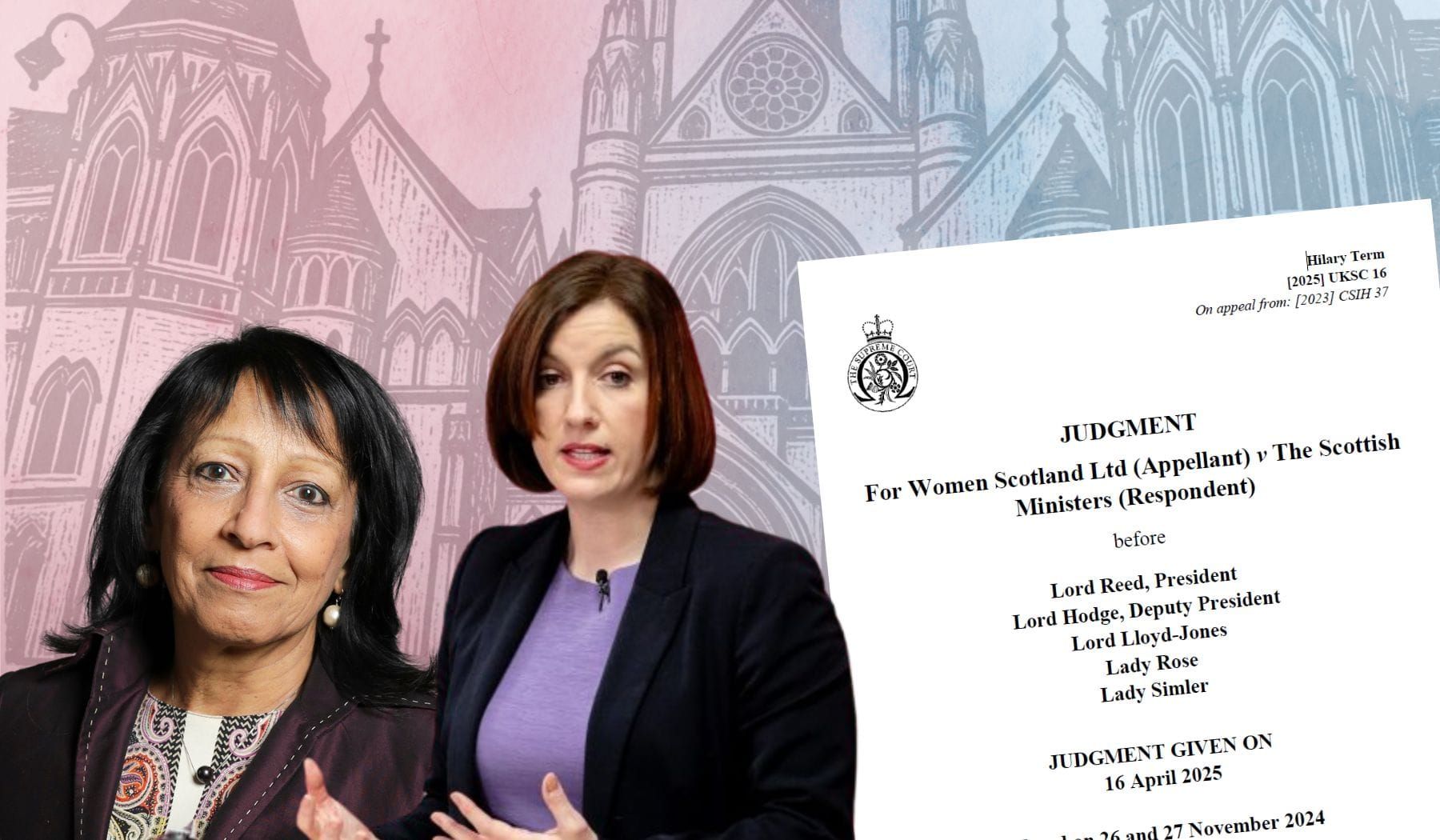
On Wednesday the 16th of April 2024, the nation’s highest court handed down its judgment in For Women Scotland Ltd v The Scottish Ministers – a judicial review into the meaning of the terms ‘man’, ‘woman’, and ‘sex’ in the Equality Act – after nearly three years of legal proceedings.
The Court declared that the terms must refer exclusively to ‘biological sex’, arguing it was necessary for the law’s protections to be “consistently understood.”
They claimed this definition was not only “workable,” but could be “applied in practice” to single-sex spaces, meaning that service providers who wanted to rely on the single-sex exceptions in the Equality Act would have to operate on the basis of “biological sex”.
365 days later, the ruling has solved nothing. A ruling that was designed to provide legal clarity has, according to an array of barristers, legal experts, and human rights lawyers, left service providers more confused than ever – and trans people more vulnerable than ever.
Analysis published in August last year by European Law Monitor Managing Director Claire Bradley accused the Supreme Court panel of omitting key equalities legislation in its ruling opinion, while employment barrister Robin Moira White said it “wouldn’t survive a trip to the European Court of Human Rights.”
It has also had huge implications for trans rights in the UK, effectively acting as a warrant to allow various groups to further erode the community’s freedoms, Multiple organisations, including most recently the Women’s Institute and Girlguiding, have chosen to exclude trans women over legal pressures, while numerous cases of anti-trans harassment in public toilets have been reported. Prime Minister Sir Keir Starmer even went as far to declare his belief that trans women are not women.
Reminiscing on the chaos of the past year, Oscar Davies, the UK’s first publicly recognised non-binary barrister joined other Trans+ experts in saying that because of the Supreme Court the law is now as ‘clear as mud’.
“I’ve advised many individuals, many companies, as to the effects of the judgment and, it’s very sad and almost tragic to see the effect of what a decision from those within the top level of my profession has had on the daily lives of trans people,” they told QueerAF.
History of For Women Scotland Ltd v The Scottish Ministers
While it only reached the Supreme Court in February 2024, the groundwork for For Women Scotland Ltd v The Scottish Ministers was laid in 2021 over a dispute regarding the Scottish Government’s trans-inclusive definition of the word ‘woman’.
In 2018, Holyrood passed the Gender Representation on Public Boards Act (the 2018 Act) requiring that a certain percentage of non-executive public board members be women. The 2018 Act defined “woman” to include people with the protected characteristic of gender reassignment who were living as women – in effect, trans women.
The legislation was challenged by For Women Scotland – a ‘gender critical’ campaign group who have long argued against the broad scientific acknowledgement that sex in both biology and physiology is more complex than a binary.
In 2021, the group brought a judicial review against the Scottish government, arguing that2018 Act’s definition of a woman was different to that used in the 2010 Equality Act, and that the Scottish government did not have the power to redefine the term. This challenge was dismissed at first instance, with the judge ruling that the Scottish legislation did not redefine the term woman for any purpose other than to acknowledge that trans women as another category of people who could benefit from the positive measure.
But the group then appealed to the Inner House of the Court of Session – Scotland’s highest court. In its February 2022 judgment, the Court ruled that the 2018 Act was unlawfulbecause sex and gender reassignment were two separate characteristics which could not be conflated.
For Women Scotland then filed a second judicial review in July of the same year after Holyrood amended the 2018 Act to replace its definition with a trans-inclusive clause recognising trans women with a gender recognition certificate (GRC) as women.
Based on their assertion that sex is binary and immutable, For Women Scotland argued in its application that the Equality Act 2010 would be unworkable unless its definition of ‘sex’ referred to ‘biological sex’ .
Their case was dismissed at first instance in December 2022, but, For Women Scotland once again appealed to the Inner House.
In November 2023, the Inner House refused their appeal. In its decision, it considered that Gender Recognition Act 2004 allowed trans people to change their legal sex, and that there was nothing in the Equality Act 2010 which meant this should not apply to its definition of sex. Having had their challenge dismissed by the Inner House, For Women Scotland could apply for permission to appeal to the UK Supreme Court.
It began a crowdfunding campaign to fund the legal challenge in February 2024, earning just over £232,000 from 5,021 pledges. £70,000 of that sum came directly from ‘gender critical’ pundit JK Rowling.
For Women Scotland Ltd v The Scottish Ministers was heard on the 26th of November 2024. A five-judge panel presided over the case consisting of judges Lords Reed, Hodge, and Lloyd-Jones, and Ladies Rose and Simler.
The claimants again argued Holyrood had misinterpreted the Equality Act 2010 in adopting its definition of ‘woman’, suggesting instead that sex under the Act had always been defined according to immutable ‘biological sex’.
The Scottish government conversely defended its definition of women as including trans women with a Gender Recognition Certificate, arguing that this was also how ‘’woman’ was defined under the Equality Act 2010..
The five-judge panel allowed interventions from four groups, three of which are well-known for expressing ‘gendercritical’ views. These groups were the Equality and Human Rights Commission (EHRC), Amnesty International, Sex Matters, and LGB Alliance.
It infamously denied intervention applications made by two trans legal experts – the UK’s first out trans judge Victoria McCloud and retired Professor of Equalities Law Stephen Whittle – meaning that not a single trans person was heardbefore the Court.
 QueerAF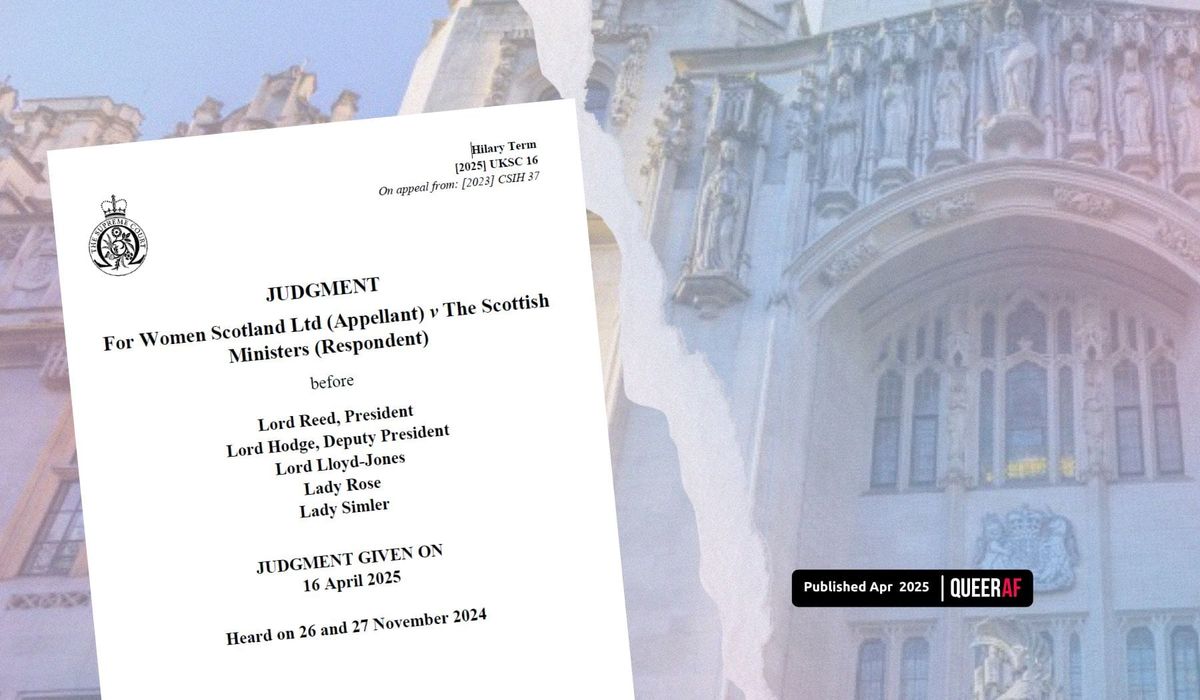
The Judgment
On the 16th of April 2025, following just over a month of deliberation, the judges ruled unanimously in favour of For Women Scotland in what would become one of the most impactful rulings for trans rights in British history.
It ruled that for the purposes of the Equality Act 2010, sex was to be defined exclusively as what it calls ‘biological sex’. This expressly excludes trans people holding a Gender Recognition Certificate from being recognised as their acquired sex under the Act.
Written by Lord Hodge, Lady Rose, and Lady Simler, the judgment’s’s conclusions leaned heavily on anti-trans narratives presented by the claimants, as well as the submissions brought by ‘gender-critical’ campaigners permitted to intervene on the case. It bears repeating, the court did not allow any submissions from any Trans+ people – a judgment was made about a community that wasn’t present.
The judgment broadly aimed to conclude whether Parliament intended the Equality Act 2010’s definition of ‘sex’ to refer to ‘biological sex’ or what it described as ‘certificated sex’ – a term it uses to describe the sex of a person who has acquired a Gender Recognition Certificate.
The Court argued it was necessary to ensure a singular definition of ‘sex’ throughout the Equality Act, which could be interpreted in a “predictable”, “workable”, and “consistently understood” way that could be “applied in practice”.
It particularly focused on FWS’s argument that a trans-inclusive definition of ‘women’ and ‘men’ would affect the Equality Act 2010’s provisions on pregnancy, which makes reference exclusively to ‘women’ as becoming pregnant. . Because trans men can get pregnant, adopting a certificated definition of sex across the Act would mean that those with Gender Recognition Certificates wouldn’t benefit from its pregnancy-related protections. But if a biological sex definition were adopted, trans men would be considered ‘women’, and so would be protected. Although this would have been resolved by adopting a variable definition of ‘sex’ across the Act for different purposes, the Court rejected this approach.
The Court also said that interpreting ‘sex’ as meaning ‘certificated sex’, it said, would “cut across the definitions of ‘man’ and ‘woman’ and thus the protected characteristic of sex in an incoherent way.”
In the Court’s view, the definitions couldn’t have been intentionally trans-inclusive because it would render women as a “heterogenous” group, essentially meaning that, from the court’s perspective, women would no longer be protected from discrimination that is based on what it calls their “shared biology.”
Barrister Oscar Davies said the implications of the ruling were so jarring that it took some time for them to sink in.
“I think the penny dropped after a few days of how serious the consequences could be,” they said. “It wasn’t immediately obvious because the judges are saying, oh, this is only relevant to people who have a Gender Recognition Certificate, but these implications have been far more reaching.”
“I remember thinking when the judgment came out that, you know, how could they have gotten this so wrong? I remember feeling professionally embarrassed to be a lawyer.”
They were among the large swathes of people concerned that the judgment would be used as a warrant by the government to bring forward statutory guidancethat would amount to a ban on trans people using public toilets.
While recent statements about service provisions from the government have left Davies “cautiously optimistic,” it remains one of the key concerns arising from the ruling.
Another of the judgment’s grim side effects, Davies said, is that its infamy has turned ‘single-sex’ spaces into a public opinion issue where dog-whistles and misinformation are spread about Trans+ people to whip up fear.
“Prior to this judgment, I was not really trying to discuss [trans people using bathrooms] because a lot of the arguments are misnomers or dog-whistles trying to reduce trans existence to the rights of a physical space. Now there is so much discourse around these spaces because of these imaginary [claims] about what trans people can and can’t do.”
Davies also noted the peculiar way that the ruling approaches the rights of non-binary and intersex people, who aren’t legally recognised in the UK.
“There are some quite surprising omissions as well in terms of how the judges have basically allowed this sex binary to be constructed as a legal fiction when we know that, in reality, there’s much more than that. … I mean, it doesn’t even mention intersex people once, which is so surprising.”
QueerAF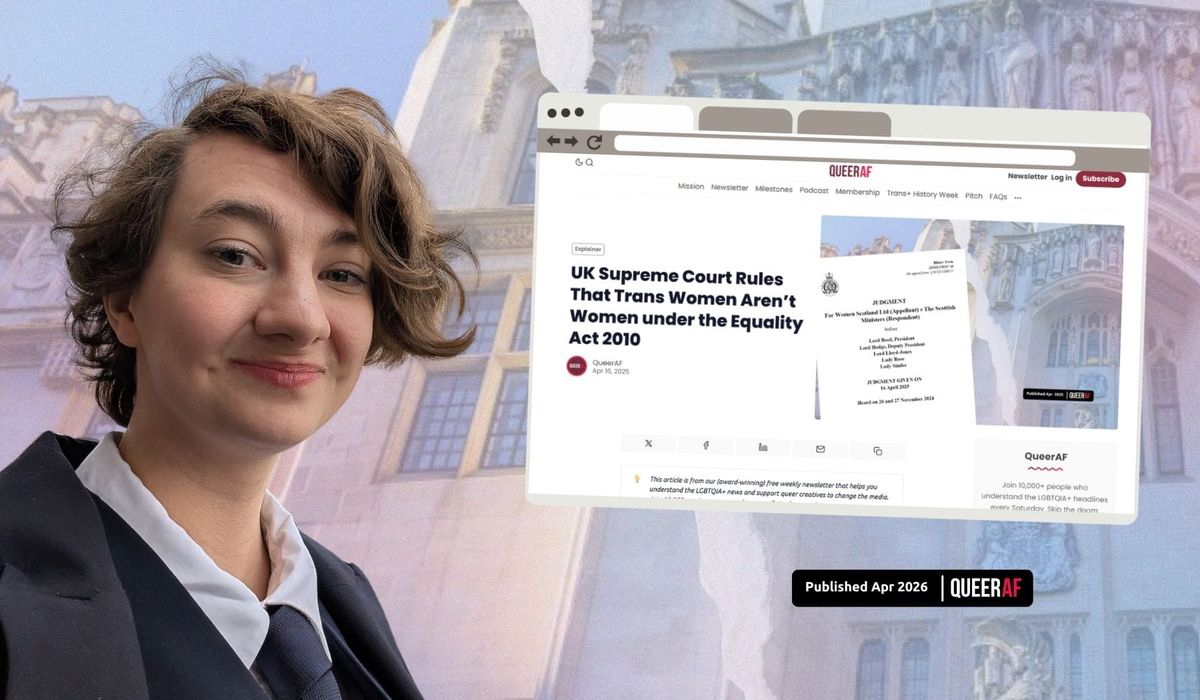
The EHRC’s chaotic public consultation
There wasn’t much time for legal experts and relevant parties to digest the ruling and its potential consequences. Less than two weeks later, late on a Friday night, the EHRC – the UK’s human rights and equalities regulator, which itself has faced scrutiny for its policies attacking the trans community – published an interim update, providing guidance advising service providers on what the judgment meant for them.
This update was largely understood as guidance, but it was not statutory advice. To confuse things further it later admitted in court proceedings that they were just “some observations – brief and high level” - and it went on to be withdrawn amid legal pressure. The High Court later held that it was guidance and intendended as such.
Its advice caused vast confusion, prompting many organisations to update their policies to exclude trans people from spaces, groups, and facilities consistent with their correct gender identity.
The update posited that “In some circumstances, the law also allows trans women to be prevented from using the men's facilities, and trans men can be prevented from using the women's.” This, in practice, would have pushed Trans+ people into using third spaces.
It would later be revealed that its draft Code of Practice suggested that organisations may need to make these decisions based on appearance without offering any advice on what this would entail.
In May the EHRC launched a public consultation into proposed updates to its Code of Practice for providers of single-sex services. The proposals similarly recommended banning trans people from single-sex spaces, suggesting that if service providers allowed trans women to use women’s facilities, they would also have to admit cis men.
The consultation was originally meant to last less than three months, but was extended after legal and human rights experts, including some convened by the UN, accused the EHRC of attempting to rush out guidance without allowing it to face proper scrutiny. The public, who were originally expected to submit their responses in just 14 days, were given six weeks following the extension – a timeframe which human rights organisation Liberty said in a lawsuit against the regulator was still too short a period.
Despite the remarkably short consultation period, over 50,000 members of the UK public responded to the proposed changes before the 30th June deadline. The EHRC took just two months to consider the responses, submitting the draft Code of Practice to Equalities Minister Bridget Phillipson in early September.
The EHRC later confirmed to QueerAF it had used AI “alongside our expert legal assessment” to review the responses. Legal advocacy group Good Law Project decried the approach, saying: “This wasn’t a consultation, it was a joke.”
Multiple backbench Labour MPs wrote to the government after the draft Code was submitted, saying they had been inundated with a cavalcade of messages from small and large private business owners concerned that the provisions were inconsistent with their values, and that the financial logistics of having to enforce a bathroom ban risked bankrupting them.
Thanks to its actions over the past year, the EHRC’s already damaged reputation has taken a nose-dive. Multiple organisations, including TransActual, Amnesty International, Trans+ Solidarity Alliance, and the Trans Advocacy & Complaints Collective (TACC), and the Lemkin Institute for Genocide Prevention, requested that the Global Alliance of National Human Rights Institutions (GANHRI) downgrade the Commission. It would go on to face further calls by Trans Exile Network and the Lemkin Institute for Genocide Prevention later in the year too.
Its actions even strained the Commission’s relationship with the government. A month after the draft guidance had been handed to the Equalities Office, Phillipson urged the EHRC to place “a little less focus on public debate” after its then-chair Baroness Kishwer Falkner urged her to approve the Code “as soon as possible.”
Both the EHRC and the UK faced legal action since. A European Court of Human Rights case was announced by Victoria McCloud against the UK for the Supreme Court’s rejecton of her’s and Whittle’s applications to intervene. Meanwhile the legal advocacy group Good Law Project sued the Commission for what it called its “transphobic, harmful, and legally wrong” interim update.
This high court decision in this case ruled the EHRC interim guidance does not force Trans+ people to use single-sex facilities in line with their birth sex, nor does it make it unlawful for service providers to provide trans-inclusive facilities like men's and women's changing rooms.
However, because workplaces must comply with workplace regulations that don't cover public services, the situation is different for Trans+ people at work. Employers are required to provide single-sex toilets that are used by employees according to their birth sex. It’s a ruling that’s been dubbed as creating a “Trans+ workers' rights crisis”.
When will the government lay out the EHRC’s Code of Practice?
The government has yet to lay the EHRC’s updated Code before Parliament, which is not available for the public to view.
All of the confusion, fear, and opaqueness created a policy landscape that Trans+ Solidarity Alliance member and campaigner Alex Parmar-Yee described to QueerAF as a “total mess.”
One of the most prominent critics against both the EHRC’s consultation and the Supreme Court ruling, Trans+ Solidarity Alliance has relentlessly urged Labour to avoid enforcing a trans bathroom ban, even parking a giant LED sign displaying the community’s fears outside of the Labour conference in September last year.
The volunteer-led organisation even worked with over 670 UK businesses to produce an open letter urging the government to oppose the EHRC’s Code.
Parmar-Yee said the political and institutional attacks against trans people in the wake of the judgment had left an entire demographic “unsure how we can still hold down a job or participate in public life with safety and dignity.”
“[The ruling] has enabled a dark political climate where some politicians, including from Labour, sound like they’re borrowing from Trump’s playbook on trans equality,” she added. “Some say that the ruling has brought clarity, but one year on it has caused nothing but chaos.
“Spaces for all women have been lost as inclusive women’s groups have closed rather than be bullied into excluding trans people, and trans people have been increasingly worried about what comes next.”
It has been seven months since the EHRC Code of Practice was submitted to the Equalities Office. The appointment of a new EHRC chair has delayed things further as both parties work on a ‘constructive’ review of the draft.
After months of silence, Phillipson finally gave a statement on the Code’s status this week (14th of April), saying the government planned to lay the Code in May and present it for Parliamentary scrutiny “as soon as practicable” after the 2026 local elections.
In her own statement on the matter, EHRC chair Dr Mary-Ann Stephenson said that progress was being made towards drafting what she described as an “accurate and up-to-date guidance on the Equality Act 2010.”
“The UK government recently provided us with a narrow set of comments on the draft Code of Practice we submitted in September. Having considered this feedback alongside consultation responses and further legal analysis, we have made adjustments where they help the Code provide legally accurate, practical guidance that is useful to duty bearers.”
Analysis: What next for the ‘clear as mud’ judgment?
The legal and policy developments in the wake of the Supreme Court’s judgment have become increasingly complex and, by extension, increasingly confusing. They have strained the relationship between the EHRC and the Government, spawned multiple employment tribunals, discrimination lawsuits, and civil trials, and have created a tumultuous public discourse that has left people scared, angry, and confused.
The story has, arguably, become more about government bodies and faceless corporations as it has progressed. However, Parmar-Yee urged the public to remember the personal toll this is having not just on trans people, but anyone who doesn’t fit traditional gender norms.
"Whatever you do to stand up for trans people, whether protesting in the streets, lobbying your MP, or building solidarity and support in your community - we have to keep going,” she said.
A report from the trans rights CIC TransActual, published in August, found that cases of harassment against trans, intersex, and cisgender people on the basis of their gender presentation has spiked following the Supreme Court’s judgment. Individuals of all gender identities shared how they have been discriminated against across nearly every aspect of public life, including at work, in public spaces, or during sporting events.
Davies warned that the complexity of applying the Supreme Court judgment has meant that discussions of it seem to presuppose that trans people are a problem that need solving rather than a group of people “just trying to live a life.”
“I think the government and whoever else needs a convenient scapegoat who they can blame for almost anything. I don’t think it was the intention of the Supreme Court judges to make trans people more villainised, but there’s certainly been some sort of effect in that regard.
“The government has almost been given more latitude now to say, for example, that a trans woman is a man. Five years ago that would be seen as quite an obviously harassing statement, whereas now the person making the statement can hide behind the ruling and say, ‘Well, technically, a trans woman is a biological male. Therefore, my statement is correct.’”
Anti-trans dogwhistles have even begun to seep into the language of unrelated legal cases. Davies noted that the term ‘gender ideology’ had been used uncritically by a judge in Smith v CC Northumbria Police to describe trans activism.
In its original petition to the Supreme Court, For Women Scotland claimed that excluding trans women from the Equality Act 2010’s definition of women would preserve cisgender women’s “decency and dignity and a sense of safety.”
One year on and women are no safer. In fact, there have been multiple reported cases of women, particularly gender non-conforming women, being confronted or harassed for simply using a changing room or toilet.
Parmar-Yee argues that the Supreme Court has, in reality, put everyone who uses public toilets at risk, adding: “Where they have been attempted before in the US they have harmed both cis and trans people by normalising regressive gender policing.”
“If we let this happen in the UK, we would be adopting some of the most extreme anti-trans policies anywhere in Europe and echoing an approach that sounds like it belongs in Trump’s America,” she added. “It’s never too late for those with power to do the right thing.”
While the confusion has reigned and clouded so many people’s lives, it’s also a clear sign of the work of Trans+ activists, legal action and tireless work - that the segregation of Trans+ people in public life, which looked set to be waved in unopposed, has been delayed, watered down and continues to face opposition.
We may be close to learning where the Government and the EHRC plan to take the UK regarding this decision, but queer history shows us that we don’t have to accept it. The fight back began on April 16th 2025, and just one year later, we can already see what a difference collective action can make.

UK Trans+ rights are a mess since the Supreme Court ruling
QueerAF was the only outlet in the UK to hire a Trans+ journalist to respond to this ruling. This lack of trust, investment and journalism by Trans+ talent by the UK media continues - and is a striking reason for the lack of clarity in public understanding of the issues that have arisen since.
At the time, we said this ruling means “we'll likely see a raft of new legal challenges, political fights, and anti-trans propaganda that needs to be challenged.”
It was a prediction, that like many featured in Jess O'Thomson's in response to the ruling, we wish had never come to fruition.
We can only win the ongoing fight ahead if we all get the information we need to cut through the noise. We need to use nuanced, detailed analysis as the base for our activism.
That's what QueerAF does best. That's why thousands of you read our newsletter every week. That's why we need you to upgrade to a QueerAF membership today.
If you valued Jess's analysis, and our approach - to hire Trans+ journalists to report on the Trans+ community, please subscribe to supporting QueerAF's journalism.
Every membership help us invest in a new generation of LGBTQIA+ journalists to give you the information you need to fight back.