
It’s May 1977. For almost two hours, you’ve sat in the dark surrounded by strangers, marvelling at the dizzying spectacle of special effects and sincerity onscreen. But as Luke Skywalker hits a target the size of a womp rat to destroy the Death Star, you probably don’t know that the swelling score you’re hearing was orchestrated by a trans woman.
The film, of course, is Star Wars. But, unlike Luke – the quintessential cishet hero of a thousand faces – most don’t know the name of Angela Morley. So, what gives?
Music was intertwined with grief in Angela’s early life. At the age of eight, her dad bought an upright piano and sent Angela for lessons. But after only three months, he died, and the lessons stopped.
Fifteen years later, Britain was fighting the Third Reich. With many musicians conscripted into the armed forces, ample opportunities arose during World War II for a teenage pianist who could sight read. Over the next few years, Angela moved from touring band to touring band, before getting paid work recording and writing arrangements.
Further recognition arrived shortly after the war, when she was appointed musical director for the newly launched Philips Records UK. Every week, she conducted and arranged for all the label’s contract artists, including queer icons Dusty Springfield and Marlene Dietrich. All the while, she was recording her own instrumental albums and continuing to score for TV, film, and radio.
A consummate collaborator, Angela’s talents collided with Scott Walker of the Walker Brothers, the teen pop icon turned avant-garde experimenter. Angela’s arrangements played a key role in Walker’s transformation in the late sixties, providing a discordant interplay between lament and a distorted sort of cheerfulness. But the world remembers Walker’s influence and genius, while Angela’s continues to fade away.
Towards the end of the decade, Angela would once again become intimately acquainted with loss after her first wife died. To what extent her work during this period provided an outlet for her grief remains unknown. But the sound of her string arrangements in Walker’s music speak profoundly of loss – and the hope that comes after.
Following the path of trans trailblazers like Lili Elbe and Christine Jorgensen, Angela quietly stepped away from music in 1972 to undergo gender reassignment surgery overseas – a move encouraged by her second wife, Christine Parker. The impact of this relationship can’t be overstated. In Angela’s own words, “It was only because of her love and support that I was able to deal with the trauma and begin to think about crossing over that terrifying gender border”.
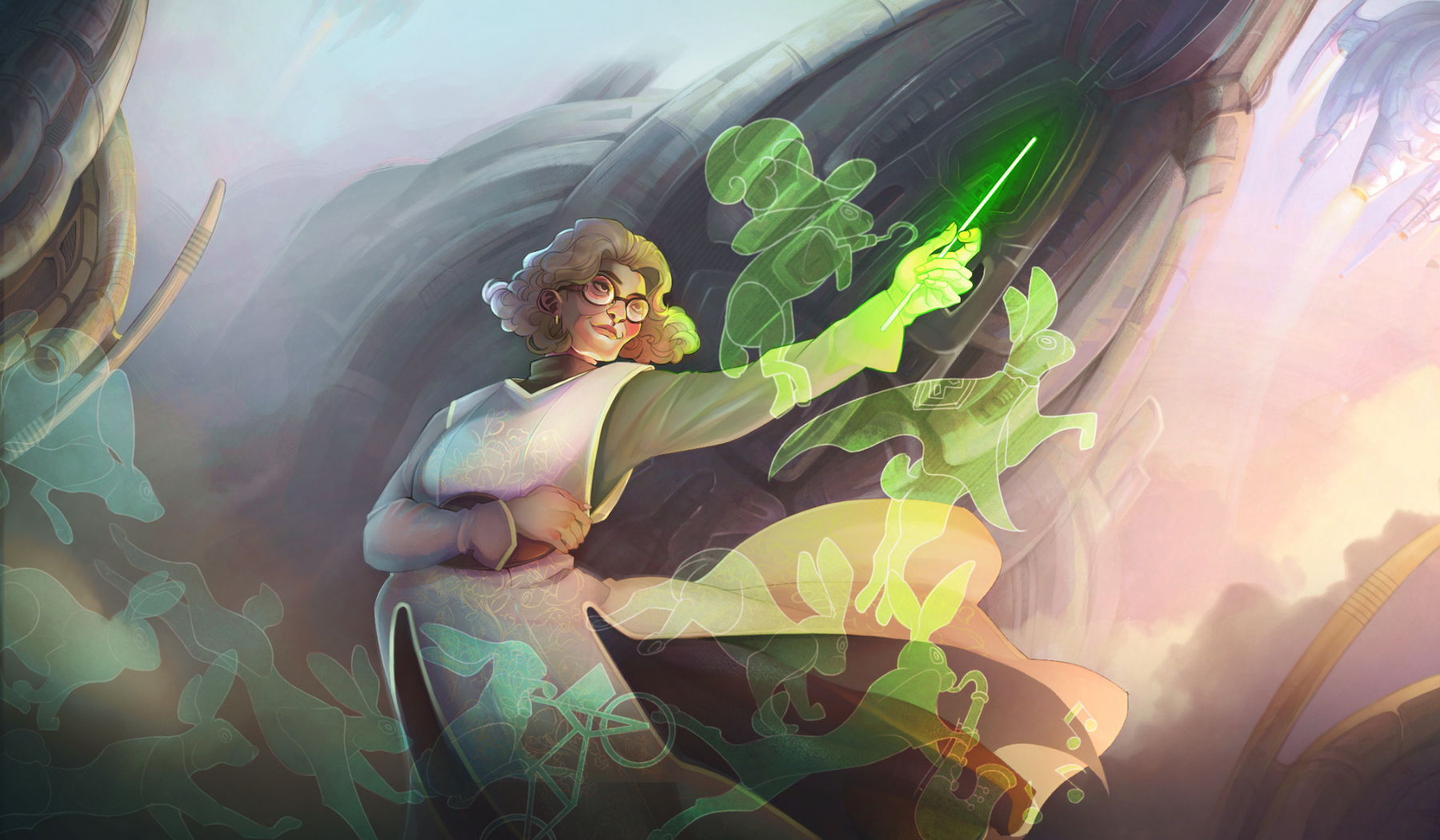
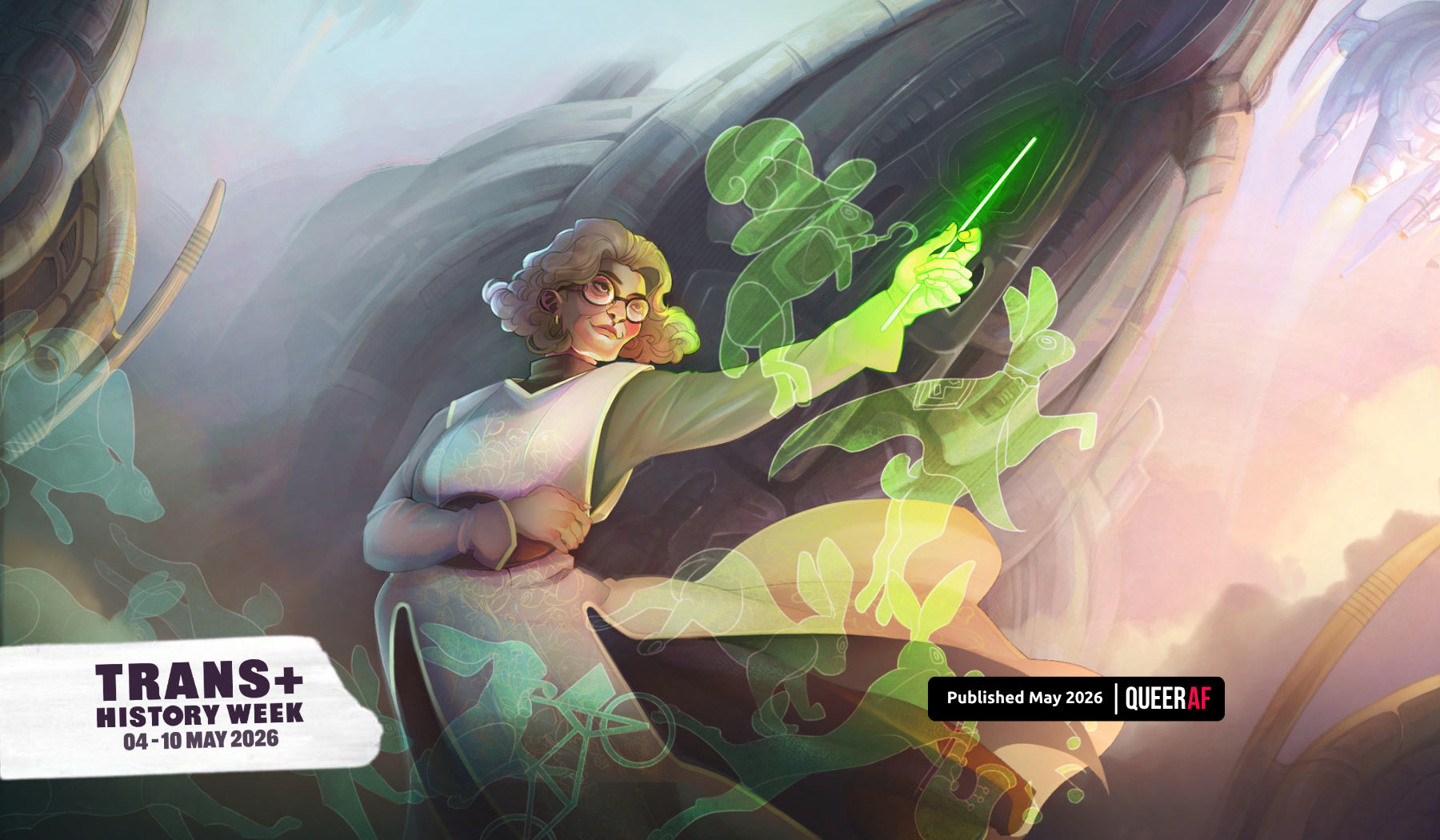
🎨 Artwork description, by David Woods Meland
Digital artwork depicting a woman, sandy curls glancing her cheeks as she sweeps forward with glowing green baton. Spiralling around and under the billowing fabric of her dress, a stream of rabbits march, aglow and shifting shape, as if compelled to embody the very themes that orchestrator and composer Angela Morley conducted. Like Morley's own scores, we hoped to create an image reminiscent of the dynamicism and presence of her work. Not unlike the lilt of sweeping strings as they pitch into a grand cacophony of strutting horns, this piece is a shifting cycle of motifs. The contrast between the ethereal Angela and the imposing fleet of ships passing overhead provoke a scene that is, in some ways, at odds with itself, but hopeful and resolute as the accomplished conductor ushers in the harmonising light of a new dawn.
Angela returned to England with little fanfare, letting her new name and gender presentation do the talking. Unfortunately, she was met with lewdness and cruel comments. It became so bad that she almost quit Philips Records, until a close collaborator convinced her to stay. A role model for all allies.
Angela’s magnum opus remains the peerless score for Watership Down. No other work quite distills her duality of light and dark, what conductor John Wilson called the “wistful melancholy” of her work. It’s the sound of yearning, loss, and hope; transness made music. And it resonated, ranking in Classic FM’s Movie Music Hall of Fame on the centenary of her birth. Remarkably, Angela composed it in only three weeks.
Its recognition, however, was immediate, earning an Ivor Novello Award nomination and helping cement the film’s enduring legacy. In 2015, Sarah Wooley wrote a BBC Radio 4 drama providing a semi-fictional account of Angela’s involvement. Despite being voiced by trans actor Rebecca Root, the drama diminishes Angela’s transness. A common side effect in so much media representation when cis writers, however well-meaning, are the ones telling our stories.
From the late seventies onwards, Angela helped John Williams make his scores a reality, orchestrating on Star Wars, Superman, The Empire Strikes Back, E.T., Home Alone, Hook, and other famous pictures. To this day, her work soundtracks countless Christmases and comings-of-age.
Remembering Angela after her death, Williams said: “She was certainly one of the finest musicians I've ever known or worked with. As an orchestrator, her skill was unsurpassed, with a technical perfection that was drawn on and nourished by a lifelong devotion to music.”
Although much of her Hollywood film work remains frustratingly uncredited, Angela didn’t go entirely without recognition. She won three Emmy Awards and received eight further nominations. She was the first openly trans person to be nominated for an Academy Award, as important a milestone as Wendy Carlos’ historic triple Grammy win.
As with Carlos, Angela has slipped into obscurity. All the accolades, praise, and acclaim she received in her time should have resulted in the creation of a household name. Had she come out in her teens or twenties, her career probably never would have started. Now, imagine if she’d never come out of the closet at all. It’s likely she’d be spoken about in the same reverent breath as Ennio Morricone, Howard Shore, and John Williams himself.
What can we learn from this history?
The system is rigged to minimise the lives of Trans+ people, to deny credit for their contributions. Even her Rainbow Plaque in her native Leeds significantly downplays her accomplishments, while another from the British Plaque Trust deadnames her.
Angela’s music is characterised by a clarity of emotion. From hope to grief, she passed on her love of music and lived experiences through film scores, instrumentals, and collaborations. Millions of people still experience that clarity today.
Most of these listeners are cis, and have no idea a trans woman has shifted their emotional states and contributed to childhood nostalgia. But this ignorance doesn’t erase the fact people felt – and continue to feel – these responses. It’s time we stopped shutting Trans+ people out of their own achievements, give them the credit they deserve, and ensure their names burn bright.
Looking back at your own history, are there any memories you have of these classic soundtracks? How does it feel knowing, a Trans+ person was there - scoring the sound of hope behind them?
Morley, is one of many trans women of this era, who because of her identity, has had her accomplishments diminished and tucked behind the men that they worked with. It's time to change that.
Trans+ History Week is here to play it's part in the fight back against anti-trans narratives - by investing in Trans+ creatives, to tell history stories.
Stories, with lessons that help us in the march ahead. And that's where we need your help. Information is a tool for liberation, and we need to escalate the work we're doing here at QueerAF with Trans+ History Week - so more people can access it, and use it in the fight ahead.
QueerAF's biggest source of revenue is from readers like you and our newsletters are ad-free. It helps us focus on our work, instead of chasing clicks for advertisers.
This week, we're running a sale on our most popular membership - to make it super easy to support our work, and award-winning journalism. So please upgrade now. Help us invest in Trans+ creatives to give our community the history lessons it needs - to win the fight back.
15% off Monthly - £5.95 / 15% off Annual - £50.15
All memberships come with a number of perks like early access, a greater say on content, plus discounts on events and merch.