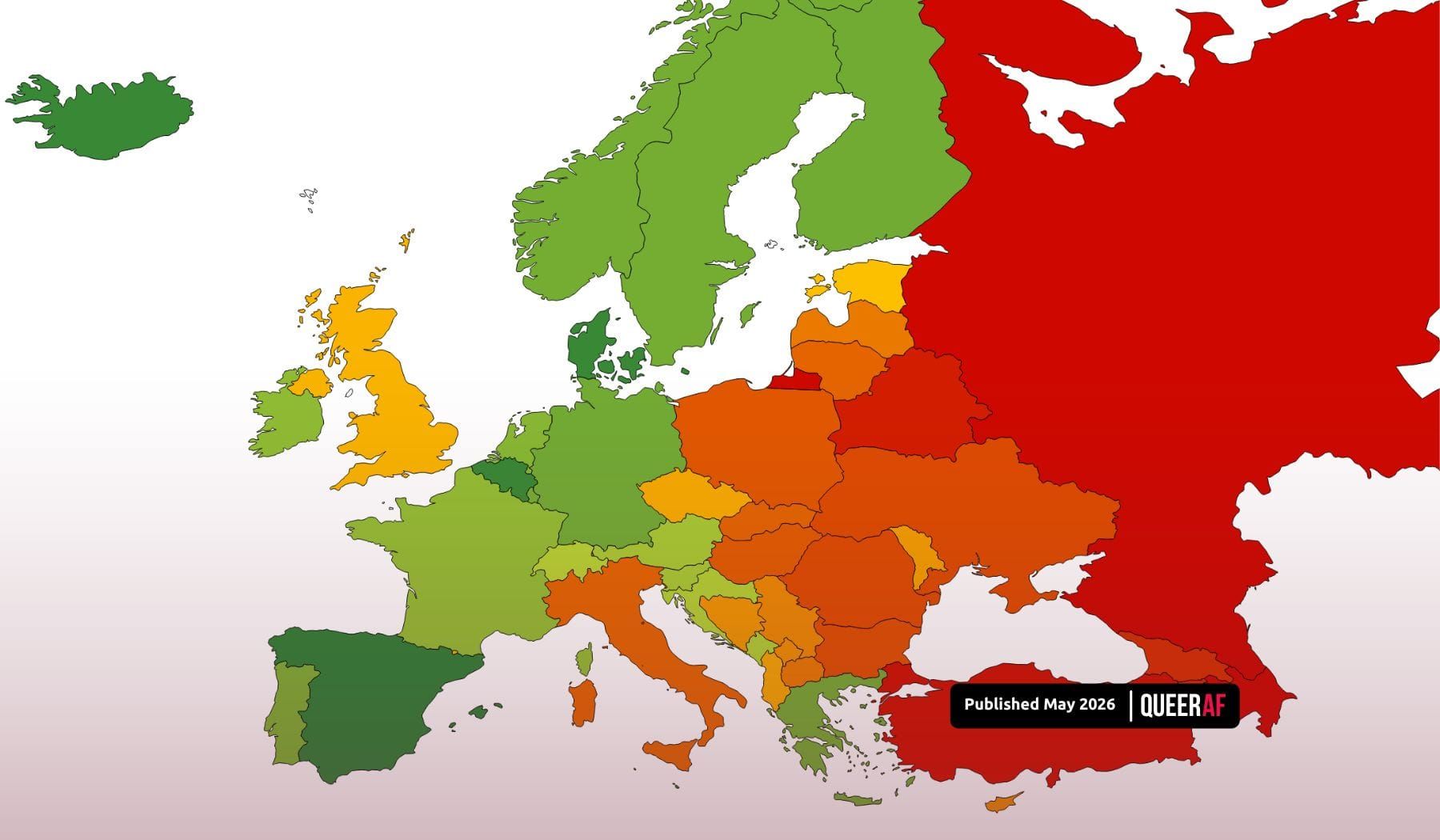

The United Kingdom has slid down yet again in the ILGA Europe annual Rainbow Map ranking of countries’ LGBTQIA+ rights provisions. Though it stays in 22nd place, it now has a ranking of only 44%, just one point above the Europe-wide average.
ILGA Europe, the international LGBTQIA+ rights NGO that produces the rankings, said the UK lost two points "following the Supreme Court decision on the definition of women and sex", and also because of a High Court ruling that trans men cannot be automatically registered as a parent of their children.
The annual map has been produced since 2009. The UK held the top spot in the ranking in 2015, but in the decade since it has slid to the middle of the list following successive rollbacks of rights and a barrage of anti-Trans+ rhetoric from politicians, the media, and increasingly the judiciary.
Spain took the top spot this year, after Malta held it for a number of years. Deputy Director of ILGA-Europe, Katrin Hugendubel, said Spain's number one ranking is a "strong example of what becomes possible when a government makes a deliberate choice to advance equality rather than retreat from it."
"We see this same spirit in leaders like Zohran Mamdani in New York, who are refusing to bow to the authoritarian pressure of this moment and choosing instead to stand with their communities. Of course, more needs to be done in Spain, but this is a reminder that political courage is a choice, and that governments who make it can effectively push back.”
Intersex people remain the least well protected section of the LGBTQIA+ community across Europe according to the rankings, with only a handful of countries receiving any points in the ‘intersex bodily autonomy’ category.
Though Trans+ rights remain on the frontline of attacks, there was some progress across the continent, with Albania introducing new gender-based discrimination legislation recognising Trans+ people. In Czechia and Latvia, legal gender markers can now be changed without sterilisation.
Austria introduced alternative gender markers for non-binary people, while in Croatia and Poland, the administrative measures for legal gender recognition have been improved. Sweden was the only country to have introduced new legislation on legal gender recognition this year.
The annual Transgender Europe map was also launched this week. It too found that while more positive developments have been recorded than in recent years, "many of these hard-won shifts are driven by activists and courts rather than proactive government action."
TGEU’s Chair, Isa Nico Borrelli, said: “Trans rights are not moving forward because of governments. They are moving forward because trans people, activists and communities are forcing change against all odds.”
ILGA also warned of fights ahead, with warnings that Italy's new security law contains provisions that risk curtailing freedom of assembly, including Pride marches. Meanwhile, Portugal has advanced legislative drafts that would severely roll back protections for trans and intersex people.
Slovakia has introduced constitutional amendments defining sex as immutable and assigned at birth, making legal gender recognition impossible and restricting legal parenthood to a mother and father. It also pinpoints Turkey and Russia as countries where being LGBTQIA+ is getting increasingly difficult due to strict right-wing crackdowns on communities.
Analysis: Our fight back is stronger than they want you to know about
From 1st to 22nd in just ten years. It’s a damning reflection of the UK's slide away from being a world leader on LGBTQIA+ rights. And it is a critical reminder of how quickly homophobia, transphobia and hate towards our community has become permissible by the media, politicians and now the judiciary.
However, these reports provide a key insight: the work of activists, using democratic systems, is paying off. While progress may seem slow, we're winning in many countries despite powerful figures who would like to see us put back in the closet.

We need more investment in queer accountability journalism.
Our rights are under attack, and navigating how to fight back is only possible with quality, fact-checked, accessible information - written by LGBTQIA+ journalists.
We're a small but mighty publisher, and are so glad you trust us every week to bring you a selection of the top queer news, unique perspectives and content everyone's talking about in this newsletter.
If QueerAF had more resources, I can assure you - we'd double down even further on our investigations and news output, but even more so: We'd train, mentor and invest in an even bigger new generation of queer journalists.
In just four years, we've supported 150 LGBTQIA+ creatives to develop their craft and careers.
We're not going anywhere, and that work continues.
We can't do it without you, so if you can - please start your monthly or annual membership to QueerAF, so we can help even more people fight back.