

Exclusive | TL;DR: A ‘gender critical’ Scottish Labour executive committee member and councillor failed to declare on her register of interests the company she set up to sue her trade union, in an apparent breach of the Scottish Councillors’ Code of Conduct. Her legal action, which begins next week, seeks to force her union to implement “trans exclusionary” guidance.
A Scottish Labour councillor will be in court next Friday (25 September) to attempt to force her trade union to implement the EHRC’s “trans-exclusionary” guidance. But, in an apparent breach of her legal obligations as a councillor, she has not declared her role in the private company she set up to fight the legal case - QueerAF
Since October 2025, councillor Alison Ann-Dowling has been on the board of directors of ‘gender critical’ company Adult Female Trade Unionists – yet this role does not appear on her councillor’s register of interests, QueerAF can reveal.
Ann-Dowling has been the councillor for Renfrewshire ward 10, which comprises the small villages of Houston, Crosslee, and Linwood in the west of Scotland, since 2017. A member of the Community union, which represents workers regardless of the sector they work in, she is also the deputy leader of the Labour Group on Renfrewshire Council and sits on Scottish Labour’s executive committee.
Adult Female Trade Unionists, or ADFEMTUS LTD, is a private company that Ann-Dowling and former Edinburgh councillor Norma Austin Hart set up to campaign for “women’s sex-based rights in the trade union movement”. Its purpose is listed as “trade union activities” - Companies House
However, despite Ann-Dowling’s legal obligations to report such interests, this appointment does not currently appear on her register of interests as a councillor for Renfrewshire Council.
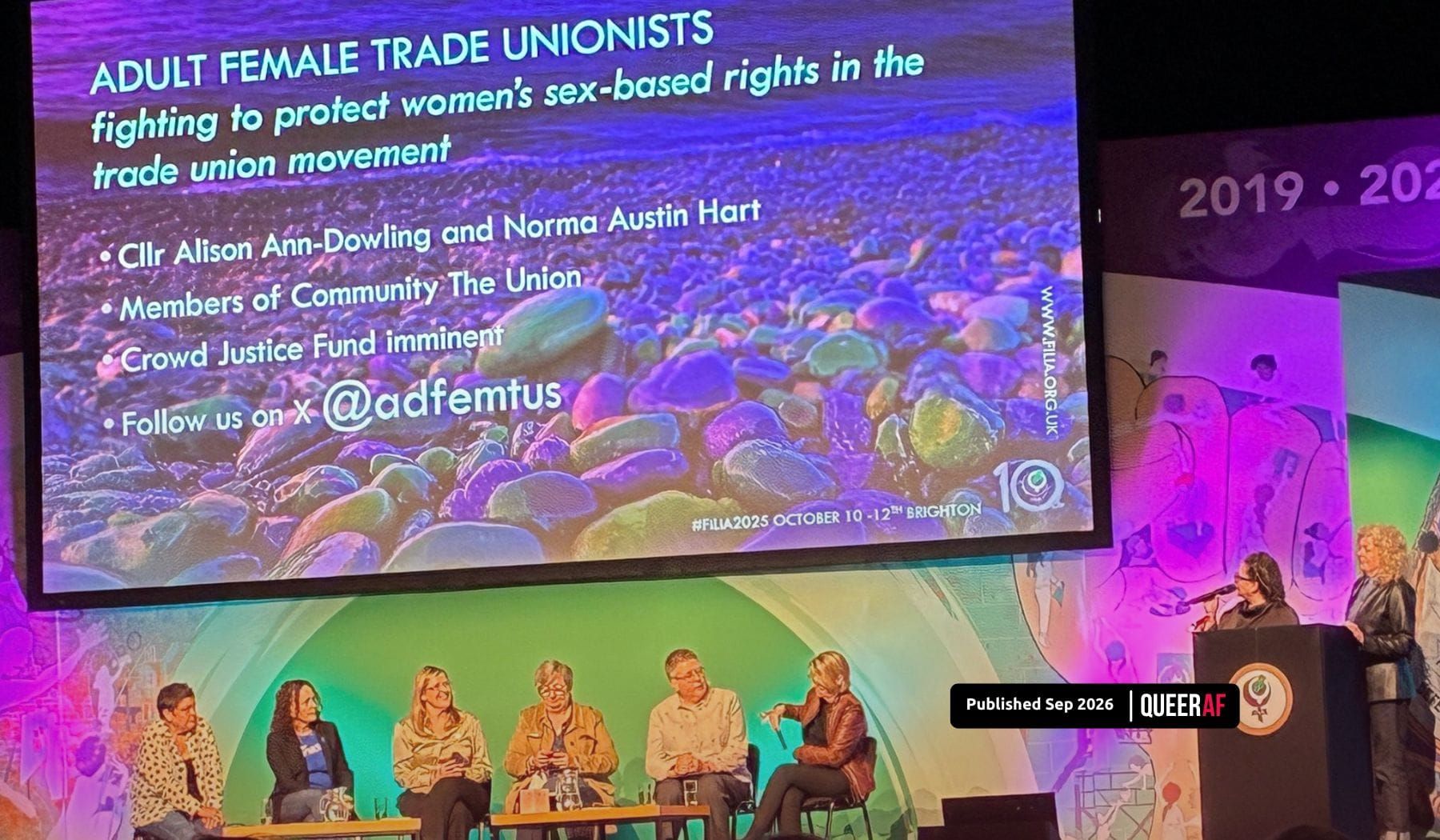
Eleven months ago, at the gender-critical FiLiA 2025 conference, Ann-Dowling and Hart publicly declared that they would be launching a crowdfunding campaign for the legal costs of the upcoming case. But in a statement to QueerAF, Ann-Dowling said that they in fact did “not establish a crowdfunder” and that the legal costs of the case would be “met by a private donor”.
“I am an unpaid Director of an organisation established to campaign for women’s rights,” Ann-Dowling told QueerAF. “I am in the process of noting it [in] my register of interests.”
Why is Ann-Dowling suing the Community union?
Ann-Dowling and Hart announced plans to sue their union, Community, over its Equality Policy in a Substack publication called The Frontline. Community’s policy refers to “women and non-binary people” in its gender section, which Ann-Dowling and Hart claim goes against the April 2025 Supreme Court ruling on the Equality Act - Personnel Today
The women are also making claims of victimisation, as they claim they were threatened with disciplinary action following the initial Substack post.
A Community spokesperson told QueerAF they are “an inclusive trade union committed to increasing gender diversity” within its democratic and leadership structures.
“Our Gender Equality Strategy reaffirms that commitment and supports the steps we are taking to build a more representative union. We strongly refute suggestions that the union has acted unlawfully, and remain confident that our approach is consistent with both our values and our obligations.”
In April 2026, Ann-Dowling and Hart were granted permission to proceed with their judicial review of the policy in Scotland’s Court of Session, which handles high-level civil cases. Their hearing is due to take place on September 25 in Edinburgh, as listed on the Scottish Courts and Tribunals website - The Scotsman
The women are represented by Balfour + Manson LLP, the same firm that represented For Women Scotland in their successful bid to exclude trans people from being recognised as the correct gender under the Equality Act 2010 - Supreme Court
What does the code of conduct say?
The Scottish Councillors’ Code of Conduct states in section 4.22 that councillors must register non-financial interests, defined as “those which members of the public with knowledge of the relevant facts might reasonably think could influence my actions, speeches, votes or decision-making in my council”.
They must register these interests within a month of any changes occurring. Relevant interests include being a member or holding an office in public bodies, companies, and trade unions.
Ann-Dowling currently lists non-financial interests in several ‘gender-critical’ organisations. She has declared herself as a supporter and donor to the LGB Alliance, a donor to FiLiA, and a supporter of the Labour Women’s Declaration, which aims to “hold Labour to account on women’s sex-based rights” - Renfrewshire Council
She has also listed several organisations where she’s a member, including credit unions, the Renfrewshire Citizens’ Advice Bureau (where she was previously chair), Fostering Network, and Re-engage, an organisation she volunteers with.
According to the Councillors’ Code, Ann-Dowling should have declared her role as a director of ADFEMTUS LTD within a month of October 17, 2025 when she assumed the position.
The Councillors’ Code applies when someone has identified themselves as a councillor at the time of the conduct in question. On ADFEMTUS LTD’s Companies House profile, Ann-Dowling lists her occupation as “politician”.
When launching Adult Female Trade Unionists at the October 2025 FiLiA conference, Ann-Dowling was introduced as “councillor”, and her official X account was tagged in social media posts announcing the launch - FiLiA
In the event of a breach of a code of conduct, the Ethical Standards Commissioner on the council will investigate if a complaint is made.
What is Ann-Dowling’s record on Trans+ issues?
As a Renfrewshire councillor, Ann-Dowling has been outspoken about her ‘gender critical’ views, including through her policies.
On May 1, 2025, she brought a motion to the council congratulating For Women Scotland, Sex Matters, Scottish Lesbians and the Lesbian Project for their win at the UK Supreme Court. The motion also instructed the council to move towards ensuring “compliance with the Supreme Court ruling” for both the council itself and any services it runs or commissions.
Earlier in 2025, she presented a motion at the Scottish Labour Party Conference endorsing the flawed Cass Review and calling for the recommendations to be implemented in Scottish schools, which was ultimately rejected. She described “gender ideology” as the “pediatric medical scandal of the century”.
Ann-Dowling also advocated against the Scottish government’s Gender Recognition Bill, which aimed to simplify the process for trans people to be legally recognised as their correct gender. She was criticised by the Scottish Greens for appearing at a rally organised by For Women Scotland - The National
Renfrewshire council declined to comment to QueerAF for this story.
Analysis: Following the money, and holding it to account
The Supreme Court judgement of April 2025 gave ‘gender critical’ campaigners a precedent to push for trans-exclusionary policies in public institutions, including councils and unions.
Ann-Dowling and Hart’s legal action against Community is just one example of a vocal ‘gender-critical’ minority weaponising the EHRC guidance to force policies that will ultimately exclude Trans+ people further from public life.
The legal action may seem small in scope, but should be understood as part of a broader strategy to suppress Trans+ inclusion through the courts. It’s worth remembering that For Women Scotland, using the same legal representation as Ann-Dowling and Hart, started off as a minor Scottish case but ended up fundamentally changing a major piece of UK legislation.
Nevertheless, bringing forth such legal actions is expensive. While some people have launched crowdfunders to cover legal fees, they may also receive support from the movement’s wealthy backers.
It’s important to follow where the money for ‘gender critical’ legal actions is coming from and hold those involved accountable, particularly when they breach the obligations of a public office.
An investigation from the Thomson Reuters Foundation found that between mid-2017 and 2020, over £800,000 was raised for lawsuits pushing back against Trans+ rights. For Women Scotland later launched a crowdfunder to support their Supreme Court challenge, which raised over £232,000. In a similar case to Ann-Dowling and Hart’s, retired civil servant Fiona MacDonald raised over £30,000 to sue the Public and Commercial Services Union for “gender critical discrimination”.
Women’s organisations and service providers have long been underfunded in Scotland and the rest of the UK. Just last July, campaigners, including trade unionists, gathered on Glasgow’s Buchanan Steps to protest cuts in funding for specialist women’s services such as the women’s service at Murray’s Initiative supporting survivors of gender-based violence experiencing addiction.
Imagine what these organisations could do with the millions of pounds being raised for ‘gender critical’ lawsuits. One thing is certain: it would definitely have a greater material impact on women’s health and safety than removing the word “non-binary” from a trade union’s gender equality policy.
We need more investment in queer accountability journalism.
Our rights are under attack, and navigating how to fight back is only possible with quality, fact-checked, accessible information - written by LGBTQIA+ journalists.
We're a small but mighty publisher, and are so glad you trust us every week to bring you a selection of the top queer news, unique perspectives and content everyone's talking about in this newsletter.
If QueerAF had more resources, I can assure you - we'd double down even further on our investigations and news output, but even more so: We'd train, mentor and invest in an even bigger new generation of queer journalists.
In just four years, we've supported 150 LGBTQIA+ creatives to develop their craft and careers.
We're not going anywhere, and that work continues.
We can't do it without you, so if you can - please start your monthly or annual membership to QueerAF, so we can help even more people fight back.