
Exclusive | TL;DR: The Ministry of Justice's new transgender staff policy, part of a wider roll out of guidance for trans staff across the civil service, sets they "must tell" managers of their trans identity if they search prisoners. Trans+ civil service, prison and probation staff members have also been told they "must not use single-sex facilities designated for your affirmed gender."
New guidance from the Ministry of Justice, seen by QueerAF, sets out that Trans+ civil service, prison and probation staff members have been told they "must not use single-sex facilities designated for your affirmed gender."
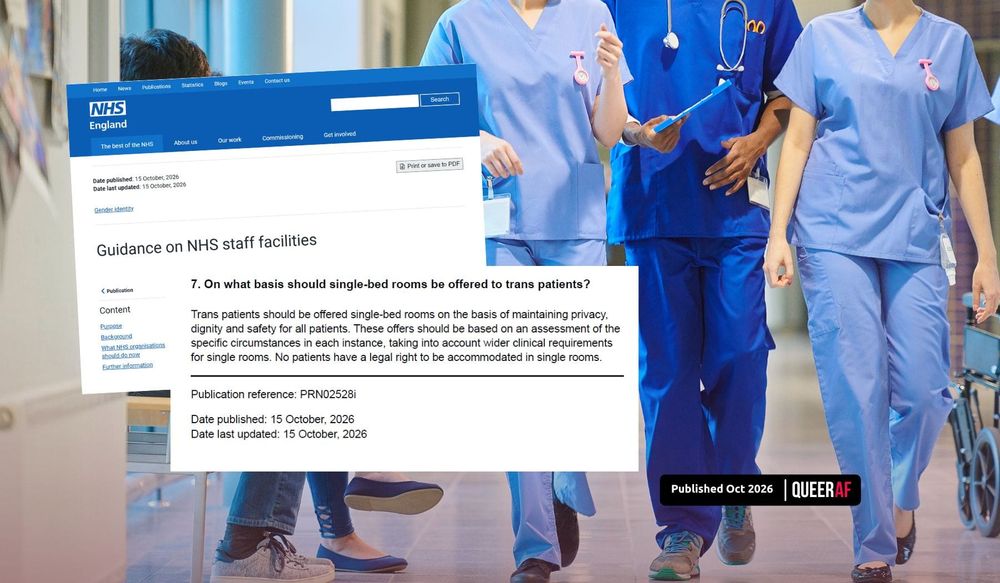
The guidance, dated September 2026, mirrors advice from the Ministry of Defence, the NHS and, as a government spokesperson has now confirmed to QueerAF, a wider civil service rollout of the EHRC Code of Practice, which has followed a seemingly coordinated timeline.
It means the effective segregation of Trans+ staff in Ministry of Justice run workplaces to "alternative arrangements" including mixed sex or accessibile toilets if they do not want to use single-sex facilities aligned with their sex assigned at birth.
It does set out that Trans+ staff "have a right to privacy about their gender identity and gender transition", however, this is countered by an exception in cases "where certain duties are segregated by sex.”
In examples such as officers who search prisoners, trans people have a duty to tell their manager they are transitioning, have transitioned, or are planning to transition. The policy sets out this duty to disclose applies to any jobs or duties "segregated by sex".
In guidance to managers, it sets out, "if a member of your team is performing, or may be asked to perform, duties that are segregated by sex, they must tell you if they are transitioning or proposing to transition."
Managers are, however, instructed to support staff transitioning, including special and, in some instances, paid leave for gender-affirming care, appointments and mental health care.
It also states that staff should not "monitor" who uses which workplace facilities, and that if there are concerns, they should raise them with a manager rather than the individual.
The policy covers staff, not service users, and applies to His Majesty's Prison and Probation Service (HMPPS), His Majesty's Courts and Tribunals Service (HMCTS), the Ministry of Justice civil service and all its arm's-length bodies.
Analysis: EHRC code put into practice across English society
Overall, the policy in the Ministry of Justice feels more affirmative towards Trans+ people in tone, with more explicit care set out for the community, than others across the civil service that QueerAF have seen, but critically - only when considered relatively.
A section about misgendering and dead-naming is explicit about the harm it causes. However, as with all the codes we've seen, it explicitly states that because beliefs are protected, you don't have to respect people's pronouns. If your belief is as such, you are instructed to use people's “chosen or given name” instead of using the wrong pronouns.
Overall, no matter how affirmative some sections are of Trans+ identities, the nature of the EHRC's directive, which has shaped all these policies, is that any affirmations are undermined and undone by protections for anti-trans people's beliefs.
The MoJ's code will have the same impact and harm as the wider civil service and NHS rollout, making the Ministry of Justice, prison and probation service an inhospitable environment for Trans+ people to work in.
The Cabinet Office responded on behalf of the Ministry of Justice, saying only: “Departments are responsible for their own internal policies. We will always ensure these remain legally compliant and are updated in line with the Supreme Court ruling and latest case law.”

The implementation of the EHRC code is creating a stark and scary context for Trans+ people
Segregation has already begun - with a now widespread rollout across the civil service, in schools and in the armed forces.
Despite claims 'sex questioning' will be rare, forms of gender policing have been on the rise since anti-trans movements gained a foothold in the public sphere.
We're aware of all kinds of attempts to undermine Trans+ rights taking place at businesses, in government and in civil society. But we simply don't have the resources to investigate them all.
To deliver high-quality journalism and hold power to account, we need your help.
It's clear there are dark and powerful forces behind those who are seeking to take away our rights.
QueerAF has a proven track record of bringing them into the light, so you can use that information to fight back.
Help us deliver even more queer accountability journalism with a QueerAF membership. They start at just £4 a month and every membership helps us invest in Trans+ journalists, in the fight back for all of us.