
Exclusive | TL;DR: The Ministry of Defence's own equality impact assessment warned about "adverse impacts" of guidance, revealed by QueerAF, which will see Trans armed forces members often segregated from single-sex spaces; could create increased risk of ‘sex policing’, "exclusion" and lack of "dignified provision". It also found it could affect disabled service personnel and civil servants. Despite this risk, the assessment recommended continuing to implement the policy.
The Ministry of Defence's equality impact assessment of changes to policies for Trans troops and civil servants warned of "potential adverse impacts" on Trans+ and disabled people, but recommended implementing them regardless.
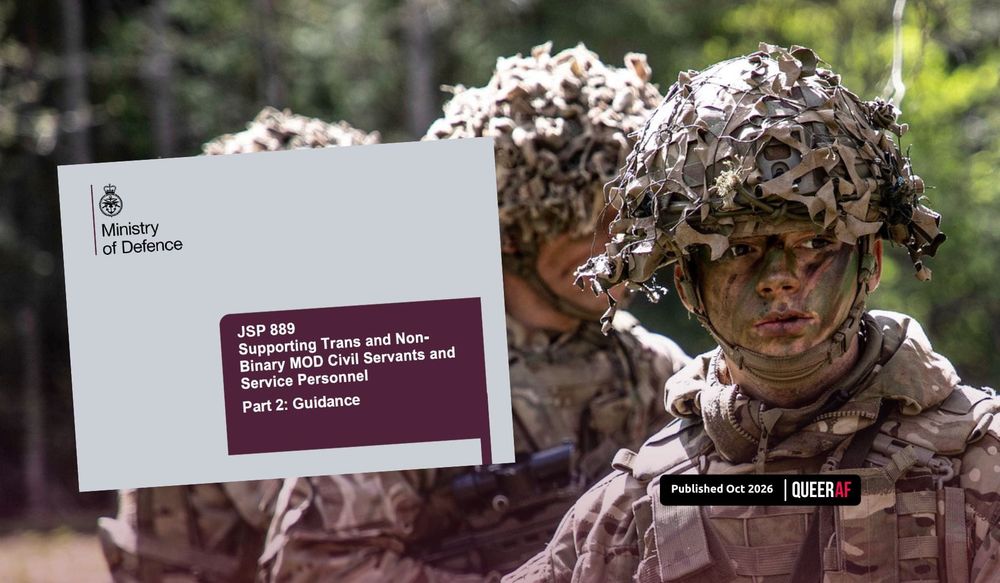
The guidance revealed by QueerAF last week sets out that Trans service members and civil service staff will be "accommodated in line with their biological sex". It sets out that if this is "undesirable or impractical," they will instead face segregation into individual, mixed-sex or gender neutral facilities.
Trans troops, who have already been affected by the guidance, have told QueerAF that despite the mitigations built into the Joint Service Provision (JSP), they have already faced some of the impacts the assessment warned of.
Speaking anonymously, three Trans+ service personnel have said they plan to leave the armed forces in the wake of the guidance, at a time when the UK armed forces are facing a retention and recruitment crisis.
Samantha, who has worked in the forces for multiple decades, says they won't be the only ones: "I feel neglected, and it's made me think it's time to leave the armed forces, and the country. I can’t be in an organisation that doesn’t see me as a human.”
"My name will simply be added to a growing list of former service personnel, further weakening an already overstretched and depleted workforce. Getting rid of us is one more person out of work at a time when we’re under-resourced and understaffed.”
She also added that it will harm the UK's ability to defend itself because the guidance will make trans people undeployable.
What did the MoD Equality Impact Assessment warn of?
The Equality Impact Assessment set out that the policy could create increased risk of sex questioning and informal “policing” based on assumptions about people's appearance, alongside risks of exclusion and lack of "dignified provision" for Trans+ troops.
It also warned that non-binary people surveyed ahead of the changes said they would "feel 'pigeonholed' if required to use facilities based only on biological sex."
It states that this can be mitigated by saying Trans+ service personnel are not required to out themselves to any MoD representative. But the JSP also says this does not mean that an individual can never lawfully be asked to disclose or confirm their sex:
"Where sex is relevant to the lawful provision of a service, exercise of a public function or other legal requirement, an organisation may ask for confirmation of an individual’s sex."
It also highlighted the need to communicate the policy proposal well, and that trust would be affected if it was communicated poorly or outside the chain of command. Samantha found out about the changes from a WhatsApp group:
“There was very little top-down support from the chain of command when the JSP was released, I found out about it in a WhatsApp group. Everything has been hearsay. And it was like, OK, so I don’t have the same rights as yesterday.”
Could troops face repercussions for using the toilet?
The JSP is an official policy, which means breaches are considered punishable offences.
Samantha, a senior member of the forces, said these will be delivered on a 'case-by-case' basis, as it depends on the subjectivity of officers across the armed forces.
For the troops we spoke to, the fear, however likely or not, was clear. If they used a toilet that aligned with their gender identity, they all expressed that it could lead to the kind of repercussions you'd expect for any breaches.
While this may start with warnings, it can lead to pay and promotion restrictions or, for repeated breaches, a court-martial. If convicted, a trans woman would then be held in the male “corrective training centre” in Colchester, for between 14 days and up to two years.
Trans troops we spoke to said they've already faced warnings for using the toilets, and shared how other officers have been watching and reporting them. It's also already created situations where people have been forced to out themselves.
Ellis, who works for the RAF, told us the changes felt like an "overnight switch", adding, "I shouldn't be put in a position of being outed, it's affected my ability to be deployed, which affects my career. I'm considering leaving the Air Force and the country because of the new rules."
JSP 889 deemed "unworkable"
The provision states that disabled toilets should not be the "default" alternative for Trans+ personnel, or it could have "potential adverse impacts" on disabled service personnel and civil servants.
But Jodi, who works in Cyber and Specialist Operations Command, told QueerAF the defence estate is in a "horrendous condition", detailing major issues with armed forces buildings, and in relation to the JSP she said there is a notable lack of gender neutral and accessible toilet provision to accommodate Trans+ people under the rules.
She is also not the only troop who told us that early adaptations of these rules by different areas of the military in the wake of the Supreme Court ruling have made Trans+ troops undeployable, putting additional strain on the limited resources the UK armed forces already have.
"It basically renders me undeployable, and therefore militarily useless," Jodi told us. "We already have a recruitment and retention crisis in the MoD, and this is going to have us all heading for the exit; why would we fight for a country that treats us as second-class citizens?
"It's bizarre we’re trusted to defend the nation, and risk our lives for it, but not allowed to pee. I’m going to leave my job with the MoD and the country over this. Apparently I’m the threat, not the Russians."
Samantha concurred, adding that she believes this choice has been made intentionally to drive Trans troops out of the services:
"They know it's unworkable, that’s intentional, so we give up and leave. They’re aware the impact is that it will make trans people such a problem that organisations and managers will decide that we’re more trouble than we’re worth. It's a short-sighted, cowardly approach."
Responding to our requests for comment to multiple government departments, a Government spokesperson confirmed guidance had been issued to transgender staff across the Civil Service, and added:
“Departments are responsible for their own internal policies. We will always ensure these remain legally compliant and are updated in line with the Supreme Court ruling and latest case law.”
Analysis: Trans+ people seen as more dangerous than the Russians
The head of the army, General Sir Roly Walker, this week said that Britain's political leaders will soon be having a “frank conversation” with the public about the sacrifices we need to make in the event of war "to prioritise defence and security".
“There was a time that our nation didn’t want to think of a time when it would need its soldiers to fight in a war. But as anyone who is studying the trajectory of world affairs and the geopolitical system within which our nation sits and thrives will realise there is extreme jeopardy in the world at the moment, and the business of soldiering is coming back into the nation’s psyche,” he told 700 troops this week. The comments seemingly pre-empted a new campaign from Defence Secretary Wes Streeting, who told Britons to stockpile goods and prepare for natural disasters, cyber-attacks or state-sponsored terrorism and 'Be Ready'.
In that context, the MoD is implementing rules that will limit staff numbers, which has already led to troops being questioned over which toilets they're using and facing warnings and reprimands. The army says between 3,000 and 6,000 service personnel are LGBT, around 3-5% of all UK armed forces.
This shift hasn't come from nowhere. Behind the rules are the EHRC code of practice, waived through by Keir Starmer's Labour government, and being implemented across the civil service under Andy Burnham's stewardship.
Just a year ago, the British Army's most senior transgender officer, Colonel Grace Sangster-Wall, said she thought it "unlikely" that Trans+ personnel would serve in the Armed Forces beyond 2026. Making the comments on the 25th anniversary of the lifting of the ban on gay people in British Armed Forces, she said "The harsh reality is that it's unknown if, and increasingly unlikely that, I and those trans service persons that I support and I will be able to serve into and beyond 2026." At the time, the MoD rejected her warning and the 2026 date - but committed to being "guided by the revised EHRC Code of Practice."
That ban is something the MoD is still dealing with the reparations of all these years later. Streeting also said this week he was attempting to settle a court challenge to the Government's compensation scheme for veterans who were forced out for being gay. The judicial review follows two veterans being denied compensation, despite what they believe is their clear eligibility.
And perhaps the Armed Forces are walking straight back into the same mistake that will require even more reparations. Based on the troops we've spoken to, who've said it's rendered them undeployable and "militarily useless", much like the Section 28 2.0 approach in education, it has effectively created a backdoor ban that looks set to force trans people out of the Armed Forces.
Politicians can stand up and say it's not an outright ideological ban, but the gender-critical ideology that underpins the new approach has made it next to impossible to be trans in the armed forces and serve your country. It delivers the same impact, without the accountability and ownership.
*Names have been changed to protect identities.

The implementation of the EHRC code is creating a stark and scary context for Trans+ people
Segregation has already begun - with a now widespread rollout across the civil service, in schools and in the armed forces.
Despite claims 'sex questioning' will be rare, forms of gender policing have been on the rise since anti-trans movements gained a foothold in the public sphere.
We're aware of all kinds of attempts to undermine Trans+ rights taking place at businesses, in government and in civil society. But we simply don't have the resources to investigate them all.
To deliver high-quality journalism and hold power to account, we need your help.
It's clear there are dark and powerful forces behind those who are seeking to take away our rights.
QueerAF has a proven track record of bringing them into the light, so you can use that information to fight back.
Help us deliver even more queer accountability journalism with a QueerAF membership. They start at just £4 a month and every membership helps us invest in Trans+ journalists, in the fight back for all of us.