
TL;DR: The chair of the EHRC has claimed in a letter to a Labour MP that sex questioning under the updated Code of Practice will be “rare and exceptional”. Academic research and accounts of lived experience dating back more than a decade show this is not the case – and suggest it is becoming more common - by Sophie Perry
The chair of the Equality and Human Rights Commission (EHRC) has claimed cases of someone being asked to confirm their sex in order to access single-sex spaces will be “rare and exceptional” under the updated Code of Practice, in a letter seen by QueerAF. However, despite the Code not yet being in force, there is growing evidence that ‘gender policing’ in single-sex spaces is on the rise in the UK amid heightened anti-trans sentiment.
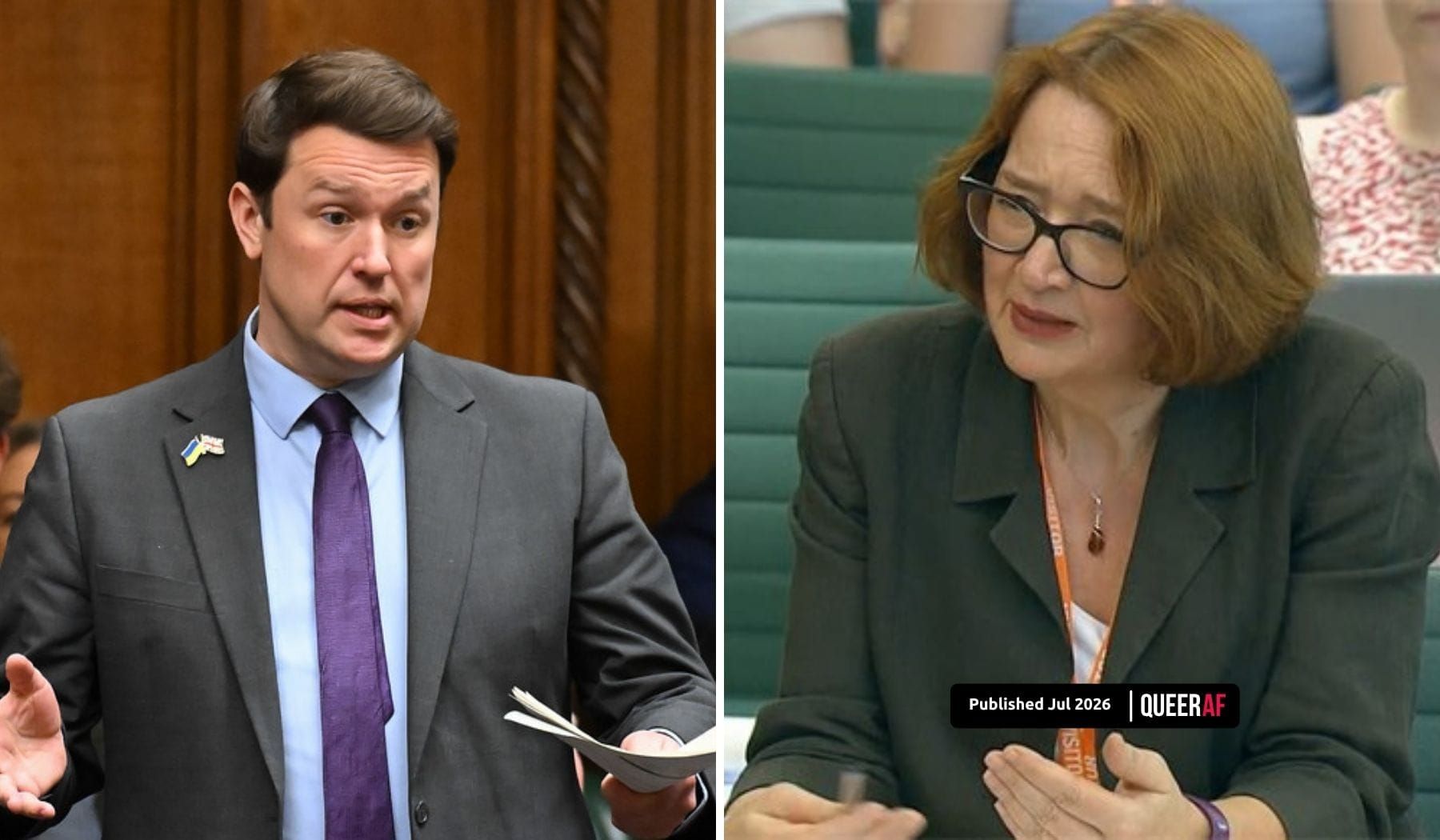
Dr Mary-Ann Stephenson, the chair of the EHRC, made the statement in a letter of correspondence to Labour MP Steve Race, where details of the Code were discussed at length.
In the letter, Stephenson responded to the MP’s question on how staff working in organisations that are subject to the Code will be trained to ‘weigh up’ competing factors, including when to challenge people’s biological sex, who shoulders the risk in such circumstances, and how the proposed threshold of “genuine concern” in order to justify doing so should be measured.
In her response, Stephenson stated it is down to organisations themselves to decide how to train staff within their own specific circumstances, adding “asking someone to confirm their sex in relation to accessing single or separate sex services should be done sensitively and discreetly, and respect privacy” and the need to ask this will be “rare and exceptional”.
Following the Supreme Court decision from April 2025 that the protected characteristic of ‘sex’ in the 2010 Equality Act refers to “biological sex” only, the EHRC – the UK's equality watchdog – laid its updated Code of Practice before Parliament on May 21st - QueerAF
The draft Code of Practice for services, public functions and associations sets out that single sex provisions, such toilets and changing rooms, must be based on the definition of “biological sex” in the Supreme Court judgement, which it defines as “the sex of a person at birth”. Both the code and the ruling say this is the case even if a person has a Gender Recognition Certificate (GRC), which changes their legal sex – QueerAF
The code has been widely criticised by Trans+ organisations, international LGBTQIA+ groups and political parties as a “system of segregation” and "impractical, intrusive and inhumane", while the Lemkin Institute for Genocide Prevention labelled it a document that is “genocidal in nature”. More than 150 MPs have also signed a cross-bench Early Day Motion calling for it to be disapproved – QueerAF
From the date it was laid, Parliament has 40 days to disapprove it, which will end on July 9th owing to parliamentary recess – otherwise, it will be automatically waived through.
'Sex questioning' is far from new, and evidence suggests its increasing
There is growing evidence that a person having their sex questioned over use of single and separate sex spaces is already far from "rare and exceptional", as Stephenson claims.
Six months after the Supreme Court ruling, a report published by TransActual found incidents of Trans+ and gender non-conforming cis people being openly challenged in public spaces had increased markedly in the wake of the judgement. The vast majority of respondents who reported being challenged said they were questioned by members of the public rather than venue staff.
In one case, a trans intersex woman described using the male toilets during a work party as she was not out to her employer, “which was in accordance with the gender I was presenting as, the gender I was assigned at birth, and EHRC guidance”. However, security staff believed she should be using the female toilet as they presumed she was a trans man and ordered her to leave the event altogether.
In another case, a tall, flat chested cis woman with short hair described being surrounded by a group of women in a toilet at Victoria station, who threatened to call the police and told her “don’t you know you’re not allowed in here anymore” in the wake of the Supreme Court ruling.
“Before the ruling any challenges had been gentle, like ‘oh by the way this is the ladies’,” she was quoted as saying, “and people were embarrassed or apologetic when I said ‘it’s okay I’m a girl’, but now it’s aggressive and horrible.”
Speaking to The Guardian, Claire Prihartini – the wife of Good Law Project founder Jolyon Maugham – also described being questioned in a swimming pool changing room about her gender. Prihartini, a cis woman, was diagnosed with breast cancer in 2024 and had a bilateral mastectomy, which has left her a flat chest, two scars and no nipples.
In addition to this, prior research conducted by Ellis, McNeil & Bailey (2014) found Trans+ people often avoided gender-segregated spaces because of anticipated questioning, outing and harassment.
TransActual told QueerAF that in this “increasingly hostile environment” many trans staff are now choosing to work from home, have been forced to use different facilities at work, and in some cases, are opting out of using public and work facilities entirely.
“The Supreme Court ruling has had a severe and negative impact on trans people’s dignity and privacy at work and in public”. The organisation added the Code’s impacts are “being felt far and wide, regardless of how ‘rare and exceptional’ Stephenson may claim it will be for a trans person to be challenged”.
“A number of trans people have also reported being forcibly outed at work, or having their transgender status discussed among senior staff without their knowledge, as a result of this increased scrutiny.”
In a statement to QueerAF the EHRC, said: "The Code makes clear that it is unlikely to be either practical or appropriate to ask people about their sex in relation to facilities, like toilets, which are incidental to the primary service. It also explains ways services can prevent the need to ask someone's sex through measures like having clear signage.
"In the exceptional circumstances where a service provider needs to ask about someone's sex, this must be done sensitively and discreetly. It must respect their privacy, dignity and safety, and services should ask no more than is necessary to establish eligibility."
When Seema Malhotra, Parliamentary Under-Secretary of State for Equalities was challenged on this in the House of Commons, she also affirmed the stance that the code does not give “the right for members of the public to challenge one another on their sex and their access to those spaces". However she also seemed to contradict this immediately, signalling the government stance was this would be permissible in single-sex spaces, adding that "most people have the common sense to step in when necessary, for example when a person of the opposite biological sex enters a single sex facility in error - and when to alert a member of staff."
It was an intervention the Trans+ Solidarity Alliance described as an "extraordinarily inflammatory and dangerous contribution," adding that the government is at risk of ushering in "a dark era of people being challenged for their compliance with gender stereotypes." - QueerAF
Analysis: Its already far from rare
As the 40 day deadline for disapproving the Code of Practice draws near, the fallacy of Stephenson’s assessment of its impact, strikes right to the heart of the hypocrisy that underpins the Code of Practice. Simply put, it undermines the lived reality of Trans+ and gender non-conforming cis people – groups who are clearly not safeguarded by the Code in practice, regardless of what it says on paper.
As research and lived experience show, for both Trans+ and gender non-conforming cis people, sex questioning is neither “rare” nor “exceptional”. Indeed, if anything, it is becoming increasingly common and ordinary – and certainly does not come with the supposed safety benefits touted by the proponents of such exclusionary policies.
One need only look at the research to see the real result of transphobic policymaking and heightened anti-trans sentiment – increased threats, violence, fear and isolation.
This hostility is not just directed towards Trans+ people though, as people of all genders are negatively impacted by policies that view the world through a white, Western, heteronormative and patriarchal lens and seek to fit everyone into narrow boxes.
Cis women, the group claimed to be most protected by such policies, are not being kept safer – in fact they are becoming subject to greater suspicion when they do not conform to traditional ideas of womanhood.
“Bathroom bills reduce people to their appearance – when it's peoples’ behaviour that deserves the attention,” Trans Media Watch's Helen Belcher previously told QueerAF when proposed UK single-sex laws were shelved under Liz Truss's tenure as Equalities Minister - QueerAF
"Women start to get singled out because of their appearance. It’s ultimately a law enforcing gender stereotypes.”
Bathroom bans don’t do what they purport to do. The argument is that they're created to 'protect women', but they usually do the opposite by encouraging society to enforce ever-narrowing definitions of what men and women should look like.
We need more investment in queer accountability journalism.
Our rights are under attack, and navigating how to fight back is only possible with quality, fact-checked, accessible information - written by LGBTQIA+ journalists.
We're a small but mighty publisher, and are so glad you trust us every week to bring you a selection of the top queer news, unique perspectives and content everyone's talking about in this newsletter.
If QueerAF had more resources, I can assure you - we'd double down even further on our investigations and news output, but even more so: We'd train, mentor and invest in an even bigger new generation of queer journalists.
In just four years, we've supported 150 LGBTQIA+ creatives to develop their craft and careers.
We're not going anywhere, and that work continues.
We can't do it without you, so if you can - please start your monthly or annual membership to QueerAF, so we can help even more people fight back.