

TL;DR: Schools have begun implementing guidance and curriculum which requires them to segregate Trans+ pupils, while teachers are banned from “encouraging” pupils from ‘questioning their gender’, in a rulebook which many view as directly parallel to Section 28, the now revoked law that banned “promoting” gay identities in schools and local authorities. Unlike Section 28 these rules are spread across a myriad of documents, which will make it harder for LGBTQIA+ groups to fight to overturn their harmful impacts.
Back-to-school anxiety is a common feeling amongst young people, but for Trans+ pupils in England this new autumn term will bring with it deep uncertainty as a series of confusing and conflicting school policies come into force – amid ever-increasing anti-trans rhetoric.
Dubbed by many in the LGBTQIA+ community as ‘Section 28 2.0’, a new era of anti-trans hostility in the education sector has begun following the implementation of policy guidelines which activists say will erase Trans+ identities, bodies and lives in school settings.
The guidelines, including the new sex and relationships curriculum and Keeping Children Safe in Education guidance, set out a wealth of detail about how schools in England “should” treat Trans+ pupils and address Trans+ topics. Clauses across several documents work in tandem to foster a non-affirming environment for what the guidelines call “gender-questioning children”. A number of other consultations on guidance for schools due to complete in the coming months, will add to this complexity.
The National Education Union (NEU), which represents nearly 500,000 members in the education sector, said in a statement that whilst educators “must implement the law” they should “uphold the values that sit at the heart of education: equality, inclusion, respect and the wellbeing of every child”, calling the KCSIE guidances “deeply unhelpful”.
“The public discourse around trans+ rights have become increasingly polarised,” the union said, adding schools “do not exist outside that wider social context” and teachers are already seeing the impacts of transphobic rhetoric in their classrooms, calling on them to “ challenge transphobia wherever it occurs.”
The guidance will see Trans+ pupils segregated in third spaces, their personal agency and autonomy diminished, and their teachers forced to self-censor in the classroom, all of which serves to invisibilise Trans+ youth in the public sphere.
Much like the Thatcher-era Section 28, this new era will erase an LGBTQIA+ minority group. However, unlike Section 28, it is not just one clause in one law that is of concern; the anti-trans policies are a complex web spread across the education sector in the form of statutory and non-statutory guidance, legal rulings, internal policies, and personal beliefs. All of which will make it harder for the queer community to unify around, and defeat.
Worse still, each piece of guidance features a level of vagueness about how schools should specifically interpret and implement policies, creating – what education groups are concerned will be – a “postcode lottery” of Trans+ inclusion. This has already fostered a "climate of uncertainty and reputational anxiety", according to an analysis carried out by Pride in Education.
Their research outlined that some schools were trying to find ways to continue being trans-inclusive, while others said their schools planned to significantly restrict any supportive trans policies. Others also reported that their school had no clear direction whatsoever.
Advocates in the education sector have also expressed concern to QueerAF that this already confusing and conflicting environment is being directly impacted by anti-trans rhetoric in society, with decision-making influenced by various factors such as anti-trans misinformation on social media, the personal ideological stance of staff and parents, and even the level to which a school’s resources are under- or over-stretched.
Emma Doyle, Communications Director at Pride in Education, warned QueerAF that this ‘postcode lottery’ inconsistency in how schools are applying the guidance risks some schools providing affirmative support for trans youth while others – maybe just a postcode over – will not. Education staff we spoke to additionally set out concerns that this could also compound inequalities that are prevalent in the education system, whereby some schools may be able to afford costly building alterations to better support their Trans+ pupils while for many other schools that is simply not an option – further disadvantaging already vulnerable young people.
“It's really difficult to predict, because everything is so volatile.” Laïla El-Métoui, the founder and CEO of Pride in Education, told QueerAF. “But, one thing that I can predict for sure, it is going to have a detrimental impact on young people’s well-being and mental health and it breaks my heart – because all of these things are preventable.”
What anti-trans education guidance is now in force?
On September 1, the updated ‘Keeping Children Safe in Education (KCSIE)’ and ‘Relationships Education, Relationships and Sex Education (RSE) and Health Education’ guidance came into force.
The RSE guidance was widely dubbed as ‘Section 28 2.0’ when it was first released and faced wide criticism from the LGBTQIA+ community for utilising language that is reminiscent of Section 28. A Thatcher-era law, Section 28 instructed local authorities not to “intentionally promote” – through either materials or teaching – ‘homosexuality’ or same-sex relationships as a “pretended family relationship”. In the new guidance, teachers are instructed that they must not use materials that "encourage" people to question their gender, and are told that there is "significant debate" about trans people.
Section 28 silenced LGBTQIA+ voices in schools for 15 years until it was repealed in Scotland in 2000 and England and Wales in 2003. The government recently refused to launch a public inquiry into its damage, after a parliamentary petition called for one.
Much like Section 28’s ban on content that “promotes” LGBTQIA+ identities, the RSE guidance frames Trans+ lives as a “significant debate” with teachers are warned they should be “careful not to endorse any particular view” nor “encourage pupils to question their gender” nor “teach as fact that all people have a gender identity”.
There is real concern from Trans+ groups that these guidelines may put teachers in an “impossible position” and force them to self-censor to avoid being seen as potentially endorsing one perspective or another. Equally that it will make it harder for teachers to talk about sex, sexuality and gender in general whilst leaving Trans+ excluded from much of the conversation.
From segregating students to talking about sex and gender, teachers are concerned
One LGBTQIA+ secondary school teacher who works in the south-east of England – who spoke with QueerAF on the basis of anonymity – echoed the reality of this.
She said that as a humanities teacher, a subject where topics like sex and gender will often come up in lessons, she is now worried about how to approach those discussions.
“I don't want my students to feel afraid to ask these questions, and I don't want to be afraid to answer them,” she explained. “I don't want to get sanctioned for giving them answers.”
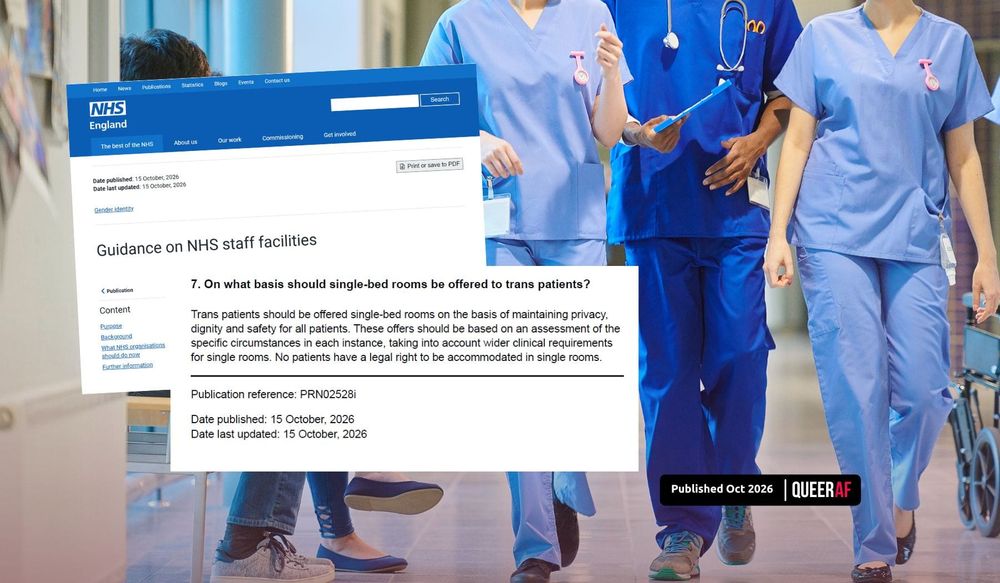
In addition to the RSE guidance, the KCSIE guidance outlines how Trans+ youth are to be banned from single-sex spaces – such as toilets and changing rooms – on the basis of 'biological sex', defined by their sex assigned at birth. If they feel uncomfortable using facilities that the school stipulates they are “allowed” to use, then they will be segregated to a third space, but in many schools that might not be possible.
Without access to an adequate facility at school, it is feared Trans+ pupils may forgo food and drink to reduce their need to go to the toilet. This is already a familiar phenomenon, with research published in the International Journal of Transgender Health in 2024 finding that 38% percent of trans and non-binary youth aged 13 to 24 abstained from drinking or eating to avoid using toilets.
Alongside this, the KCSIE guidance also contains detailed information about detransition – a phenomenon that is documented to happen in vanishingly small numbers of Trans+ people, often due to transphobic pressures rather than ‘regret’ – the guidance explains that "The Cass Review highlighted the importance of maintaining flexibility and keeping options open for children who have socially transitioned". It further states after a request by a pupil to socially transition, the decision made might not “be the same as a child’s wishes” – suggesting such requests can be denied by a school. It also calls on schools and colleges to "also be conscious of the rights of pupils and staff in relation to their religion or belief", adding that where the school does support social transition, they "might consider discussing options with pupils and staff such as using names instead of pronouns," giving room for teachers to refuse to go along with that support.
Taken separately or together, both documents already make it incredibly difficult for schools to be fully Trans+ inclusive spaces – but they are not the whole picture.
The Department for Education did not respond to our requests for comment, despite multiple attempts.
Section 28 2.0, is a far more complex web of anti-LGBTQIA+ rules to unpick than its first iteration
Currently, several other pieces of guidance are undergoing consultation, such as the SEND Reform: Education Otherwise than at School, which closes on September 18, and the Schools in England technical guidance, which closes on September 30.
There is concern within the education sector that updates to these documents with anti-trans policies could see Section 28 2.0 further woven into the wider frameworks of England’s education system, making it ever more complex to unpick.
In addition to this, there is a complex context where the UK has seen major backwards steps on trans human rights in recent years.
Between the Supreme Court ruling on the legal definition of ‘sex’, the Equality and Human Rights Commission's exclusionary Code of Practice, the widely-criticised Cass Review, the subsequent puberty blockers ban, and lacklustre conversion practices draft bill, many of which has seen the UK criticised by international bodies, including UN experts for creative legislative backsteps for the trans community.The UK, once a world leader on LGBTQIA+ rights, has tumbled from 1st place in the ILGA Europe annual Rainbow Map in 2015 down to 22nd position in 2026 – scoring just one point above the Europe average.
Analysis: The fight back against this new era of anti-LGBTQIA+ schools guidance will be more complex
It is incredibly difficult to be a young person in Britain today regardless of your gender, but day-in and day-out young Trans+ people are being barraged with implicit and explicit harmful messages about themselves and their community.
It is no surprise then that, amid this vicious anti-trans rhetoric, research has consistently shown that Trans+ youth are facing a mental health crisis, they have lower happiness levels compared with their cis peers and are dying of suicide more than the general UK population.
Given this stomach-turning context, it is difficult not to wonder what further impacts the RSE and KCSIE guidance will have on Trans+ youth in their first few weeks back at school.
And yet, as an LGBTQIA+ community, we know and understand the effects of Section 28; many spent their whole school careers under its long shadow, and no small amount of documentaries, research and journalism has been produced about its harm. Looking back at history, the fight against ‘clause 28’ as it was more commonly referred to, was unified and singular. It was simple for the community to rally around this single sentence, and call for it to be stripped from schools' rulebooks. Today’s web of anti-Trans+ guidance showing up in a growing number of documents makes that far more complex.
In a legal opinion commissioned by Pride in Education – shared exclusively with QueerAF – Oscar Davies, the UK’s first openly recognised non-binary barrister, concluded that while there is “discernible tension” in the drafting, it does not amount to the guidance being unlawful.
However, Davies notes that while there is limited potential for successful litigation right now, there is “real opportunity to seek clarification and amendment” on provisions in the guidance that are of particular concern. For example, the phrase “gender questioning” rather than the statutory concept of “gender reassignment” is used throughout and creates “some conceptual ambiguity”.
A judicial review of the RSE guidance, therefore, would need to take place after evidence has been gathered into its impacts on Trans+ youth.
“Well-evidenced submissions, grounded in the statutory framework and practical implications for schools, are likely to carry greater weight than litigation at this stage,” Davies concluded.
If these policies seek to make Trans+ youth invisible, Davies is arguing the way the LGBTQIA+ community can fight back is to make the harm they will cause to Trans+ pupils too visible to ignore.
We need more investment in queer accountability journalism.
Our rights are under attack, and navigating how to fight back is only possible with quality, fact-checked, accessible information - written by LGBTQIA+ journalists.
We're a small but mighty publisher, and are so glad you trust us every week to bring you a selection of the top queer news, unique perspectives and content everyone's talking about in this newsletter.
If QueerAF had more resources, I can assure you - we'd double down even further on our investigations and news output, but even more so: We'd train, mentor and invest in an even bigger new generation of queer journalists.
In just four years, we've supported 150 LGBTQIA+ creatives to develop their craft and careers.
We're not going anywhere, and that work continues.
We can't do it without you, so if you can - please start your monthly or annual membership to QueerAF, so we can help even more people fight back.