
TL;DR: When the British Medical Association's long-awaited review of the Cass Review was published, the media said it had "dropped its opposition" and "vindicated" Cass. But, according to doctors who were on the BMA's review team, that's not what actually happened.
The mainstream media's reporting of the British Medical Association's critique of the Cass Review contained "misinformation" and was "factually wrong", according to members of the doctors union.
When the Cass Review was published in 2024, the doctors union strongly opposed it and called for any implementation of its recommendations to be put on hold while the BMA conducted its own review of the evidence.
However, the government did not heed the BMA and has used the Cass Review to justify banning puberty blockers for trans young people and hormone therapy for 16 and 17-year-olds, and closing the GIDS youth gender clinic.
On 6 May, the BMA's own review was published. It said that the government's actions went beyond the recommendations of the Cass Review, and that the Review provided no evidential basis for a puberty blocker ban.
It goes on to point out that medical bodies could have continued managing prescriptions without the need for government intervention. In short, the puberty blocker ban was an overreach - QueerAF
But this was not how it was reported by the newspapers.
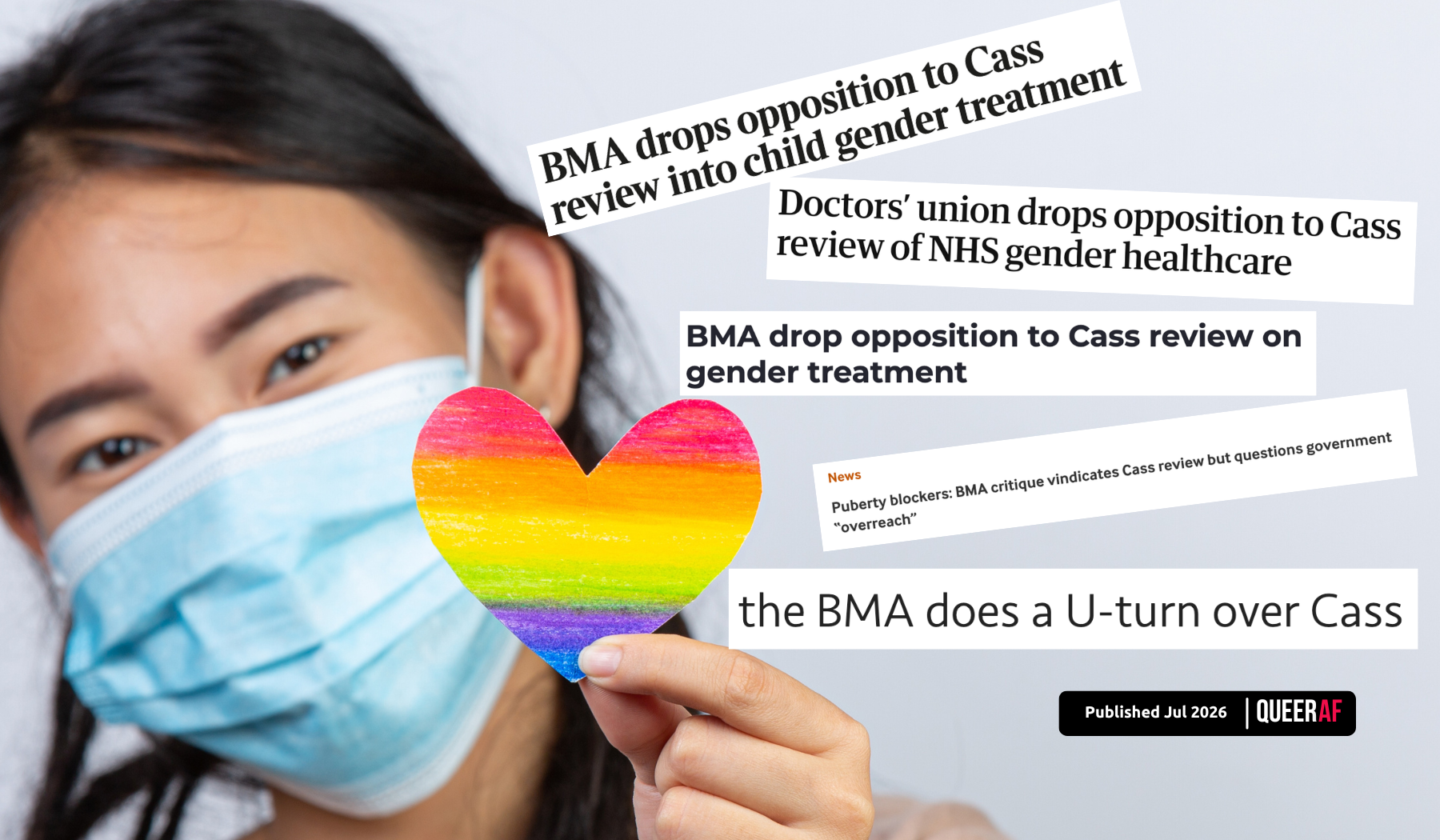
The Guardian headline claimed the BMA "drops opposition to Cass Review", as did The Times, and even LGBTQIA+ media outlets contained the 'drops opposition' line.
The British Medical Journal headline went further, saying the BMA critique "vindicates" the Cass Review.
But, speaking exclusively to QueerAF, Dr Alex Robertson, co-convenor of the BMA's LGBTQ+ network, said this reporting was both "factually wrong" and contained "misinformation".
“I was disgusted but not surprised by some of the reporting of the report," Robertson said. "It was misleading to the point of misinformation and in some places factually wrong. This is distressing to trans people as well as those of us within the profession who continue to support trans patients.”
Robertson said that the report from the doctors union contained "fairly strong criticisms" of the actions taken by NHS England "in the name of Cass", such as the ban on puberty blockers, on hormone therapy for 16 and 17-year-olds, and the abrupt closure of services like the GIDS gender clinic.
The BMA's review was "intended as a narrow-evidence based review and critique of the Cass review methodology and report" and not the doctors unions' "approach to trans healthcare", they added.
Robertson emphasised that the BMA's position on trans healthcare remains unchanged, and that it continues to have a strong, inclusive policy in support of gender-affirming healthcare for Trans+ patients, as well as supporting Trans+ and gender-diverse doctors.
A doctor who was in the BMA task group that worked on the critique of Cass also told QueerAF that the doctors union remains committed to timely, high quality, evidence-based trans healthcare provision, and that the union's position on trans healthcare is unchanged by the report.
They added that the media reporting also left out vital parts of the BMA review's criticism of the Cass Review.
"One thing I’ve noticed in the media coverage is that what the BMA’s review found about lived experiences involvement in the Cass Review really isn’t being discussed," they told QueerAF.
One such example is that meaningful participation with young people "didn't take place". Another is that the BMA criticised Cass for reframing "peer support" as a "risk".
"Engagement was widely described as late in the process with some groups not feeling it was a genuine listening exercise," they said.
Analysis: Unsurprising, yet still revealing
The way that the mainstream media in the UK reports on Trans+ healthcare has long been rife with misinformation – so it comes as no surprise that, yet again, facts have been twisted to support an anti-trans agenda.
Last month, Amnesty International UK named both The Guardian and The Times in its report about media coverage of trans lives. Amnesty studied 17,000 articles between 2020 and 2025 about trans people. The report found that media coverage of issues about trans people are excessively high compared to the size of the trans population. - QueerAF
The vast majority of the reporting excludes Trans+ perspectives and platforms' anti-trans talking points, the research found.

We need more investment in queer accountability journalism.
Our rights are under attack, and navigating how to fight back is only possible with quality, fact-checked, accessible information - written by LGBTQIA+ journalists.
We're a small but mighty publisher, and are so glad you trust us every week to bring you a selection of the top queer news, unique perspectives and content everyone's talking about in this newsletter.
If QueerAF had more resources, I can assure you - we'd double down even further on our investigations and news output, but even more so: We'd train, mentor and invest in an even bigger new generation of queer journalists.
In just four years, we've supported 150 LGBTQIA+ creatives to develop their craft and careers.
We're not going anywhere, and that work continues.
We can't do it without you, so if you can - please start your monthly or annual membership to QueerAF, so we can help even more people fight back.