

TL;DR: One of the most significant prison strikes for four decades is underway, after queer activist Amu Gib refused food on Nov 2nd 2025, inspiring eight others to join. The activists have been remanded facing allegations of carrying out actions in affiliation with Palestine Action.
A queer activist was one of the first to refuse food and embark on the largest coordinated prison hunger strike in over 40 years – which has yet to be acknowledged by the British government, even as two people have been hospitalised as a result of refusing food.
Seven people who are in prison on remand, awaiting trial in relation to alleged pro-Palestine direct actions, have been on a rolling hunger strike that began on 2 November – the anniversary of the 1917 Balfour declaration, a British pledge to establish, in Palestine, “a national home for the Jewish people”. QueerAF understands that one more person, Lewie Chiaramello, is on a partial hunger strike – fasting every other day – due to being diabetic.
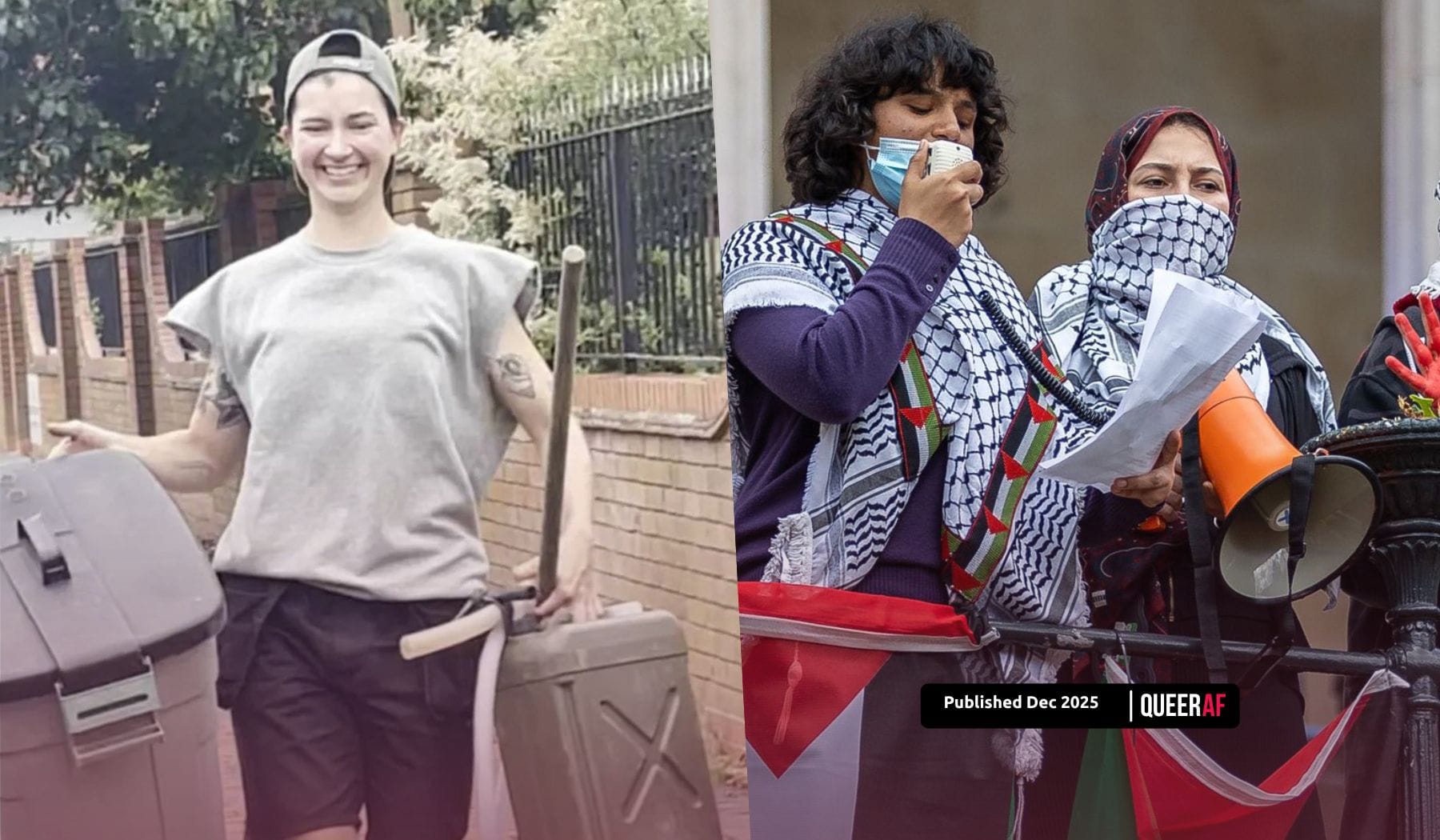
The open-ended hunger strike began when Amu Gib, who is queer, and Qesser Zuhrah refused food on 2 November. They were joined by Heba Muraisi, on 5 November; Jon Cink, on 6 November; Teuta ‘T’ Hoxha, on 9 November; Kamran Ahmed, on 10 November; and Umer Khalid, on 4 December - Prisoners for Palestine
The eight currently on hunger strike are part of a cohort of 33 prisoners accused of carrying out actions against Israel’s largest weapons manufacturer, Elbit Systems, in affiliation with Palestine Action. The alleged offences took place before Palestine Action was proscribed as a terrorist group in July 2025.
The government has so far ignored the prisoners’ demands, which include scrapping a proposed £2.7 billion contract between the Ministry of Defence and Elbit Systems, as well as permanently closing all of Elbit’s UK arms facilities.
They also demand an end to the censorship of their communications, de-proscribing Palestine Action, immediate bail and the disclosure of all documents relating to their cases.
Gib, who has been in prison on remand since 3 July, spent their 30th birthday in HMP Bronzefield. In a recorded birthday message, they said: “It’s not my birthday; it’s the 707th day of a genocide against Palestine.
“Maybe I do have one wish: that every year of my life will act as a handful of sand in the gears of this imperialist killing machine. And that we live to see the day it eventually, inevitably, grinds to a halt. Free Palestine.”
Mothin Ali, joint deputy leader of the Green Party, was this week the first – and so far the only – politician to visit the prisoners on hunger strike, travelling to HMP Bronzefield to visit Gib.
Afterwards, Ali said: “Their cheekbones were sticking out, their eyes had sunken in – they looked visibly frail.
“For the first 10 days of their hunger strike, the prison refused to even acknowledge what was happening or provide medical care.”
‘A dangerous strategy’
The 33 people being remanded in UK prisons before their trial dates all took action in support of Palestine, where almost 70,000 people have been killed by Israeli military attacks on Gaza since October 2023 in what the United Nations, as well as leading genocide scholars, have described as a genocide - BBC
Qesser, Muraisi, Hoxha and Ahmed were arrested in 2024, accused of taking part in an action at Elbit Systems in Filton near Bristol. They are due to be tried on charges of aggravated burglary, criminal damage and violent disorder next April. Part of a group known as the Filton 24, they were initially described as having a “terrorism connection”, but no charges have been brought under the Terrorism Act.
Gib, Cink, Khalid and Chiaramello were arrested this summer, shortly before Palestine Action was proscribed, accused of breaking into RAF Brize Norton alongside one other person and spraying paint onto two military planes, allegedly decommissioning the two planes and causing £7 million worth of damage. They are not scheduled for trial until January 2027.
The decision to go on hunger strike is, according to Kevin Blowe of the Network for Police Monitoring (Netpol), a “very dangerous strategy”.
“It becomes a game of chicken between those people who are wondering how far they're prepared to push a hunger strike and how far the government is prepared to do nothing,” Blowe tells QueerAF.
It’s “who blinks first”, he adds. “From the state's point of view, they're the ones that have got the power in this relationship. I don't know if anybody really knows what this government is capable of, in terms of how trenchant it's likely to be.”
History of prison hunger strikes
There is a long history of prison hunger strikes in the UK going all the way back to the suffragette movement, which saw over 1,300 women imprisoned during the 1906-1914 campaign to get women the right to vote.
The suffragettes began using hunger strikes in prison as a tactic in 1909. Prison authorities force-fed women using rubber tubes, which the movement then used as a propaganda tool – to great effect - London Museum
The last large-scale prison hunger strike in the UK was led by Bobby Sands of the IRA in 1981, who died after refusing food for 66 days. That hunger strike ended in the death of Sands and nine other men, after Margaret Thatcher’s government refused to negotiate on their demand to be treated as political prisoners.
Gib and Zuhrah have not eaten in 34 days. Ahmed and Hoxha were recently hospitalised as a result of refusing food - Novara Media
“The physical symptoms get quite severe,” Louis of Rebels in Prison Support (RIPS), a grassroots network supporting activists imprisoned for peaceful protest that is supporting some of those on hunger strike, tells QueerAF.
“After a week, your body almost starts eating itself,” he adds. “You go into your fat stores and reserves. After two or three weeks, you start to get really thin and lose that body fat.”
“If you do end a hunger strike, you can get things like refeeding syndrome. You can't just start eating again,” Louis says. “You have to go to hospital and you might have to be fed on a drip, you can't just go back to normal. It's a whole process. And if it's not done properly, that can be lethal.”
On 27 November, more than 100 medical professionals wrote to the NHS and to each prison governor expressing “serious concerns” about the treatment of the hunger strikers who are entering a “critical stage”.
“As well as the absence of appropriate safe medical management, to our knowledge these individuals have not yet received the necessary daily clinical monitoring required for patients refusing food and are at risk of sudden electrolyte disturbance, hypoglycaemia and cardiac arrest,” the letter says. “This constitutes a medical emergency.”
A Prison Service spokesperson said: “We continually assess prisoners’ wellbeing and take the appropriate action.”
Analysis: Bodies have always been the sites of queer protests
It’s unsurprising that queer activists in the British imperial core are among those on hunger strike. It may be a dangerous strategy, but that reflects the strength of queer and Trans+ solidarity with Palestine.
Under the banners of groups like Queers for Palestine, No Pride in Genocide and Dykes Against Airstrikes, queers have led many pro-Palestine direct actions and protests over the past two years. We’ve also seen the consistent presence of London Trans+ Pride stewarding at Palestine solidarity marches.
As those in prison use the last thing under their control – their bodies – to resist and to draw attention to British complicity in the Gaza genocide, it’s impossible not to think of people in Palestine, where “widespread starvation, malnutrition and disease” are driving a rise in hunger-related deaths.

To beat misinformation we need a well resourced queer led newsroom that can cut through the noise and get to the facts.
Our publisher is small, but mighty, and that's because of some key principles in the way we produce news for you:
- This newsletter always has been, and always will be, free of adverts. That keeps us focused on what counts, not what drives clicks
- Readers and members drive our news agenda, because that's what our community deserves: news told both by and for us
- Investing in a new generation of queer journalists, and packing the media full of us, is the best way to address the issue in the sector. Meanwhile, we'll model the change we want to see and prove it's possible to do justice to our community's stories
Journalism is an expensive craft. It takes all week to put together this newsletter, so you can catch up on the queer world in five minutes. And we do that alongside mentoring creatives and lobbying the media sector.
If you believe in our unique model and the change we're bringing to the queer news sector, please upgrade today if you can - and help us continue to grow.
Help us change the media, so we can change the country.