In the 1830s and 1840s, large parts of rural west Wales were shaken by a series of uprisings in which protesters disguised themselves as women - now known as the Rebecca Riots. Looking back at this period through a queer lens, it quickly becomes clear that the nuanced learnings for our community are more complex than at first glance.
Farmers and labourers, living in poverty, were pushed to breaking point by toll gates erected by turnpike trusts. These trusts, often controlled by landowners and investors far removed from local life, charged people repeatedly just to move goods, livestock, and bodies along roads that were meant to serve them.
In practice, the tolls functioned less as maintenance fees than as wealth extraction. With little money and few routes of appeal, communities organised through collective action instead. Toll gates were destroyed, toll keepers intimidated, and authority briefly suspended. These direct actions were embedded in local networks of obligation and mutual recognition.
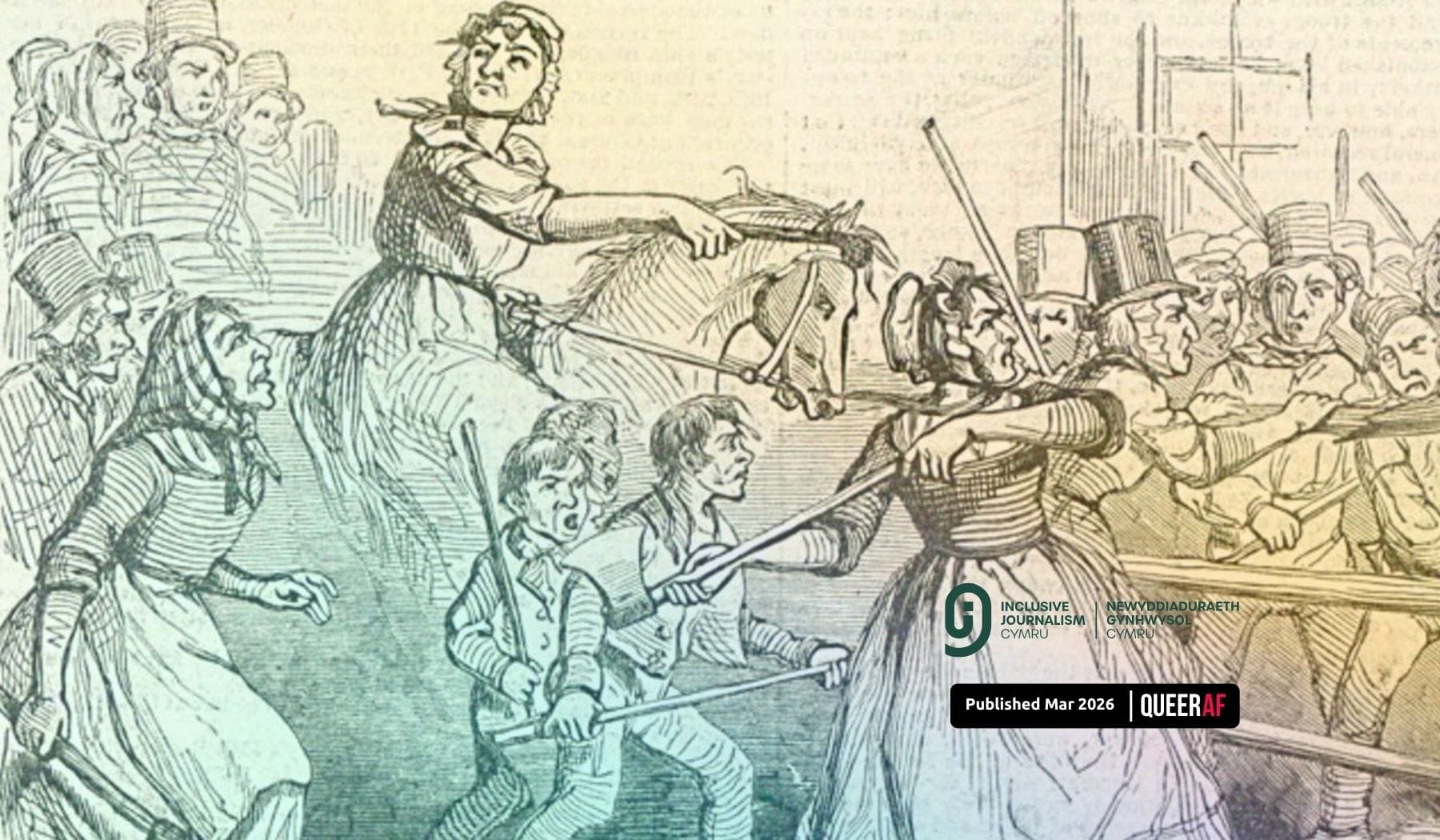
But what makes these riots distinctive is how they were carried out. Participants wore dresses, bonnets, and petticoats, sometimes invoking the biblical figure of ‘Rebecca, as they took matters into their own hands. Framing this moment as queer history can feel intuitively compelling. That reading is understandable. However, it misses what the riots actually show.
What the Rebecca Riots reveal is not that gender was being contested in a modern sense, but that it could be temporarily rearranged without loosening the order that held it in place.
Gender variance here functioned tactically, rather than expressively. It appeared disruptive, yet remained intelligible. As a result, disruption did not necessarily disturb gender regulation.
The cross-dressing rioters engaged in did not represent their identity. Rather, it worked as disguise; protecting anonymity, enabling coordination, and drawing on cultural forms already recognisable within the community. Crucially, it did so without calling masculinity itself into question. The tactic succeeded because it repeated gender in a distorted register. Gender was ritualised without stepping outside the terms that made it legible.
This is where historical context matters. Wearing clothes of the opposite gender was not alien in Welsh communal life. Seasonal customs and folk performances had long made space for gender inversion within tightly bounded conditions.
These practices bent norms without undoing them. Gender play existed, but it was contained within a temporal context. Because of this, once the riot ended, the social order could reassert itself without difficulty.
And it did.
After the riots, participants returned to their lives as husbands, fathers, and workers. Masculinity was not destabilised; it was re-secured through violence framed as obligation, defending families, protecting land, providing for the community. What mattered was not the momentary borrowing of femininity, but how firmly the structure that authorised masculinity continued to hold.
Gender disruption does not always equal gender liberation. Sometimes it unsettles power but can still be absorbed by it - and that distinction matters today.
Gender variance is frequently assumed to be destabilising by default, but history suggests otherwise. The Rebecca Riots show how gender disruption can coexist with intact hierarchies, even as authority itself is challenged and its legitimacy is thrown into question.
For many gender-queer people, resonance with the past is powerful. Seeing rebellion and refusal, especially in places marginal to dominant histories, can feel affirming. But it’s important we look at history closely, remembering that not every instance of gender nonconformity opens onto queer life as it is lived now.
Projecting contemporary understandings of queerness onto the past risks flattening historical reality. People did not understand themselves through our categories. They lived within different relationships to gender, labour, community, and power.
This does not mean gender variance was free from repression. State policing existed, and it mattered. In 1848, for example, James James, a local labourer, was arrested while riding the ceffyl-pren – the wooden horse – and wearing a dress during a ritual of communal punishment in Llandudoch, south-west Wales. The repression here came from the state, not the community. Folk practices tolerated inversion in ritualised form even as the state moved to criminalise disorder and reassert control.
So when queer people look back at the Rebecca Riots, it becomes a useful tool to approach all history and ask: what are the lessons from this, for us? The riots posed a direct challenge to authority, but the subversion of the gender order was only legitimised because it was temporary.
The Rebecca Riots therefore, matter not because they reveal more queer ancestors, but because they show how gender flexibility can coexist with radical political action without dismantling patriarchal norms. They remind us that not all disruption is emancipatory, and that some forms of variance are absorbed precisely because they are intelligible to the systems they appear to unsettle.
When looking at history for lessons for now, it’s easy to focus on the stories that have the most resonance. But there is value in looking at times in history where structures that exist today are rooted. Asking how gender and sexuality were produced, regulated, and constrained in specific conditions, and who benefited, gives us a stronger picture of how we can challenge them in the future.
Get the Queer Gaze in your inbox each week with our free weekly newsletter or pitch to write an edition for us now.
QueerAF has partnered with Inclusive Journalism Cymru
Together we're running a dedicated series of think pieces as part of a unique set of Queer Gaze commissions - our landmark writing scheme.
The articles are being written by three LGBTQIA+ journalists from Inclusive Journalism Cymru's network.
The Queer Gaze is a space in the QueerAF newsletter to commission emerging and underrepresented queer creatives to get published, receive mentorship, and kickstart your career.
Each commission comes with a unique 'retrospective' sub-editing session designed to put you in control of your article.
It's helping Welsh LGBTQIA+ creatives build journalistic craft and strategic communication skills.
You can support our work by becoming a QueerAF member.