
TL;DR: Draft safeguarding guidance for schools threatens to make it compulsory for schools to segregate Trans+ children in toilets and changing rooms, and recommends creating barriers to social transition at school. Trans+ young people already face an epidemic of bullying and frequent discriminatory policies in school. If this guidance becomes law, it will only compound that harm.
In the midst of last year’s general election, the far-right Conservative MP Miriam Cates made a podcast appearance in which she lamented what the future would look like under a Labour government.
There was, however, she noted, one ray of hope. “I am more hopeful for the trans issue [under] a Labour government than I would have been a year ago,” said Cates. “We have definitely shifted the debate in Britain.”
Cates’ lasting impact is most keenly felt in education policy. In July 2025, the government adopted new guidance that strictly limits the information about Trans+ people that teachers can include in relationships and sex education (RSE) lessons. LGBTQIA+ rights groups dubbed this “Labour’s Section 28 2.0”, drawing comparisons with the legislation that banned the “promotion” of homosexuality in schools from 1980s–2000s, and bred fear, isolation and self-hatred in generations of LGBTQ+ children.
At the same time as the RSE guidance, the government released draft safeguarding guidance that encouraged schools to out Trans+ kids to their parents. Just last week a further update – now out for consultation – was released.
The guidance is the latest in a long series of transphobic guidelines for schools published on the government’s website. Critically, almost all of them have gone out for consultation without yet being formally adopted. The latest is both more forceful and more detailed than last summer’s draft, incorporating many provisions from draft guidance the Conservative government put out for consultation in December 2023, which Department for Education (DfE) lawyers advised could breach equalities law.
This latest draft statutory guidance, published last week, would mandate segregation or exclusion of Trans+ children in school toilets, changing rooms, secondary school sports, and sleeping arrangements for school trips and boarding schools.
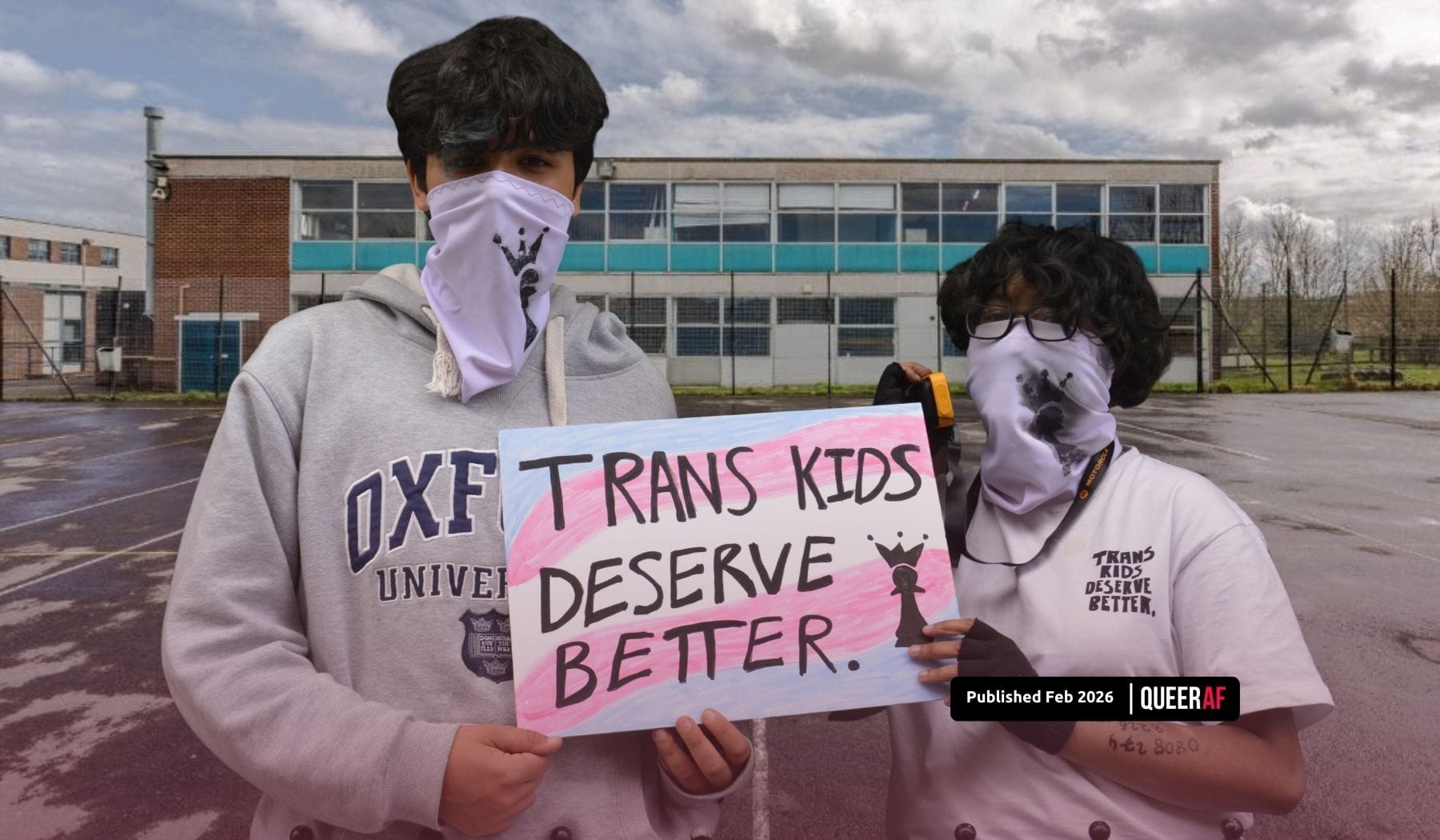
These provisions, if implemented, will have significant effects on transgender schoolchildren – when they already have to navigate difficult challenges every day. Ahead of the guidance being published I gathered insights from 19 Trans+ pupils – all members of the activist group Trans Kids Deserve Better – about their experiences in school as the landscape of guidance has changed.
Nearly half of those I spoke to said that their schools had become worse for them as trans pupils in the time since they returned from their summer holidays last year.
In the general population, less than one in five pupils are persistently absent from school, defined as below 90% attendance in a given school year. Of the trans kids I spoke to, nearly half were persistently absent last academic year – even before the ‘Section 28 2.0’ RSE and safeguarding guidance was published.
Several kids said bullying and mental health issues were the main reasons for this, with others citing disability.
The children’s responses demonstrate the harm they already endure, and how this guidance may make circumstances even worse.
The guidance isn’t law just yet – but it can still have an impact. Previous draft guidance has been seized on by hate groups like Bayswater Support Group, Safe Schools Alliance, Sex Matters and Transgender Trend – all of whom were consulted on last summer’s RSE guidance.
While it sits on the government website, the existence of the draft alone puts pressure on schools to conform, at the expense of Trans+ kids’ wellbeing and equal access to education.
What does the draft guidance say?
The guidance distinguishes between things schools “must’ do, and things they “should” do. The prohibitions on single-sex spaces are all “musts” – as are respecting the beliefs of teachers and pupils who refuse to correctly gender Trans+ people, and keeping a record of children’s biological sex. The guidance emphasises that there should be no exceptions to any of these policies, even for stealth or fully socially transitioned children.
Even without this in force, many trans kids already experience barriers to using the appropriate facilities at school. Most kids I spoke to reported not going on residential trips or taking P.E. (though most are in sixth form, where it is not compulsory). Of those who do P.E., only one said they felt safe and comfortable in the changing facilities they are allowed to use, and the majority said they didn’t feel comfortable in their P.E. class. Only about half said they can use school toilets safely and comfortably.
Children also reported frequent misgendering and deadnaming at school. Most respondents to my questions said teachers and pupils both use their name – but over a third said that teachers and pupils don’t use their pronouns. Some reported being deadnamed and misgendered even after their name was changed on the register.
Barely a handful said their school reacted well when they reported transphobic bullying, and none said their school took action against transphobic bullying without them needing to report it. The guidance briefly mentions that trans kids may be at risk of discriminatory bullying, but makes no suggestions about how to tackle it.
The “shoulds” – which schools can disregard so long as they clearly document the reasons – mostly relate to social transition. Here that refers only to changing names and pronouns; the guidance does not mention visual presentation.
Before allowing a child to socially transition, the guidance advises against taking measures towards social transition unless a child or parent has requested it. It also advises consulting parents, taking clinical and non-clinical professional advice, taking account of the child’s wider circumstances and mental health, and considering what will be in the child's best interests and the interests of other pupils.
It also advises that in primary schools, social transition should be rare, citing the Cass Review’s finding that pre-pubertal social transition is likely to lead to future medical transition. It also says that unless the school has agreed to support an individual child’s social transition, individual teachers should not adopt name and pronoun changes.
While the guidance acknowledges there are some instances in which involving parents may be harmful, it stops short of recommending any alternative route for children to socially transition at school. Instead, this decision is left up to the designated safeguarding lead.
One Trans+ young person told me they were forcibly outed to a parent by a senior staff member, while another said they were effectively forced to come out at college by a policy that required parental notification to use anything other than their legal name on the register and for their school email.
It also falsely states that parents will rarely present a danger to trans children. Research by LGBTQ+ anti-abuse charity Galop found over 40% of trans and nonbinary people experience abuse from relatives – most commonly parents.
One young person told me their parents had put them through conversion therapy, and they now keep their trans identity hidden from their parents and most teachers.
There is one potentially beneficial measure for Trans+ youth that was absent from previous drafts. The guidance is clear that: “Where a child confides in a member of staff about their feelings but does not ask the school or college to make changes to how they are treated, there is no reason to break any confidence unless there is a related safeguarding risk.”
Analysis: The floor, not the ceiling, of what schools could do to support Trans+ pupils
The government has successfully engineered a situation in which materially accommodating a Trans+ child in any way presents a major headache for even the most well-intentioned school administrator.
To reiterate, this guidance is not yet in force. That needs to be emphasised in the strongest possible terms. And if it does come into force, a school that wants to support transgender pupils can choose to discard any “shoulds” that will be harmful to those pupils.
While it doesn’t require schools to do it, the guidance suggests some may want to develop transparent policies on social transition, and it recommends documenting all decisions made around individual cases of social transition. Any schools planning to deviate from the “shoulds” are likely to be in a better position to defend that decision from challenges if they have clear, consistent, well-documented policies.
Teachers at any school can argue that they, as individuals, have the right to support Trans+ kids emotionally without breaking their confidence – which in some schools may represent an expansion of their autonomy.
The “musts” are trickier. If the guidance is implemented, mitigating their harms will present administrative and financial challenges that, realistically, most schools will find too burdensome.
Colleges have greater flexibility. Many policies that are “musts” for schools are “shoulds” for further education colleges. Nearly half the trans kids I spoke to attend college, with some saying they moved there specifically to have greater autonomy.
Replacing a large proportion of (if not all) pupil toilets with gender-neutral floor-to-ceiling lockable rooms may be realistic for some schools, and significantly mitigate the daily humiliation many Trans+ pupils will experience under this guidance.
However, the requirement to document "biological sex”, and the problems of changing rooms, gender-segregated P.E. classes in secondary schools, and sleeping arrangements on school trips or in boarding schools have no easy solution. If the guidance becomes law, many Trans+ kids will either be forced into spaces for their sex assigned at birth, made to use segregated third spaces, or excluded entirely.
This exclusion is not theoretical. Trans+ children are already being denied a full education because they cannot endure the humiliation required for them to obtain one. This guidance will make that much worse.

A lot of us have, quite rightly, been filled with worry, concern and anxiety about what another court ruling means for Trans+ rights in the UK.
And in classic fashion, right-wing media tried to obscure and further muddy the water on the result - in an attempt to smother the small wins that were contained within. Those wins may feel small in the big picture, but ultimately, they allow the fight to continue. To start with, QueerAF understands that plans for appealing that judgment are already well underway.
But something else curious happened last week that, frankly, was an oddity.
The Equalities Minister, who got a copy of the judgement ahead of its release, is also the Education Minister. And the night before the judgment, the Department of Education released guidance that could only be justified by last week's ruling.
It’s curious timing for a number of reasons. Firstly, it gave a pretty clear indication of how the judgment would rule before it actually came out. That’s usually a big no-no for government. Being released the night before also meant the LGBTQIA+ sector - and outlets like us - faced a choice: Which of two vastly significant stories to focus on?
Well, if the government thought they could hamper our coverage – they can think again.
We've spent the week working with Sasha Baker, who has produced this explainer on the new schools guidance, with insights from 19 Trans+ young people on what it will mean. And though the guidance got mixed responses initially, with some time to digest the details, it’s becoming clear how punishing it could be.
I'm sharing this insight into our editorial thinking this week, because we're in the third of four weeks of our annual crowdfunder, which is all about improving access to journalism - and helping you understand the LGBTQIA+ news.
That's what we're about at QueerAF. Critical journalism, delivered while developing queer creative careers to help them get jobs in the media.
If we can change the newsroom, we can change the country.