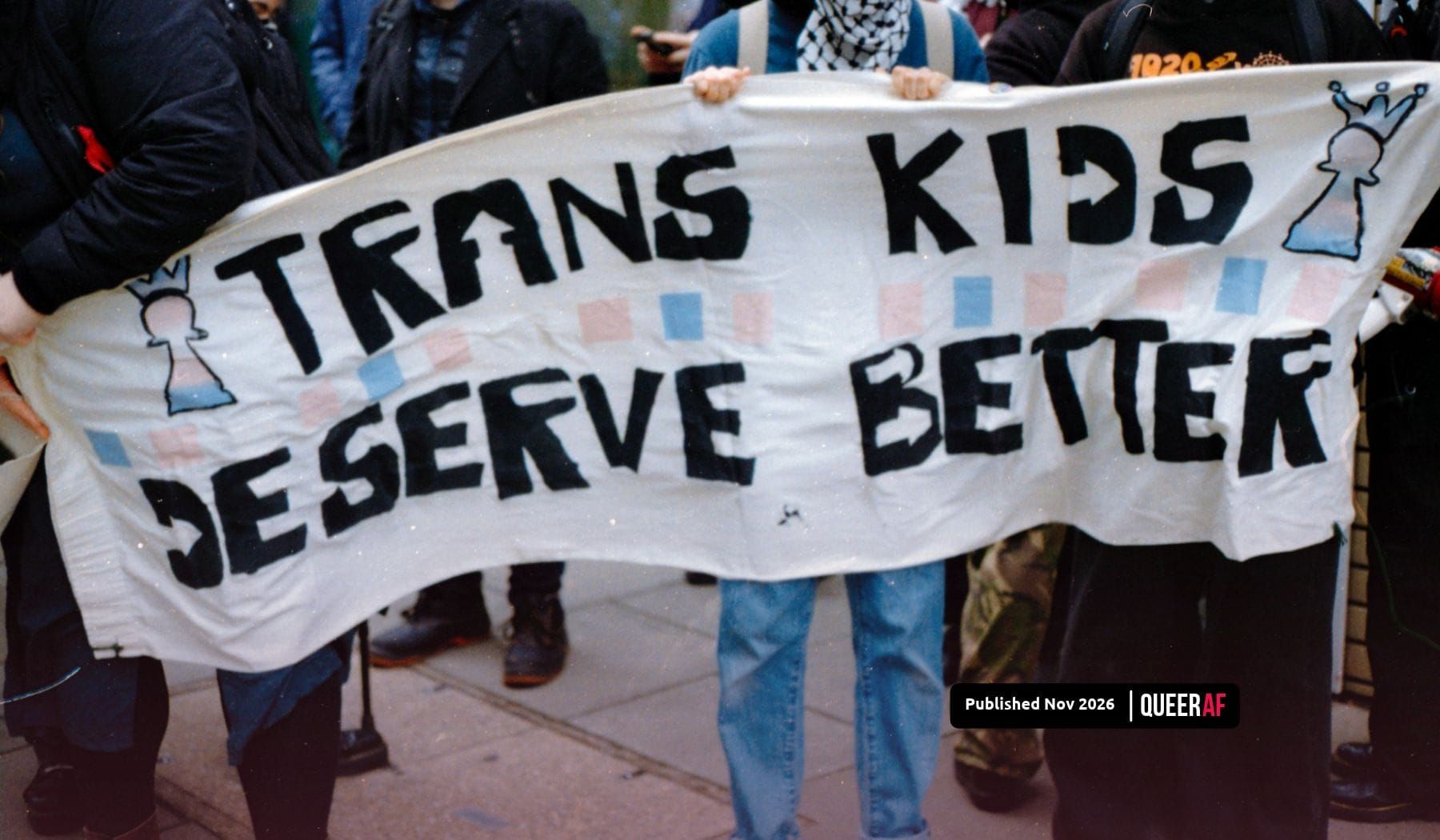

TL;DR: New evidence from Childline, seen exclusively by QueerAF, shows that Trans+ children are being outed, misgendered and facing abuse under new guidelines that require them to be segregated from single sex spaces. Alongside testimony from parents and teachers, it paints a picture of young Trans+ people fearing school, not going to the toilet until they get home, and growing up scared of their futures.
New evidence from Childline shows Trans+ pupils are feeling unsafe in school, facing abuse from teachers and being misgendered under new statutory guidance introduced in September – which in most cases segregates Trans+ pupils from single-sex bathrooms and bans teachers from “encouraging” students to explore their gender identity.
The Keeping Children Safe in Education (KCSIE) guidance requires schools to ban Trans+ children from using facilities that do not match their ‘biological sex’ – even if they have been using those spaces for years – or segregate them to a third space.
That comes alongside new relationship and sex education guidelines which have been dubbed by many in the LGBTQIA+ community as ‘Section 28 2.0’, as they instruct schools to avoid using certain teaching materials and state that teachers should be “mindful” there is "significant debate" about Trans+ topics and therefore should not “endorse any particular view or teach it as fact”.
The negative impact of the guidance on young people is evident in the personal accounts of anonymised users of Childline, a 24-hour service for children and young people in the UK, seen by QueerAF.
“I feel like the world is against me when I read the news about trans people like me,” a 14-year-old trans girl who contacted Childline said. “I tried to bring this up at school, but they refused to discuss it, saying we shouldn’t have political conversations. Yet they changed the rules about which bathrooms trans pupils can use – I think that’s wrong.
“I feel like we’re not being listened to. Why can’t we just be ourselves and use the toilet we feel comfortable using?”
The NSPCC, which runs Childline, told QueerAF the common themes that have emerged from conversations Trans+ young people have had with the confidential support service include practical worries about using public restrooms safely amid restricted access to toilets, feeling unsafe generally, and concerns about being accepted into sports clubs and competitions.
More broadly, the children also shared concerns for their future, including how legal changes will affect healthcare options, media coverage of Trans+ people, and intensifying feelings of self-hate and gender dysphoria. These Trans+ youth feel like the world is against them.
A 13-year-old trans boy described feeling “overwhelmed and hopeless” about the changes:
“My school refuses to use my preferred name and pronouns, which is really affecting me. I’ve tried opening up to some people, but all they said was that I’m confused and it’s just a phase. Honestly, it’s exhausting having to face people, so I end up not going outside. I feel like giving up.”
Parents struggling to ensure schools are safe for their Trans+ children
Jane* still speaks warmly of her daughter’s time in mainstream education. Emily* “really enjoyed” both primary and secondary school and had lots of different friends. She was a well-behaved pupil who always did her homework and had nearly a 100% attendance rate, and Jane also had a good relationship with Emily’s schools.
But she tells QueerAF, Emily’s “whole life was turned upside down” by the guidance, and she is now completely homeschooled. Before the guidance, she socially transitioned in primary school and the school fostered an accepting environment which enabled her to thrive as a “well-loved” member of the community. During her time in secondary school, Emily was not known to classmates as Trans+, with Jane saying Emily had “no problems at all” and the staff ensured she was adequately supported.
In response to KCSIE, Emily’s school held a meeting where it was decided she would use a third space toilet facility. Due to the remit of the guidance, a larger circle of staff were also made aware that Emily is trans.
This led one teacher to confront Emily one-on-one in a private room where she proceeded to “shout abuse” at her. The teacher is alleged to have physically prevented Emily from leaving the room during the altercation, with Emily left in tears and being "beside herself” when Jane collected her from school.
Emily was left “really worried” about what she might face in September and spent the “whole summer holidays panicking, thinking: ‘what’s going to happen?’”, Jane said.
When the new academic year started, Emily was outed as trans and experienced “horrendous” bullying, with other pupils shouting anti-trans slurs and physically assaulting her. The new rules she had to follow were also conflicting and confusing, such as being told to use the disabled toilet to change for physical education, but then being asked to go into the gendered changing room so the teacher could talk through the lesson plan with the whole class.
In the end, Jane pulled Emily out of mainstream education and she is now completely homeschooled. While she is free from the bullying, Emily is now isolated from her peers.
“She shouldn’t feel petrified being at school. This has totally taken us out of the school system,” Jane said. “Which is heartbreaking, because she is missing out on all the normal things that teenagers do at school.”
Emily is not alone in her experiences.
Jane said there has been a “broad spectrum” of effects on Trans+ youth, with the level of impact depending on if a Trans+ young person is publicly out as or trans is living in stealth.
She said she has heard stories from other parents about their own Trans+ children which are similar to what happened to Emily: “Which is basically they have been outed, and therefore now school life is hell.”
Teachers trying to make schools more Trans+ inclusive are facing barriers
One LGBTQIA+ secondary school teacher who works in the south-east of England, and spoke with QueerAF on the basis of anonymity, said the impact on her Trans+ pupils has been extremely negative.
“I've had students say, ‘well, this government hates me’,” she said. “They are 13, 14 years old. That's a very young age to feel like the world is attacking you.
“A lot of these students already have very complicated backgrounds or family histories, and one of the few places they should feel safe and supported is in education.”
She also said it is the pupils who have already socially transitioned that have “outwardly struggled with the restrictions” the most, with some saying how uncomfortable they are using 'third spaces’, and others saying they “do not use the bathroom until they get home because they are so uncomfortable”.
“As a teacher, my priority is the wellbeing of all of my pupils, and it is impossible to say right now that education can prioritise the wellbeing of all pupils.”
She feels that schools are not given time or the support by central government to ensure all staff understand the complexity of changes and many of her colleagues do not understand them because they are too “ambiguous”.
“I could totally see a situation where a trans pupil moves from my school and goes to a school in another part of the country, and the approach that school takes would be completely different because the guidance is so unclear,” she said.
This teacher’s assessment reflects recent findings by Pride in Education during a half-day conference and workshop for school leaders, entitled Leading the Way: Supporting Trans and Gender Diverse Learners in Secondary Schools, which highlighted the mixed levels of knowledge about KCISE.
The research found many schools are uncertain about what they are required to do in relation to trans and gender diverse pupils, with a survey revealing just 20% of school leaders who were delegates were confident implementing KCSIE before the conference.
Analysis: It is possible to create Trans+ inclusive facilities, but it is costly
Accounts of the devastating impacts the new guidance has already had on Trans+ school pupils are shocking, but not surprising.
Education advocates, teachers and unions have been warning for months that this situation – increased outing, bullying, fear and isolation – would be exactly what would happen as soon as it came into force.
Indeed, because the guidance is so vague, we’re already seeing a ‘postcode lottery’ of Trans+ inclusion, with schools across the country applying it inconsistently.
This will likely compound existing educational inequalities, further harming attainment gaps linked to other life outcomes such as employment, income, health and criminality, at a time when the government is attempting to tackle the UK’s growing youth unemployment issue.
The new guidance makes inclusion an expensive exercise. While some schools, notably one in Brighton which made changes amid a legal threat, have led the way in installing significant trans-inclusive, self-contained, single-occupancy washroom cubicles, this is costly and not accessible to all schools given their limited budgets.
It’s a tale as old as time: this policy will harm the most vulnerable young people, in the most deprived areas, and create further disadvantages in a system that is already stacked against them.
*Names have been changed to protect identities
“Far too many Trans people are dying”
Gaps in Britain’s official records mean the true scale of deaths remains unknown.
In all of our investigations and coverage of Trans+ people’s deaths, the common theme is clear. Data is not properly kept and is hard to track, meaning the state of the issue as we know it is likely only the tip of the iceberg.
That's also true of the largest monitoring project of trans murders, released annually so their names can be read out at vigils all over the world for Trans Day of Remembrance on Nov 20th.
What we do know, is thanks to the tireless work of campaigners, activists and journalists.
In April, our investigation with Good Law Project verified 50 deaths by suicide or self-inflicted death among Trans+ and non-binary people in the UK over the past decade. The evidence from that story pointed to a disproportionate rate of suicide among Trans+ people, but the true scale of deaths remains unknown.
In October, a second QueerAF investigation found that at least 618 people had died while under the care of an NHS gender clinic, including at least 21 by suicide. But only three of the 13 clinics we approached disclosed specific patient-suicide figures.
Alongside this, successive governments have shown little interest in understanding, or even counting, the deaths of Trans+ people. While there is never one reason why someone dies, experts warn that these deaths are taking place amid healthcare restrictions and rights rollbacks.
We know the power in this work. We’ve already seen it used by campaigners and LGBTQIA+ organisations, who are putting it in front of the government and calling for change.
In this ever-changing environment for our community, we're here to give you the information you need to fight back. That's why we need your support, upgrade and become a QueerAF member today.