

CW: Suicide
On the 19th of December, 2019, British author JK Rowling incited global media coverage of an event that does not usually make international headlines: an English employment tribunal.
Tax expert Maya Forstater had just lost an employment tribunal case in which she had tried to make “gender critical” a legally protected belief. Rowling tweeted in support of Forstater, making the case into something of a cause célèbre: the tweet went viral, and Rowling’s defence of “gender critical” views was national news in dozens of countries.
Much of the media coverage, however, wasn't quite accurate. It said Forstater had been sacked from her job – which she hadn't. The press said this had happened simply for stating that "sex is real" – a committed understatement, a flattening of events that was repeated in newspaper after newspaper. This misinformation shaped public understanding of Forstater's case – just as misinformation and disinformation in the media shapes and frames our understanding of Trans+ history.
Forstater had begun expressing anti-trans rhetoric online when the public debate in the UK about legal gender recognition grew heated after Theresa May promised to reform the law in 2017. The proposal to remove medical checks from the Gender Recognition Act (GRA) was opposed by trans-exclusionary feminists, who began organising against the reforms.
This led to a wave of legal cases against Trans+ rights, with “gender critical” activists particularly focusing on bringing workplace discrimination claims to employment tribunals. Other legal cases challenged the provision of Trans+ healthcare, such as Keira Bell’s case against the Tavistock youth gender clinic’s prescribing of puberty blockers, in 2020. A year after Bell’s win, Forstater succeeded in having “gender critical” beliefs legally protected.
This set a precedent used in other “gender critical” cases, including that of barrister Allison Bailey, who used the Forstater ruling to win against Garden Court Chambers in 2022 on the grounds it had discriminated against her for her “gender critical” beliefs (Bailey lost her claim against Stonewall in the same case). More recently, “gender critical” group For Women Scotland won against the Scottish Government in April 2025 at the UK Supreme Court, which ruled that, under the Equality Act, ‘sex’ means only sex at birth and cannot be changed.
May’s GRA reform proposals also galvanised Trans+ campaigners, some of whom brought legal cases trying to improve Trans+ rights. Freddy McConnell fought for years to be legally recognised as the father of his children, ultimately losing in 2020. Nongendered activist Christie Elan-Cane tried to get ‘X’ gender markers added to British passports, taking per case all the way to the Supreme Court and losing in 2021.
Campaigning group the Good Law Project has brought multiple legal challenges around Trans+ healthcare and gender recognition, with recent cases, like that of a Trans+ man wanting both to conceive and be legally recognised as a man, having more success.
British media coverage of these legal cases has been increasingly extensive. An outlet will follow a “gender critical” case all the way from an initial event or complaint through to an individual crowdfunding campaign for a legal challenge and bringing it to court. But this comprehensive – though not especially accurate – coverage is not consistent: pro-trans cases are almost never covered to the same extent.
“Trans+ legal cases do not get the coverage,” Chloe Turner, a Trans+ researcher and writer focused on Trans+ disinformation, tells QueerAF. “This is part of the machine of squashing any kind of positive or affirmative trans position: A very small, but very densely networked group of [anti-trans] people ensures coverage for all of their wins, making it sound like they're having a win every week.”
And within that coverage, anti-trans disinformation is rife. Forstater’s employment tribunal was what Turner calls a “watershed moment”: The case to protect “gender critical” beliefs became the example used by anti-trans campaigners to justify their calls for discrimination against Trans+ women, and also triggered a new era of anti-trans disinformation in newspaper reporting.
Turner explains that the media largely perpetuates anti-trans disinformation in one of two ways: “A narrative that we're either some kind of deceptive, non-truth-telling liar; or, that we're living in this make-believe fantasy land that isn't grounded in any reality.”
“We're positioned as people that are either deceptive, or fictitious.”
Neither of these narratives is new. In fact, they both go back to the 1950s, with the British media’s widespread and sensational coverage outing famous Trans+ women. To understand the current media obsession with Trans+ people, often routed through its coverage of legal cases, we must look back at the past.
How the UK media got hooked on outing Trans+ people after Roberta Cowell
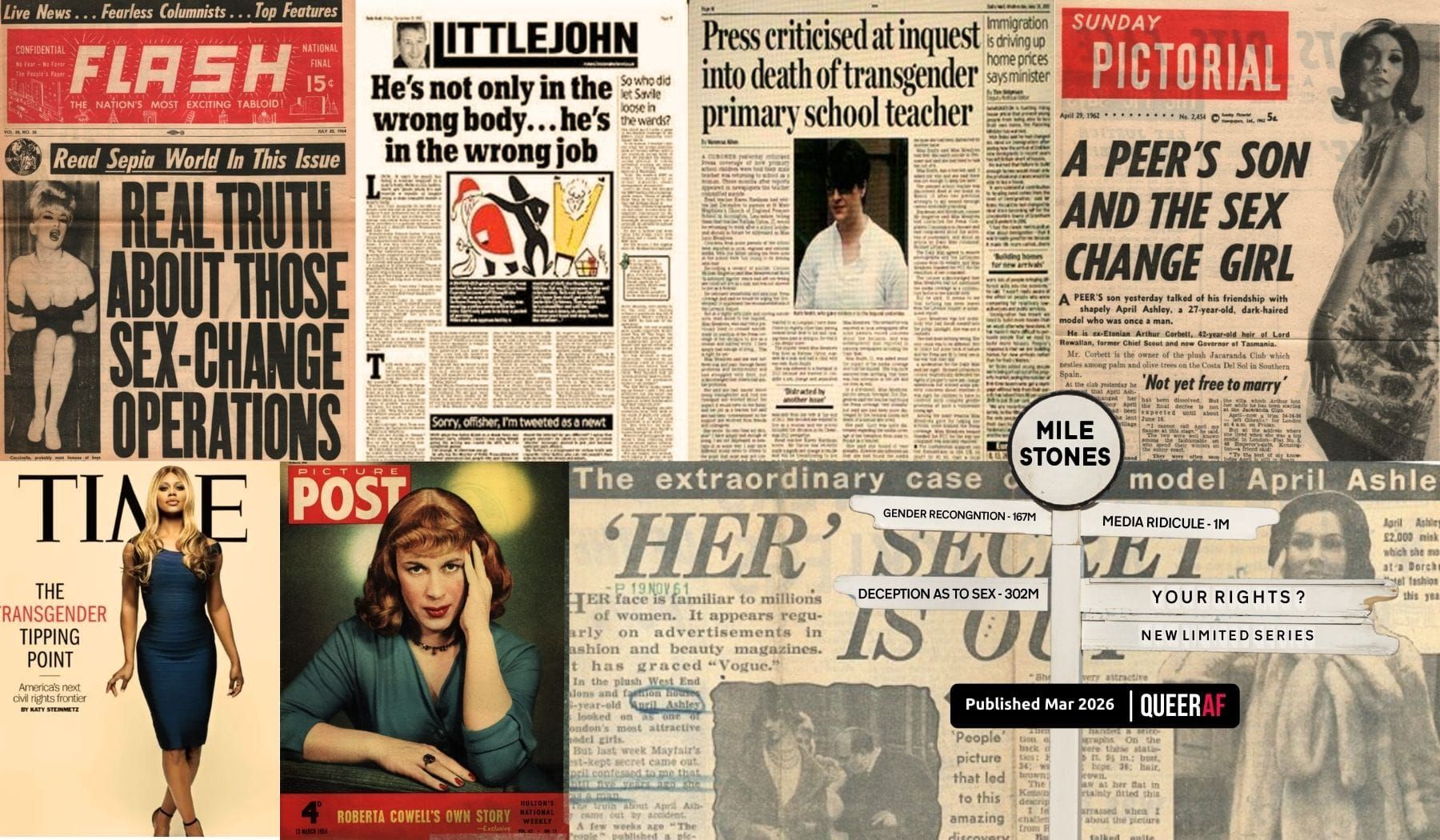
Employment tribunals are just one recent example of how popular understanding of Trans+ people has been distorted and misconstrued by the media. In March 1954, a British photojournalism magazine called Picture Post published the first of a series of stories about a former WW2 fighter pilot and racing driver who was the first known transgender woman in the UK to have gender-affirming surgery.
Roberta Cowell’s transition made headlines across national and regional newspapers, and the public interest in her story prompted an era where the press began outing more trans women.
This newfound visibility was both harmful and helpful. The term ‘transgender’ was coined in 1965 by US psychiatrist John F. Oliven to describe people who had gender-affirming surgeries; its use spread through the writings of Trans+ activist Virginia Prince in the late 1960s.
For two decades, newspapers’ outing of Trans+ women raised public awareness of the possibilities of gender transition. As a result, increasing numbers of people sought out Trans+ healthcare just as it was becoming more widely available. This convergence peaked in 1980, when the News of the World reported that London was the “sex-change capital of the world”.
Most of the newspaper articles about trans women sensationalised their medical transition, often with devastating effect: both April Ashley’s career as a model and her marriage were ended when the Sunday People outed her in 1961 with the headline “‘Her’ secret is out”.
But the impact of the media coverage wasn’t only personal: the ruling in Ashley’s divorce case prevented British Trans+ people from changing their legal gender for more than 30 years.
The legacy of the Ormrod test
Whether or not Ashley was legally a woman was a key factor in the legal proceedings of her divorce in 1970, which was widely covered by the media. In order to end the marriage and avoid paying inheritance, Ashley’s husband, Arthur Corbett, used her Trans+ status to argue that the marriage had always been void because same-sex marriage was not legal at that time.
The judge Sir Roger Ormrod agreed with him that a person’s sex as assigned at birth would remain their sex their entire life, and created a ‘medical’ test, called the Ormrod test, to determine a person’s sex based on their chromosomes, gonads and genitals. This test was used against Trans+ people by British courts for decades to come.
The judgment in Corbett vs Corbett, as the case was known, would have a long-lasting impact: denying Trans+ people the basic civil right to be recorded as the correct legal gender. This left many workers unprotected and at risk of being sacked when their documents outed them as transgender.
Ormrod’s test for sex was not abandoned by the legal profession until 2002, when a Trans+ woman called Christine Goodwin won her case in the European Court of Human Rights (ECHR).
Goodwin challenged the lack of legal gender recognition for Trans+ people in the UK over the impact this had on an individual’s right to privacy, and she won on the same day that another Trans+ woman, named only as I, also won her case at the ECHR. Both of these victories forced the British government to introduce legal gender recognition for Trans+ people through the GRA, in 2004.
But searching through press archives, it seems that in the 1990s, the press were less interested in covering the story of two trans women taking their cases to Europe’s highest court.
In fact, while media coverage of the AIDS crisis in the 1980s had been front-page news – like the ‘sex change’ stories of the 1960s – advances in British Trans+ rights were only lightly covered by UK newspapers as the millennium approached.

‘Shame on you all’
This relationship between the media and Trans+ legal cases, in which lurid articles portraying Trans+ people as abnormal deviants were far more frequent than those about Trans+ people’s material needs and civil rights, persisted through the 2000s and 2010s.
In December 2012, The Daily Mail published a story by columnist Richard Littlejohn attacking a teacher called Lucy Meadows, who had transitioned while working at a school. Littlejohn questioned her suitability to teach, deadnaming and misgendering her in his article.
After the story did the rounds of British newspapers, Meadows complained to the Press Complaints Commission (PCC), the self-regulatory body run by the newspapers until it was replaced by IPSO in 2014, about the article and subsequent press harassment she experienced.
The complaint detailed how Meadows was subjected to having journalists camped outside her house, trying to buy photos of her from parents at the school she taught at, downloading and publishing photos of her from her family’s Facebook pages. She also received death threats. After receiving her complaint, the PCC did nothing.
The next month, January 2013, The Observer published an op-ed by Julie Burchill attacking Trans+ people, which contained vile transphobic language. After 800 people complained to the PCC about the article, the paper took it down and issued an apology, with editor John Mulholland writing: “The piece was an attempt to explore contentious issues within what had become a highly-charged debate… On this occasion we got it wrong.”
Although Mulholland had accepted the article caused “hurt and offence”, in March, the PCC again did nothing – saying Burchill’s piece did not breach the Editor’s Code of Practice.
The same day that the PCC issued its non-decision about Burchill’s article, Meadows died by suicide. She was 32.
After Meadows died, more than 100,000 people signed a petition calling for the Daily Mail to sack Littlejohn – but the British media closed ranks and defended him, even across party lines. The Guardian’s media editor, Roy Greenslade, was one of the chorus that defended Littlejohn.
“Sticking to the facts, it is important to note that there is no clear link – indeed any link – between what Littlejohn wrote and the death of Lucy Meadows,” Greenslade wrote.
At the inquest for Meadows in March 2013, the coroner ruled that she had killed herself after her gender transition was reported in a "sensationalist and salacious" way by national news. At the end of the inquest, he turned to the media gallery and said: “And to you the press, I say shame, shame on all of you."
The Transgender Tipping Point
Despite the coroner’s warning at Lucy Meadows’s inquest, the British press’s latest onslaught of coverage against Trans+ people was only just getting started. In 2012, 60 trans-related news stories were published in the UK; in 2022, that number had skyrocketed to 7,500, according to Trans Media Watch.
One major catalyst came a little over a year after Meadows died, in May 2014. TIME magazine put Orange is the New Black actress Laverne Cox on its cover with the headline “The Transgender Tipping Point”, declaring that Trans+ people were “emerging from the margins to fight for an equal place in society”.
A year later, Caitlyn Jenner’s Vanity Fair cover was an international sensation. In the UK, as in the US, Trans+ visibility in film and TV was at an all-time high. But rather than heralding a new era of mainstream Trans+ acceptance, in the UK the 2010s were a backslide: visibility led to more hostility.
The media played a crucial role in this. When then-Prime Minister Theresa May announced in 2017 that she wanted to demedicalise the Gender Recognition Act – saying that being Trans+ is “not an illness and it should not be treated as such” – nascent anti-trans groups coalesced around their opposition to the proposals.
The press amplified their campaigning: sending journalists to early meetings of anti-trans groups, repeating transphobic dog whistles, and platforming anti-trans journalists who strategically wrote column after column guiding public opinion about Trans+ people towards suspicion and fear.
Those involved in the resultant slew of trans-related legal cases were propelled into becoming minor celebrities of the ‘gender critical’ or Trans+ causes: Maya Forstater, Allison Bailey and Keira Bell; Freddy McConnell and Christie Elan-Cane. But the way the media reported on these celebrities and their cases was not equal, with anti-trans cases containing anti-trans misinformation both in court and in media coverage – and this misinformation has had an impact.
“Deliberate misinformation and alarmist reporting by mainstream British media has contributed significantly to a backlash against trans people,” Trans Media Watch (TMW) and TransActual, two trans-led organisations, told MPs in 2024. “This manifests as an increasingly hostile political climate, with significant proposals being put forward by government… to the detriment of trans people.”
Importantly, TMW and TransActual said, the media’s “concerted campaign of disinformation may have directly influenced government decision-making”.
“While the press and wider media do not directly determine the outcome of legislation, they can be highly influential in setting a public agenda,” MPs were told. And when it comes to reporting on court cases, the influence of the media's disinformation can have a direct material impact on Trans+ communities in the UK.
Justice: What coverage of the Keira Bell case tells us
Young trans people have been increasingly targeted by the British press in the last 10 years, while their access to support and gender-affirming care has been removed.
The relationship between the media, courts and government was demonstrated in December 2020, when the press reported that detransitioner Keira Bell had won her judicial review against the Tavistock gender clinic over young Trans+ people’s access to puberty blockers.
Newspaper journalists sat through and reported on the hearing. The national broadcasters arrived for the verdict, flocking to the Royal Courts of Justice in London to report live. Bell had won, and this was widely covered by the national media.
Although it was not required to do so by the ruling, NHS England immediately suspended new referrals for puberty blockers to young Trans+ people.
Yet less than a year later, when the Tavistock won its appeal against the original judgment, there was scant coverage in the media. The Telegraph, which had by this point published multiple articles about the case, sent a reporter to court to write up the appeal hearings. When the Tavistock won its appeal, the paper did not deign to report it.
And even though the Bell ruling was overturned, NHS England did not restart puberty blocker access for young Trans+ people.
Neither the newspapers nor the NHS seemed to care that Bell's argument had now been lost – enough misinformation had been spread by the media about puberty blockers that the government had a mandate to continue restricting their use. Access to Trans+ healthcare was being controlled by the court of public opinion, rather than by legal victories in court.
Pressing the off switch: Lack of Trans+ legal success on media coverage
Reporting on anti-trans victories but not on transgender victories in court is another way that the media controls the narrative about Trans+ issues. The stark difference in press coverage between the first and second verdicts in the Bell case will be familiar to anyone following contemporary media reporting on Trans+ issues.
Eva Echo is a Trans+ activist who knows this firsthand. When she was the claimant in a 2022 case brought by the Good Law Project, challenging long NHS waiting times for Trans+ healthcare, the media coverage was “quite sporadic”.
“Even though we'd been planning this case for the best part of a year or two – it wasn't secret what we were doing – no one took an interest until the actual hearing,” they tell QueerAF.
Then, broadcasters like the BBC and ITV started covering the case, but they didn’t go into much detail, or provide the context of the impact that a win would have had on NHS waiting times for everybody accessing healthcare – not just Trans+ people.
Instead, Echo says, the media framed it as “Trans+ people taking our precious NHS to court”, using the case to stir up anti-trans sentiment, even when Echo and the Good Law Project lost, twice. While the first loss was covered by the media, the second round of the legal fight was barely mentioned.
“It was almost like the first loss was enough for them,” Echo says. This contrasts sharply with another case Echo was involved with, an employment tribunal brought by a “gender critical” police officer called Melanie Newman against the Metropolitan Police over a Trans Day of Visibility presentation given by Echo and others in March 2023.
Newman complained at the time that the presentation, held by the Met Police’s LGBT Network, discriminated against her and harassed her due to her “gender critical” beliefs.
There was a “media frenzy” when Newman complained, Echo says, which continued right up until the employment tribunal took place. “Soon after the event I was attacked by the Daily Mail who did some digging about the work that I do, tried to drag my reputation through the dirt, framed me as an extremist and all sorts,” Echo recalls.
“It started almost immediately after the event itself. And it's kind of been simmering ever since. I didn't realise it would come to a full blown tribunal until almost the last minute, and then [the media coverage] was just relentless.”
The press angle was “typical right-wing propaganda”. But what Echo says was most notable was that when Newman lost, “it was like someone pressed the off switch”.
“It was just silence,” she says. “They really did not want to acknowledge that the Trans+ side had won.”
By not covering ‘gender critical’ losses like this, the British media contributes to portraying the ‘gender critical’ movement as successful and powerful. This feeds into the public discourse about Trans+ rights, on which many decision-makers' views about Trans+ lives are based.
And it’s not only about the public discourse. For Trans+ people involved in legal cases like this, the toll is immense – win or lose. Echo describes the “weight of one-sided reporting” as feeling like being up against a “huge, well positioned and well financed machine” that makes you “feel so helpless because it’s like they’re allowed to say what they want”.
“I don't think people realise just how much you put yourself into it and therefore when you are attacked by the media that it really takes it all out of you,” Echo says. “It takes its toll because of the power that the media has. It's taken its toll on my mental health.”
Analysis: The changing landscape
The media's coverage of legal cases such as Echo's impacts her directly, the same way it affected April Ashley. Those impacts also affect Trans+ communities through a changing and incoherent trans rights landscape.
Since Forstater's case, JK Rowling has continued to support "gender critical" cases – including financially. Rowling donated to the "gender critical" group that brought a case ending in the April 2025 Supreme Court decision about the definition of 'woman' in the Equality Act 2010, which has in turn led to intense wrangling both in court and in the media over who can use public, gendered spaces like toilets and changing rooms.
Guidance from the UK's equalities watchdog, the EHRC, was supposed to bring some clarity – but instead, the minister for women and equalities, Bridget Phillipson, questioned the logic of the arguments that the EHRC used to defend its advice, which has led to many organisations segregating Trans+ people from single sex spaces.
The final version of the EHRC's guidance, which has yet to be given government approval, was leaked to right-wing paper The Times – known for its anti-trans coverage – in November 2025, swiftly being dubbed a "misogynists charter" for suggesting that gender would be policed in toilets based on physical appearance.
A recent High Court decision, which set out that there is no legal requirement to segregate Trans+ people in public services, but that there is one in workplaces, has further muddied the understanding of where Trans+ rights are in the UK. Again, the media has been providing a one-sided view on this, rather than highlighting the complex nuance contained in the judgment.
The misinformation, the politicisation of transness, and the confusion over the state of play makes it hard to know what constitutes discrimination against Trans+ people in public spaces. Coupled with the increasing number of Trans+ related legal cases and inordinate amount of media coverage and misinformation, it has been made difficult to understand the history of Trans+ rights in the UK.
In turn, this confusion makes it harder for Trans+ people to know, and defend, their rights. While the 'gender critical' lobby maintains its nepotistic chokehold on British newspapers, this seems unlikely to change in the mainstream media. That’s why learning about Trans+ history from alternative sources is so important.
Understand how we got here, so you can fight back
Milestones is a limited six-part newsletter that will unpack, explore and deliver you a critical understanding of how Trans+ rights in the UK have been shaped.
From the creation of NHS gender identity clinics, to the pivotal court cases that set precedents for rights that exist - but are under attack today.
This article is just a preview of what's to come in the series.
This special newsletter series has been written by some of the UK's most respected Trans+ journalists, Ludovic Parsons, Jess O'Thomson, Sasha Baker and Alexandra Diamond-Rivlin - with hours of research poured in.
Expect accessible, but comprehensive long reads on six themes:
- What court cases have shaped the rights of Trans+ people at work
- The history of the UK's Trans+ healthcare system
- How the media has shaped public understanding of Trans+ rights
- Legal gender recognition
- The way the criminal justice system is treating Trans+ people
- Different ways Trans+ communities have fought for rights