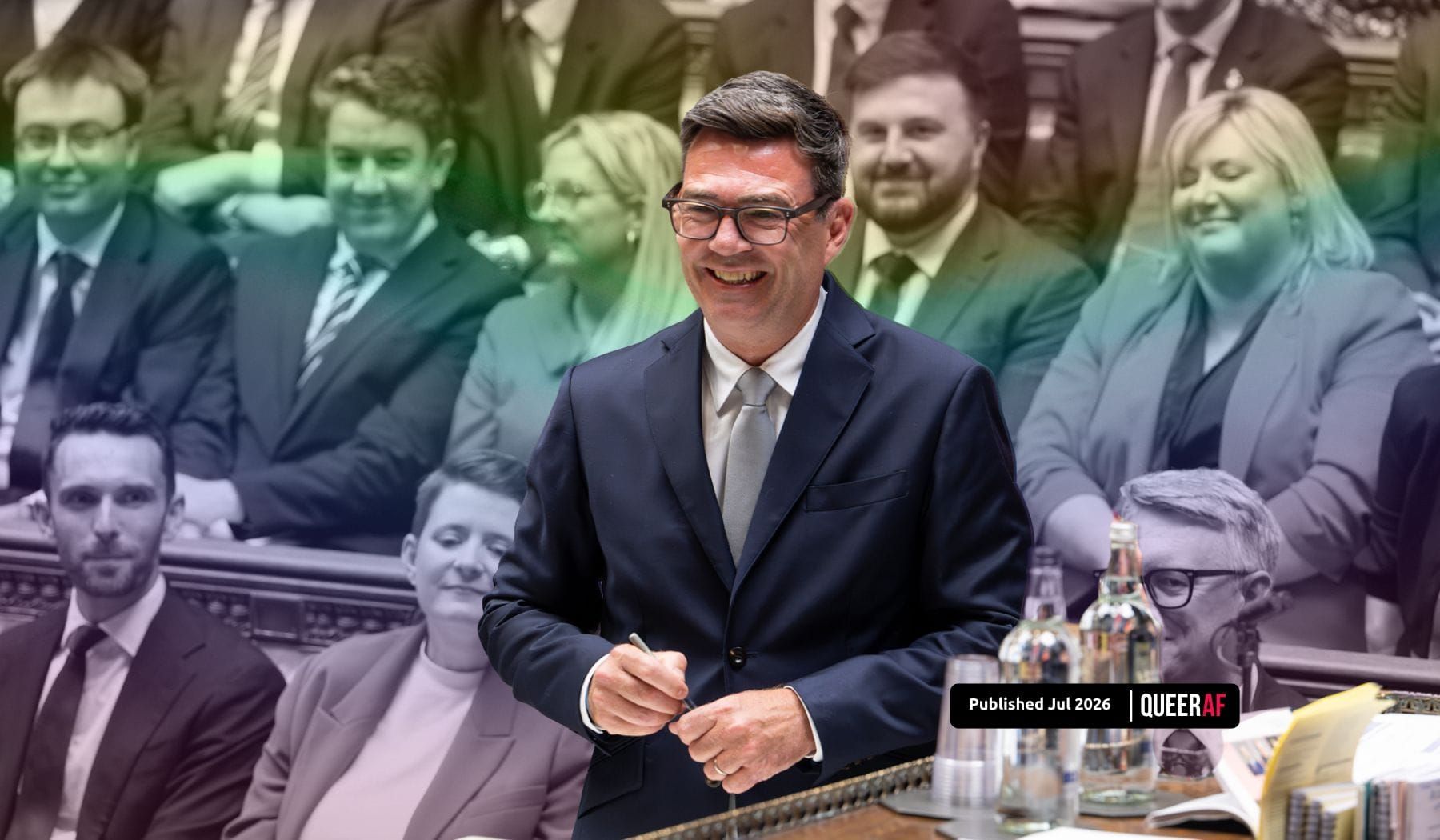

TL;DR: Andy Burnham has become the UK's 7th PM in just 10 years. He is Catholic, and has a mixed history on LGBTQIA+ rights. His cabinet, which features a mixture of Trans+ allies and gender critical voices, give us an insight into the broad church government he's set out to create.
Andy Burnham has become the UK's 7th Prime Minister in just ten years. He enters No. 10 – and his new No. 10 North – at a time when Trans+ rights have been rolled back by his predecessors, including many who he has reappointed to his cabinet.
Little is known about Burnham's priorities, largely because his rise to power has been so swift that he has not had time to articulate them. However, in just one week, he has attempted to make clear what his premiership will be about.
In his first speech, notably given without a lectern, he promised a new 'ten-year plan' for the UK which would be the most radical shake-up in a decade. He has since announced a flurry of policies designed to help people's bottom lines, including cuts to VAT on electricity bills, tax cuts for pubs and hospitality, and a £2 cap on bus fares.
Elsewhere, he's paused a prison early release scheme, and announced ‘No. 10 North’, a new office for the PM in Manchester, where he was previously Mayor, alongside his new home in Downing Street.
The focus so far is undoubtedly on the promise that his government will be a 'cost of living government'. As for LGBTQIA+ policies, we're only a few days in, but the scrapping of Digital ID in its entirety will be a breath of relief for many Trans+ people. Meanwhile, his cabinet appointments give some indication of what this new shake-up of the Labour government might mean for our community.
Who's in Burnham's Cabinet and where do they stand on LGBTQIA+ rights?
First up, Wes Streeting is back in government. His resignation was one of the final blows to Starmer's premiership, and his exit from the Department of Health left behind a legacy of anti-trans policies, rolling back healthcare for Trans+ youth especially. James Murray, who temporarily replaced him, is no longer in the cabinet. Streeting's new role is as Defence Secretary, putting him on the front line of national security. His ties to private firms, including donations from people linked to Palantir, are already under scrutiny.
Labour grandee Yvette Cooper replaces Streeting and Murray in the Health Department. In her first announcement, she increased funding for maternity services – but like her predecessor, she is already facing allegations of accepting donations from the private healthcare sector. She has previously been a mild supporter of LGBTQIA+ rights, supporting the same-sex marriage bill, and largely dodging 'gotcha' questions about what the 'definition of a woman is'. Her most recent policy intervention has been on AI, warning against the ‘Hiroshima’-style threat to humanity that it poses without global rules. Burnham has appointed Kanishka Narayan as the first minister for AI, an area of tech that often exacerbates existing LGBTQIA+ prejudices in algorithms and systems.
The other returning figure known to many is Bridget Phillipson, who oversaw Education policy under Starmer, bringing in the segregation of Trans+ kids in school and a curriculum which has been widely labelled as 'Section 28 2.0' as it tells teachers not to “encourage pupils to question their gender". She has lost her job in the Department of Education but remains in her role as Equalities Minister.
The new education minister is Lucy Powell, a leftist figure in the party, who was a leading anti-Starmer voice and won a deputy leadership role largely thanks to her critique of Starmer. During that election process, she said MPs should get to vote on the implementation of the EHRC code of practice due to come into force in just two weeks. She also said "I'm a woman, I'm a feminist and I see absolutely no contradiction in being a woman and also supporting the trans community to feel included and to have their rights as well."
Other figures worth taking note of from an LGBTQIA+ rights perspective include Anas Sawar, Angela Eagle and Chris Bryant. Sawar, who stepped up his opposition to Starmer in the final weeks of his time as leader, will step down as Scottish Labour leader and join the House of Lords to become a Trade Minister. He ran a significantly anti-trans campaign for Scottish Labour in the recent Scottish elections.
Chris Bryant is a longstanding Labour name, who speaks about his sexuality openly and is supportive of Trans+ rights. He steps into the role of Secretary of State for Northern Ireland. Meanwhile, lesbian Angela Eagle becomes Environment Secretary. Lisa Nandy continues as culture secretary – she was seen just a year ago wearing a 'protect the dolls' t-shirt at a Pride march in her constituency.
Analysis: What does Burnham mean for LGBTQIA rights?
Burnham himself has a relatively positive history of supporting LGBTQIA+ rights. Despite coming from a Catholic background, he has supported same-sex marriage, and even advocated to the Pope to recognise gay unions. He's also made several public interventions on key policies like Conversion Practices bans, defended trans inclusion and apologised for Manchester Police homophobia.
More recently, he's taken a mostly on-the-fence approach to the EHRC guidance, saying it should be implemented "in the fairest and most compassionate way possible". He's also met with the LGB Alliance to discuss Gender Recognition Reforms.
Overall, he's a politician who has a progressive approach to politics, but also clearly understands how to be a winner. In the UK, that means pandering to the right-wing press, who are notoriously transphobic, and increasingly homophobic.
His attempt to reset the agenda, however, could look more like what many in the LGBTQIA+ sector expected when Starmer took over: no progress on LGBTQIA+ rights, but no deterioration either. After years of rollbacks, that may be more of a valuable stop-gap than it seems at first read. The queer sector is exhausted and needs space to get back on the front foot, instead of being constantly in firefighting mode.
No matter what a new PM would want his legacy to be, it is not often defined by them – the press, the opposition and global events will have more say. When it comes to LGBTQIA+ rights, our community will be looking to him to halt, pause and question decisions of the previous cabinet – as he already has on many other policies in just a few days.
We need more investment in queer accountability journalism.
Our rights are under attack, and navigating how to fight back is only possible with quality, fact-checked, accessible information - written by LGBTQIA+ journalists.
We're a small but mighty publisher, and are so glad you trust us every week to bring you a selection of the top queer news, unique perspectives and content everyone's talking about in this newsletter.
If QueerAF had more resources, I can assure you - we'd double down even further on our investigations and news output, but even more so: We'd train, mentor and invest in an even bigger new generation of queer journalists.
In just four years, we've supported 150 LGBTQIA+ creatives to develop their craft and careers.
We're not going anywhere, and that work continues.
We can't do it without you, so if you can - please start your monthly or annual membership to QueerAF, so we can help even more people fight back.